
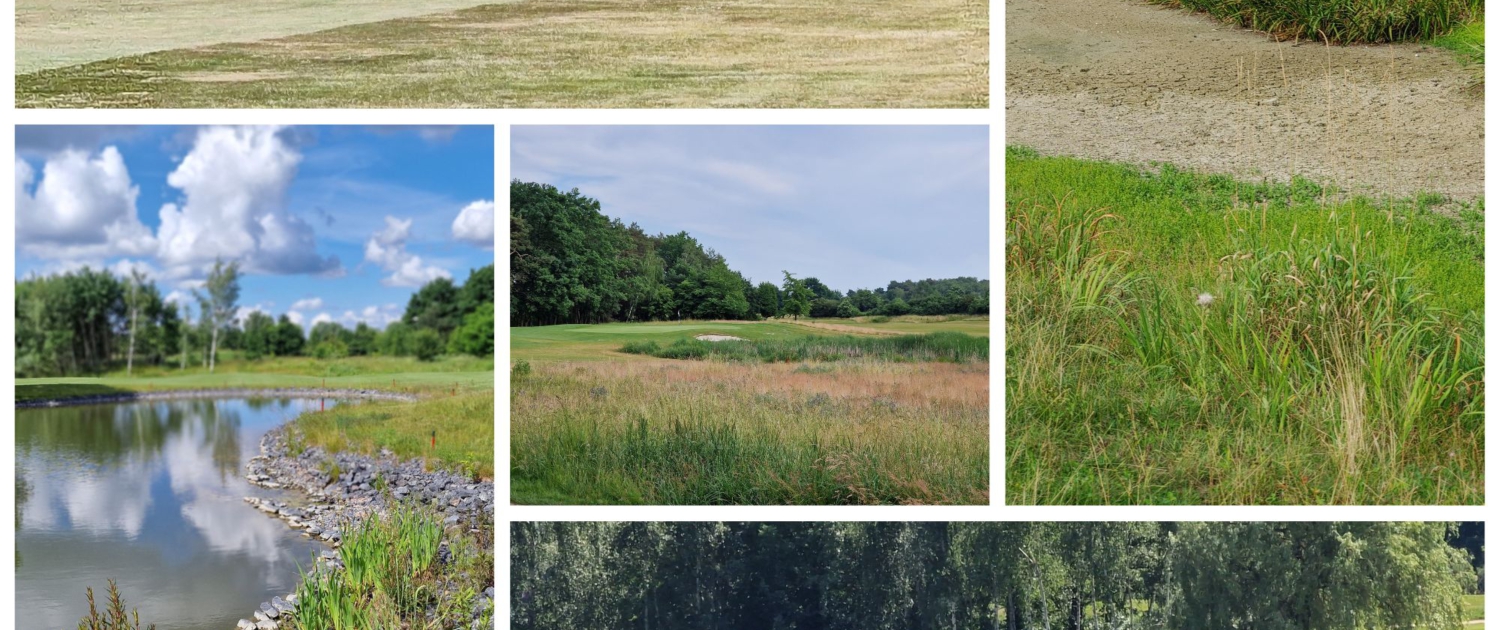
Grass cannot survive without water—at least not for months on end. Water is in short supply in many parts of Europe these days. The heat and drought of the summer of 2026 have shown their limits to numerous countries—such as Austria, Germany, and Switzerland—whose residents had previously faced few, if any, restrictions on water use. Even in supposedly perpetually wet England, the golf community was shaken. For England’s golf industry, this summer was a wake-up call: “It made people realize that climate change is real,” sums up Jim Croxton, CEO of the British and International Golf Greenkeepers’ Association. “We’re not getting any snow anymore, and we have to recognize that these hot, dry summers—or even extremely wet winters—are the new normal.”
In the summer of 2026, water conservation measures were necessary in many regions of Germany because streams had dried up, rivers were carrying only low water levels, and lakes had significantly lower water levels. In many places, it was prohibited to use tap water to irrigate grassy sports fields and parks, fill swimming pools, or water gardens. However, the drought of 2026 did not just affect the surface. It impacted groundwater recharge, river outflows, and, consequently, water reserves for public supply.
The Heat of 2026
In the summer of 2026, Berlin-Brandenburg experienced an exceptionally hot summer, which also affected the hosting of golf tournaments, normal course operations, and greenkeeping. The German Weather Service reported record-high temperatures:
Berlin:
- Average temperature of 20.0 degrees Celsius
- Deviation of +2.2 degrees from the long-term average
- 19 hot days at 30 degrees or higher and four very hot days at 35 degrees or higher
- Record high temperature for the capital on June 28, 2026, with 40.3 degrees at BER Airport
Brandenburg:
- Average temperature of 19.5 degrees
- Deviation of +2.2 degrees from the long-term average
- 18 hot days at 30 degrees or higher and four very hot days at 35 degrees or higher
The record high of 41.7 degrees in Coschen is a record for all of Germany
“This year’s extreme heat waves have posed enormous challenges not only for the Berlin-Brandenburg Golf Association but also for the clubs and, of course, individual golfers,” summarises Managing Director Roderich Wegener-Wenzel. “Since such periods are likely to recur in the future—and may even become more severe—we must urgently consider adaptation measures for the competition calendars of both the German Golf Association and the state golf associations.”
The Drought of 2026
In both Berlin and Brandenburg, precipitation in the summer of 2026 was 81 and 78 % below the long-term average, respectively. The combination of a lack of precipitation, unusually high temperatures, and the resulting increase in evaporation meant that water deficits were evident not only in soils and surface waters but were also increasingly reflected in groundwater levels.
Golf Courses Under Pressure
In this context, golf course and golf club operators are facing increasing pressure when it comes to water consumption. On the one hand, many golf courses themselves are suffering from a lack of rainfall; on the other hand, non-golfers are becoming far less tolerant of deep-green golf courses that are clearly being watered. Instagram and Facebook posts calling for a ban on watering golf courses were plentiful in July and August.
At the same time, the water crisis also highlighted the shortcomings affecting golf courses throughout Germany.
- The water supply for many clubs is generally not secured in the long term, even during periods of drought. This means that the golf course does not have enough water to ensure emergency irrigation of the most important areas for six to eight weeks using its own reserves.
- Even when the water supply is secure, irrigation systems are often unable—due to their design or age—to deliver the necessary volumes within a specific time frame, making it impossible to irrigate at the appropriate times.
- Even modern irrigation systems are often not adapted to current needs in terms of the area they cover. For example, sprinklers are not installed at all in certain fairway areas.
- Some greenkeeping teams do not have enough staff to devote significant time and effort to the irrigation system and, for example, to water particularly stressed areas by hand.
The consequences for the sport of golf quickly become apparent: In the event of a drought or restrictions on irrigation imposed by authorities, the quality of the golf course suffers significantly. At the same time, many golf course operators whose permits to draw water from wells are set to expire in the coming years fear a significant reduction in water supply. “It really helped that I invited the authorities here to the course for a meeting with management and the greenkeeping staff,” summarises Ariane Fränkle, managing director of the Groß-Kienitz Golf Centre. “It was the first time the officials had been to a golf course, and they didn’t have a clear picture of how it operates.” According to Fränkle, the on-site tour alone led to a much greater understanding of the golf course’s situation—as well as its positive aspects, such as its contribution to biodiversity.
Ensuring a secure future.
Golf course operators and greenkeepers in Berlin-Brandenburg can breathe a sigh of relief for now: the extreme heat of the summer of 2026 is over—for the time being. But that doesn’t mean the issue is off the table. “For the Berlin-Brandenburg Golf Association and its golf courses, building resilience against heat and water shortages is an important issue that we must address over the long term,” Wegener-Wenzel sums up. “Securing the future of golf courses depends on the water supply—whatever form it may take.”




 Foto: Petra Himmel