
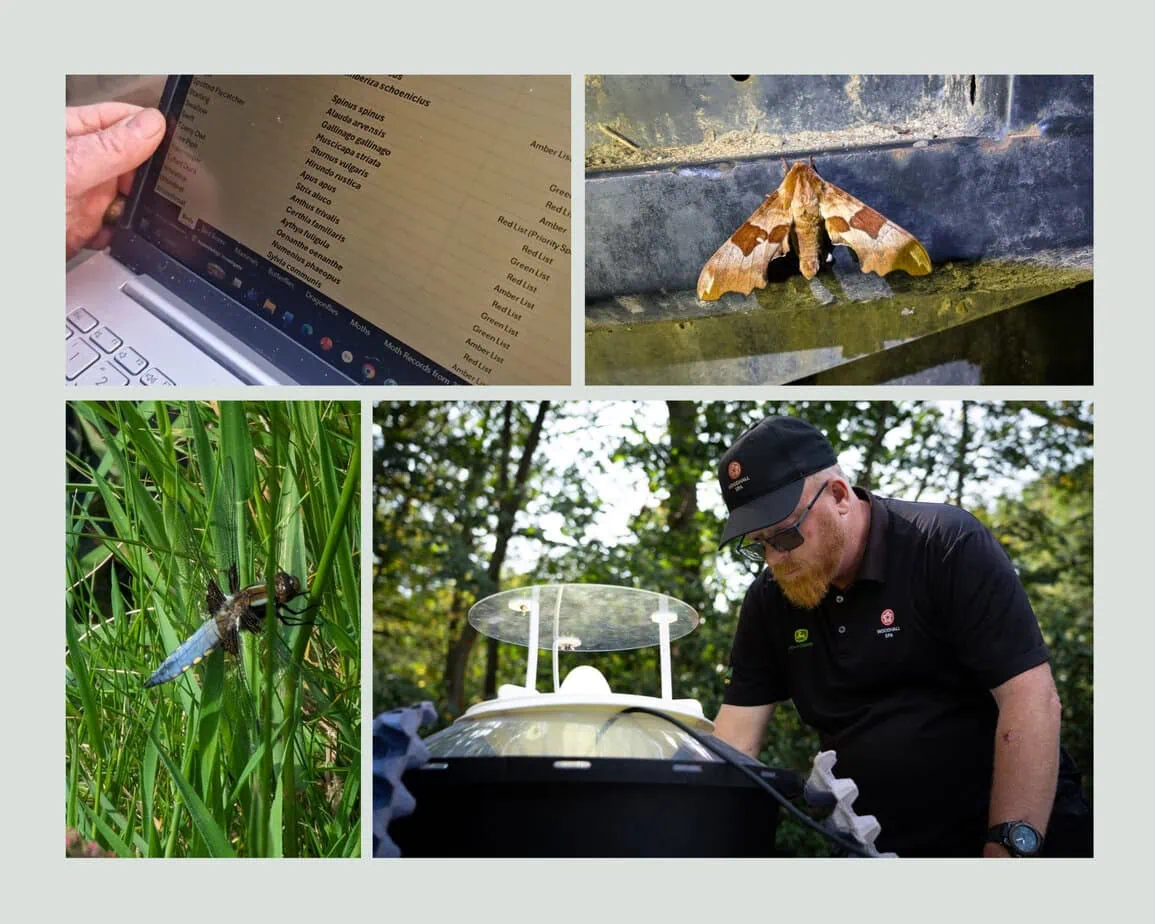
The assumption that a golf course is little more than hectares of mown grass—a green desert, so to speak—falls apart the moment you look at an Excel spreadsheet on Stephen Thompson’s laptop: hundreds of moths, butterflies, birds and amphibians, grasshoppers, dragonflies, reptiles and other animals are neatly listed here—along with where they were found, their Red List status, and their Latin names. Thompson scrolls and scrolls; the list seems endless. “I put the list together for GEO recertification.” It’s impressive.
Woodhall Spa Golf Club: so much more than just golf
We are standing behind one of the barns for the greenkeeping vehicles on the grounds of the National Golf Centre of England Golf in Woodhall Spa in Lincolnshire and looking at a large, round container that turns out to be a moth trap. Moths will keep us busy again and again over the next two hours, even though this is actually a place where another topic takes centre stage: Woodhall Spa Golf Club, with its two 18-hole courses and a first-class golf academy, is world-famous. The Hotchkin Course is an 18-hole course with impressive heathland, a superb arrangement of wild bunkers that look as if they were simply scraped out of the sandy ground. It is one of the top 50 golf courses outside America—and yet Stephen Thompson and I are not talking about hole strategy today, but about moths, otters, owls and all sorts of other wildlife.
Stephen Thompson is not a golfer. He is a Senior Greenkeeper. Above all, however, he has been nominated by the National Biodiversity Network for the 2026 NBN Biodiversity Lifetime Achievement Award and has made it to the final alongside three other contenders. The winner will be announced on 19 November. “It’s a huge honour to be nominated and to make it among the finalists,” he says. It is recognition for work that even his wife long viewed with a certain scepticism. “To be honest, she didn’t think moths were that great at first. Since she’s realised how much I’m invested in the subject, she’s become more interested in it.”
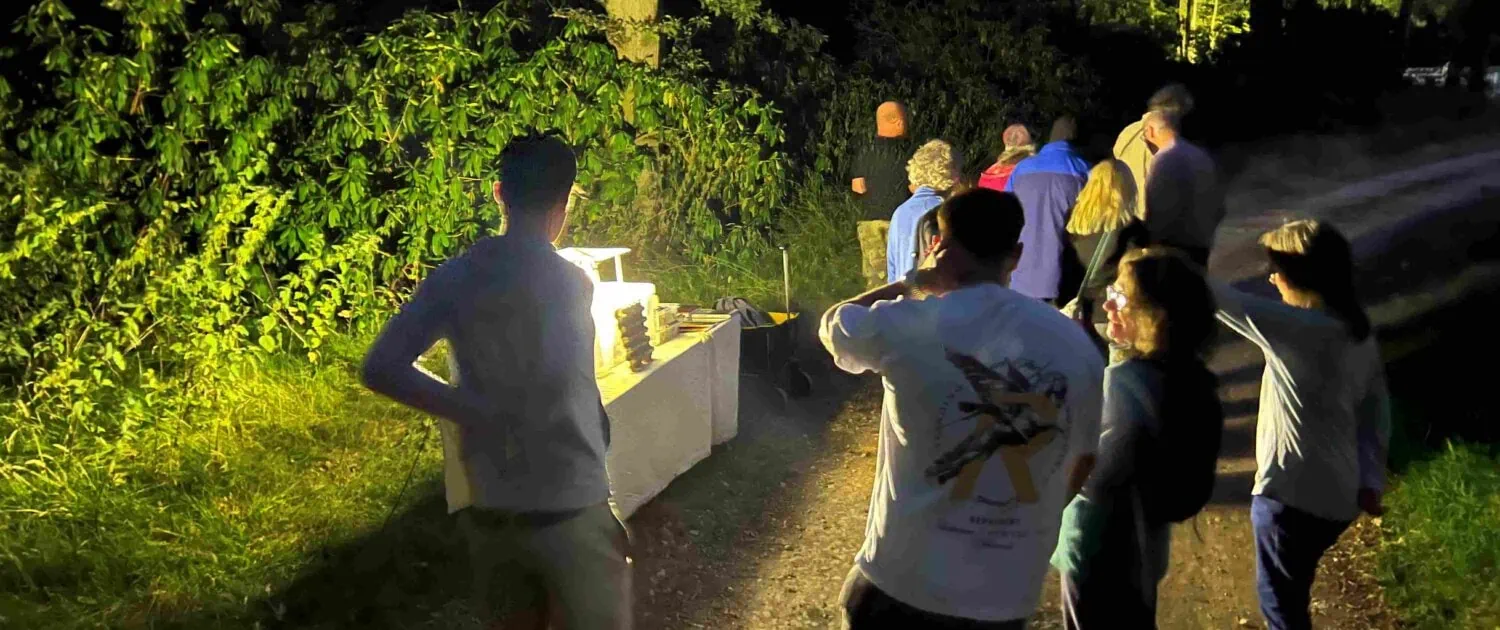
More than 500 moth species in Woodhall Spa
There are more than 2,500 moth species in the UK, including around 900 macro-moths and roughly 1,600 smaller species. Things are not looking good for these small pollinators. According to a 2021 report by Butterfly Conservation, 51 species have become extinct in the UK since 1900, and 41% of the species studied declined in numbers. Particularly conservation-worthy moth species are declining by 87.3% in relative abundance, according to a government data survey from 2024.
And it would be unfair to speak only of Thompson’s passion for these small pollinators, of which he says, “They’re just as important for pollination as butterflies, but because they’re not as pretty, people simply don’t think they matter as much.” He always has his smartphone on him, always keeping an eye on the meadows, hedgerows and trees beyond the fairways to identify any striking movement or a new species. Unfortunately, he has only spotted the otter at the small water hazard on one hole of the Bracken Course twice. It was a special moment that he captured on video. Very close to the green, the slender black body moved through the water hazard, unfazed by the golfers. For Thompson, it was yet another sign of just how much potential golf facilities have as habitat for wildlife.
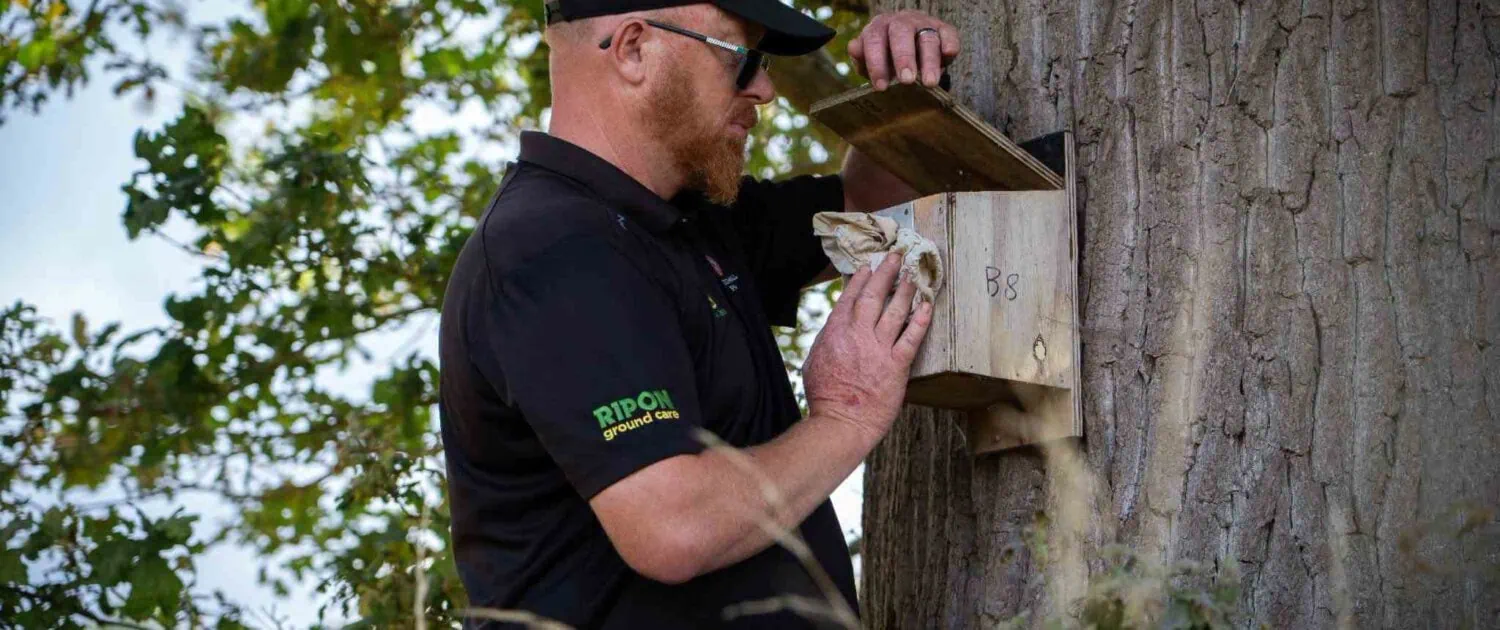
His work in Woodhall Spa is not without challenges: establishing barn owls, for example, is proving difficult. He has now installed three nest boxes. He does not yet have a licence to check them during the breeding season, but now in winter he opens them to see whether they have been used. “We actually have a food supply here that’s large enough,” he says, analysing the surroundings. In fact, below the bird box there is a wide meadow margin stretching the length of a fairway, where mice, small rodents and other creatures can thrive. The owls could hunt here. “You just need patience,” is his conclusion. At some point, the barn owls will come.
He checks all the nest boxes on the golf grounds regularly, cleans them, and keeps meticulous records of occupancy. “Eleven great tits on 14 May, no dead chicks,” reads the summary for a bird box by the greenkeeping building as well. Thompson rings the young birds in early summer. He has had a licence for that too—for years.
Combining profession and passion
First and foremost, the Englishman was—and still is—a naturalist with a high level of expertise. He only came to greenkeeping later, when the man from Horncastle was looking for a job near his home town in the county of Lincolnshire. “I’ve always liked working outdoors, and when in the 90s a greenkeeper position came up at the golf course around the corner from me, John O’Gaunt Golf Club, I thought it would be a great opportunity to combine birdwatching with my job.” In Woodhall Spa, he was hired in 2023 both as a Senior Greenkeeper and as a recognised expert on flora and fauna.
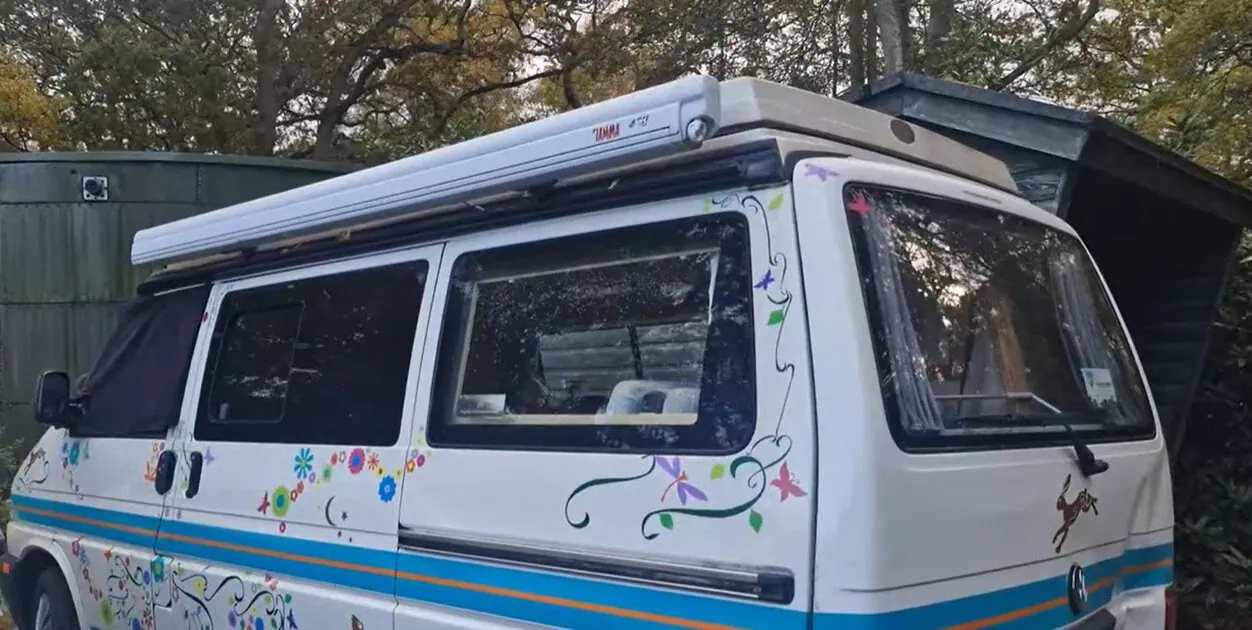
On Friday evenings, when he’s finished his greenkeeping job, he sometimes sets off in his VW bus to go moth hunting over the weekend in England’s untouched landscapes. The white bus with all the plant and animal paintings suits his passion perfectly. Then he sets up a moth trap, sleeps in it, and counts the species the next morning. The finds are abundant. In his moth traps in Woodhall Spa, during the high-summer months from June to August, there are often more than 100 different moths. He records the find and then releases them. His list grows—day by day.
His nomination for the National Biodiversity Lifetime Achievement Award shines a new light not only on him, but also on golf. “Being part of it now also shows that golf courses are places that matter for nature,” he says. Presenting golf courses on the national stage as places of biodiversity is a great opportunity for the sport—and we agree on that. I wish him the best of luck for the final on 19 November. We say goodbye.
The next morning, a Saturday, an email from Stephen Thompson flashes up in my inbox: “Hello. Moth news. Two new species for this week. A Rusty Dot Pearl and a November Tunic. That makes 513 species. Total for this year: 303.”





 Fotos: GC Holledau/Petra Himmel