When Handicap No Longer Matters
Author: Dr. Sabine Köhler
Haxterpark in Paderborn is home to Germany’s most unusual golf model: accessible sports, a nonprofit inclusive organization, and eco-friendly course development all come together here. Rafa Lawah’s story illustrates what this means in everyday life—and why the debate over Paralympic golf extends far beyond competitive sports.
It doesn’t start with golf
When Rafa Lawah sat down at Haxterpark for the first time, she knew very little about golf. Her job interview took place on the terrace by the driving range. From there, you can look out over the practice area and toward the first tee. Lawah remembers the atmosphere more than the sporting details: “That’s when I realized: There’s harmony here, a really great vibe. I thought I’d feel right at home here.”
Today, Lawah works in the golf course’s office. She takes late shifts, locks up at the end of the day, and organises her workspace so that she can work as independently as possible. And she plays golf—regularly, with friends, and now even in tournaments abroad. The sport first came into her life through her job.
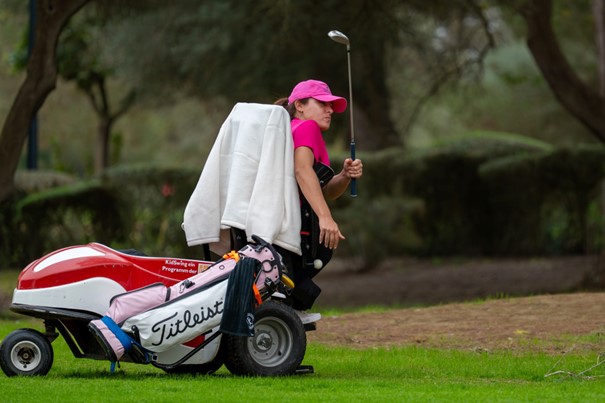
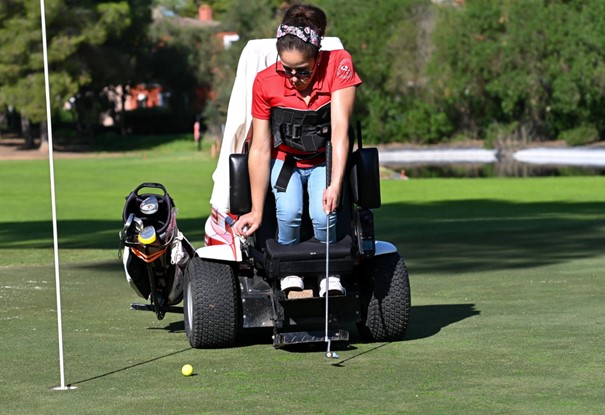
The turning point was a device she hadn’t known existed: the Paragolfer, a special electric vehicle that can help people with significant mobility limitations move around the course and position themselves properly to take a swing. When Haxterpark purchased one of these devices, Lawah gave it a try. “That’s when I got interested. And I really enjoyed it.” A golf course employee became a golfer.
This small biographical shift describes quite accurately what Haxterpark is all about. Here, inclusion does not mean providing people with access to an existing system after the fact. The system itself should be designed so that as many people as possible can work, play sports, and be active within it.
A golf course as an inclusive business
Haxterpark, located on the Paderborn Plateau, is no ordinary golf club. It is operated by a nonprofit limited liability company (GmbH) organized as an inclusive workplace. Greenkeeping, food and beverage services, and golf administration are all handled by this company. According to Haxterpark, there are currently about 50 employment relationships subject to social security contributions; just under half of these are inclusive employment relationships.
This shifts the perspective on inclusion. People with disabilities are not just guests or participants in a special sports program. They are coworkers, staff members in the office, and employees in the kitchen, in customer service, or in grounds maintenance. The operation itself is part of the concept.
Managing Director Helmut Böhmer describes this goal in a single sentence that, at Haxterpark, sounds almost like a set of operating instructions: The entire operation must function in an inclusive manner; otherwise, inclusion remains merely an optional offering. Accordingly, the facility’s mission statement outlines three interconnected areas: inclusion, science, and sustainability.
Lawah doesn’t see this idea as a program, but as part of everyday life. “We’re very close-knit here,” she says. “We treat each other very well, whether we have a disability or not. It doesn’t matter if you have a disability.” For her, inclusion is most evident in her independence. At work, she uses a height-adjustable wheelchair that allows her to perform nearly all her tasks without assistance. “I also work late shifts; I close up shop in the evening—I do everything myself.”
121 accesible bunkers
How seriously a facility takes accessibility is rarely evident at the entrance. What really matters are the areas where standard solutions fall short: door widths, clear spaces in changing rooms and showers, restroom facilities, slopes—or an obstacle right in the middle of the golf course.
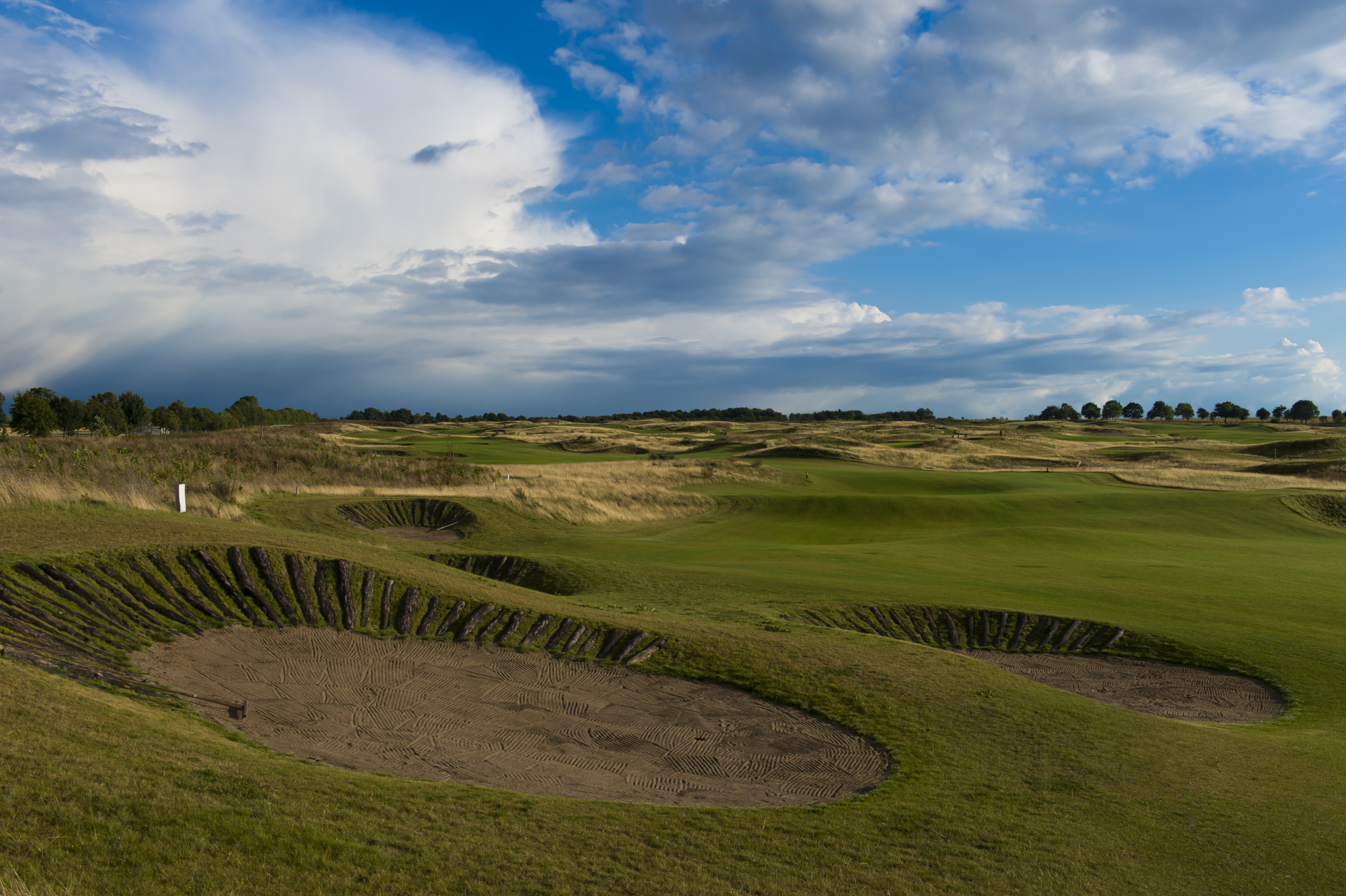
The 18-hole Haxterhöhe Links course features 121 bunkers. They are part of the course’s challenging character. At the same time, the bunkers were designed so that one side of each is accessible to wheelchair users. The entire golf complex and central facilities are designed for accessibility in accordance with the “Travel for All” system. The key lies in the details: the bunker isn’t removed to make golf easier. It’s made accessible so that more people can experience the athletic challenge in the first place.
Lawah, too, moves around the course largely on her own with her Paragolfer. A gripping aid helps her pick up balls. When she talks about her round, the conversation remarkably quickly shifts from barriers to golf. Hole seven on the nine-hole course particularly challenges her: two trees, a narrow fairway, a longer hole. She tries again and again. This is precisely where her story hardly differs from that of any other golfer: suddenly, the focus is no longer on her own body, but on the next hole.
“I don’t even think about it”
When asked whether she is still aware of her disability while playing a round, Lawah replies without drama: “I don’t think about it at all. I just think about playing golf, about the person I’m playing with, about having fun—and about playing well.”
A powerful statement about inclusion in this context, precisely because the word itself doesn’t appear in it. Participation is successful when it doesn’t need to be explained in every situation.
Golf is particularly well-suited for this. The sport already encompasses a wide range of physical abilities, age groups, and skill levels. Its handicap system—in the sporting sense—is designed to make differences in performance comparable. Age, mobility, and coordination also change over the course of a person’s life. Accessibility is therefore not merely about infrastructure for a small group. It can become a guiding principle of a sport whose members are aging themselves.
Lawah describes her experience in Mallorca in a similar way. In 2025, she competed in the Handisport Mallorca Open, where she met golfers with various disabilities. For her, the trip itself was part of the experience: flying, playing at an unfamiliar course, and meeting other athletes. “It works. It’s doable; it’s possible,” she says. This is exactly the experience she wants to share—especially with people who rule out golf for themselves from the get-go.
From inclusive recreational sports to the international elite
At the same time, international trends show that golf has long been a competitive sport for people with disabilities. The 2026 G4D Open at Celtic Manor in Wales featured 80 players from 25 nations. The tournament was played in nine competition classes, which reflect different types of disabilities in the categories “Standing,” “Sitting,” “Visual,” and “Intellectual.” The tournament is co-hosted by The R&A and the DP World Tour and supported by EDGA.
Germany is by no means insignificant in the world of sports. In 2026, Jennifer Sräga won the women’s division of the G4D Open, edging out two-time champion Daphne van Houten of the Netherlands on the final hole. That same summer, Sräga led the German team at the European Championships. Anyone discussing Germany’s shortcomings should therefore be precise: there is no shortage of athletes who can compete internationally. The greater gap lies in the breadth of participation, visibility, and the natural integration of inclusive programs at golf courses.