Biodiversity Encyclopedia: Y for Yponomeutida
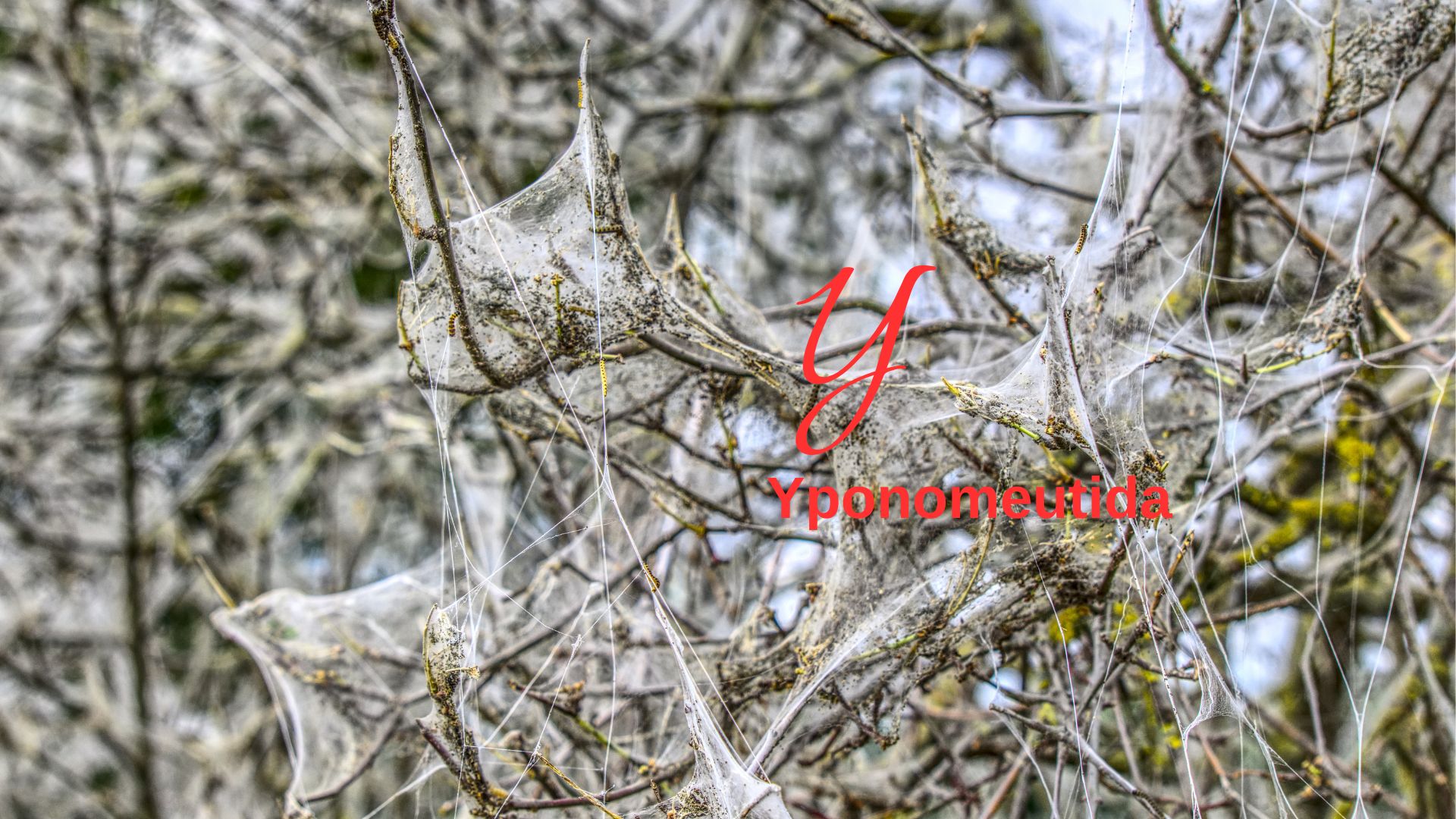
It’s not a pretty sight: white webs spreading over the branches of shrubs. Especially in spring, the caterpillars of certain moth species cover entire shrubs with a dense web and eat a large portion of their leaves. Behind this striking phenomenon is the genus Yponomeuta, which includes the ermine moths.
Their adult moths are usually small, with pale, often whitish wings marked with dark spots. More conspicuous than the adults are their caterpillars. In spring, they live gregariously and spin fine silk threads, which they use to build communal webs. These can cover twigs and entire shrubs. Within the webs, the caterpillars are protected from various external influences while they feed on the leaves of their host plants. In cases of heavy infestation, shrubs can be temporarily stripped almost completely bare. The caterpillars of different ermine moth species are specialised on particular host plants. These include the spindle tree, as well as hawthorn, apple, and bird cherry.
The sight initially alarms most golfers, but it doesn’t necessarily mean a shrub has been permanently damaged. Many healthy shrubs sprout new growth again after being eaten. Caterpillar development is time-limited; once they pupate, the moths emerge, and the conspicuous webs lose their function. The exact timing depends on the species and the weather conditions.
Ermine moths are also ecologically interesting. Their caterpillars are part of the food web and provide development opportunities for specialised parasitic wasps and other natural predators. Their dependence on particular host plants also illustrates how closely insect diversity is linked to the composition of woody vegetation.
On golf courses, ermine moths can appear in hedges, groups of shrubs, and near-natural peripheral areas. For management, the guiding principle is: first assess the species and condition of the affected plant. Hasty pruning or chemical control is often not necessary.