Brandenburg is a hotspot for wildfires
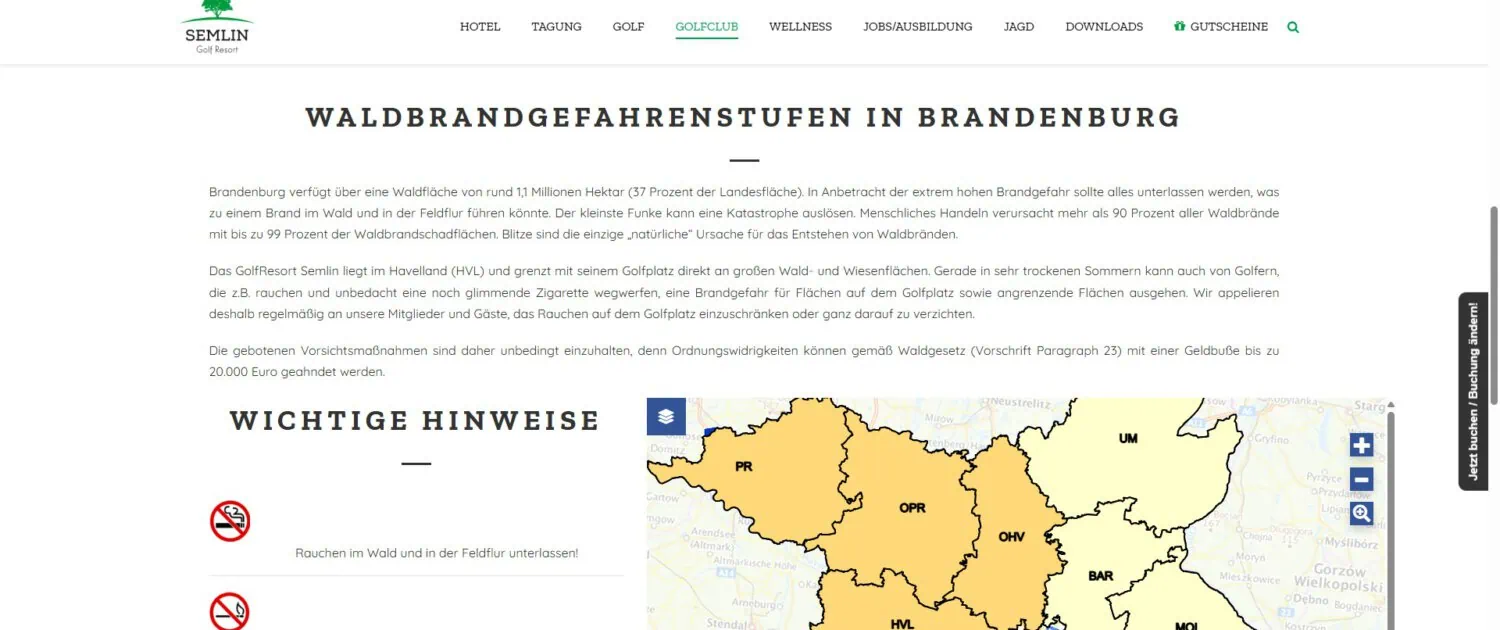
“No Smoking”—there’s no getting around this rule at the Semlin Golf Resort. “We take this issue extremely seriously,” explains Managing Director Bernd Eulitz, pointing to the golf course’s sensitive location in the heart of the Westhavelland Nature Park, with its large forests. Numerous trees, plenty of deadwood, and dry leaves in the summer are all part of the golf course and are extremely flammable. Highlighting this danger is so important to Eulitz that the Semlin Golf Resort’s website even has a dedicated page on the topic.
Semlin is not an isolated case. Brandenburg is Germany’s number one hotspot when it comes to wildfires. Light, sandy soils that dry out quickly; numerous pine forests, whose resin and oil burn easily; areas—some of which are littered with old ammunition—that are difficult to extinguish; and low rainfall in the region—all of this means that the state consistently ranks among the most affected regions in forest fire statistics.
High level of awareness at golf courses
Golf courses have responded to this differently than in some other parts of Germany. “We enforce the smoking ban based on the current wildfire danger level. It’s currently in effect,” explains Ariane Fränkle, managing director of GC Großkienitz. Just like her colleague Sven Geißler from GolfRange Großbeeren— where “No Smoking” is also currently in effect—she knows that not every golfer is happy about this rule. When it comes to the risk of wildfires, however, the course managers are in agreement. You just have to live with the occasional critic, explains Eulitz. Nevertheless, he isn’t backing down from the smoking ban in Semlin.
“This awareness of the danger is extremely important,” says Marc Biber, Head of the Department of Environment, Course Maintenance, and Sustainability at the German Golf Association, which is quite concerned about the current risk of wildfires in Germany. “We repeatedly see dead trees on golf courses, as well as large amounts of leaves on the ground or pine needles, which catch fire extremely quickly—especially when there is dry sandy soil underneath. Risk awareness at golf courses is important, but so is communicating this information to golfers.”
Although Germany has significantly fewer large-scale fires than, for example, Spain, Portugal, or Greece, according to analyses by the European satellite system EFFIS, the risk of wildfires is increasing due to climate change and longer periods of drought and heat. Given that golf courses often have clusters of trees and hedges on the course or in the immediate vicinity, they, too, are affected by this risk of wildfires. There are currently several real-life examples: On July 12, a vegetation fire broke out in the immediate vicinity of the Schloss Kressbach Golf Club in Tübingen. According to the Tübingen Fire Department, “trees and shrubs” burned over an area of 15 by 10 meters, which the responding firefighters were able to extinguish quickly.
Humans are the main cause
In general, humans are the primary cause of fires in open countryside. Johann Georg Goldammer, Germany’s best-known fire ecologist, repeatedly points this out. And it doesn’t even have to be deliberate arson: A carelessly discarded cigar butt, overheated parts on a grounds maintenance vehicle, or even a few sparks from a fire pit used during a barbecue evening—all of these can very quickly develop into a major fire under the right conditions.
Smoking ban—yes or no?
A general smoking ban on golf courses is not an issue in Germany due to the current legal situation. “However, golf courses should decide on a case-by-case basis if they are located in a high-risk area,” Biber notes. “While this isn’t always popular with golfers, the risk of fire is simply too great.”
The German Greenkeepers Association (GVD) also views a blanket smoking ban on all golf courses with scepticism. Local conditions vary too widely. In the GVD’s view, the current weather conditions and the specific risk posed by each course are far more critical factors. Employees and golfers must be made aware of this issue.
The greenkeeping team should know exactly what options are available in the event of a fire—such as how to use sprinkler systems on short notice or quickly connect hoses. At the same time, golf courses can help by implementing simple measures, such as providing portable ashtrays with the club’s logo, to prevent cigarette butts from ending up on the course in the first place.
No Patent Requirements for Golf Courses
The GVD deliberately rejects blanket fire safety requirements, arguing that the topography, vegetation, and infrastructure of golf courses vary too widely. Instead, the association recommends close cooperation with the local fire department and the relevant fire and disaster response agencies. Joint site inspections help identify potential hazards and coordinate response plans. Club boards and operators should also be more closely involved—fire safety is not solely the responsibility of the groundskeeping staff, but rather that of the entire golf course; the owner bears responsibility for public safety and maintenance.
Fire Safety Inspection with the Fire Department
At GC Motzen, another course with extensive wooded areas, the local fire department has conducted drills on the golf course grounds in recent years. This ensures that, in the event of a fire, the fire department is immediately familiar with the local conditions. “I think that’s very commendable,” explains Robert Paas, a German expert on golf course insurance. “A fire safety inspection and a check of the on-site water lines should be conducted regularly.” For courses that, according to his estimate, are among the approximately 30 % without fire insurance, these precautionary measures may well ensure their financial survival.
A look abroad shows just how quickly golf courses can be affected by major fires. Around Bordeaux, all golf courses had to close as a precautionary measure over the weekend due to the uncontrolled wildfires in the region; the smoke made it impossible to play anyway. The historic Golf de Fontainebleau club near Paris closed for a week because the fire in the Fontainebleau National Forest led to the evacuation of the area. In Los Angeles, the devastating Eaton Fire in January 2025 completely reduced the historic clubhouse at the Altadena 9-hole course—built in 1910—to rubble and ashes and caused severe damage to the course. A temporary closure was unavoidable.
That is why the risk of wildfires should not be underestimated in Germany either. As heat waves become more frequent, the risk also increases.
INSERT_STEADY_NEWSLETTER_SIGNUP_HERE