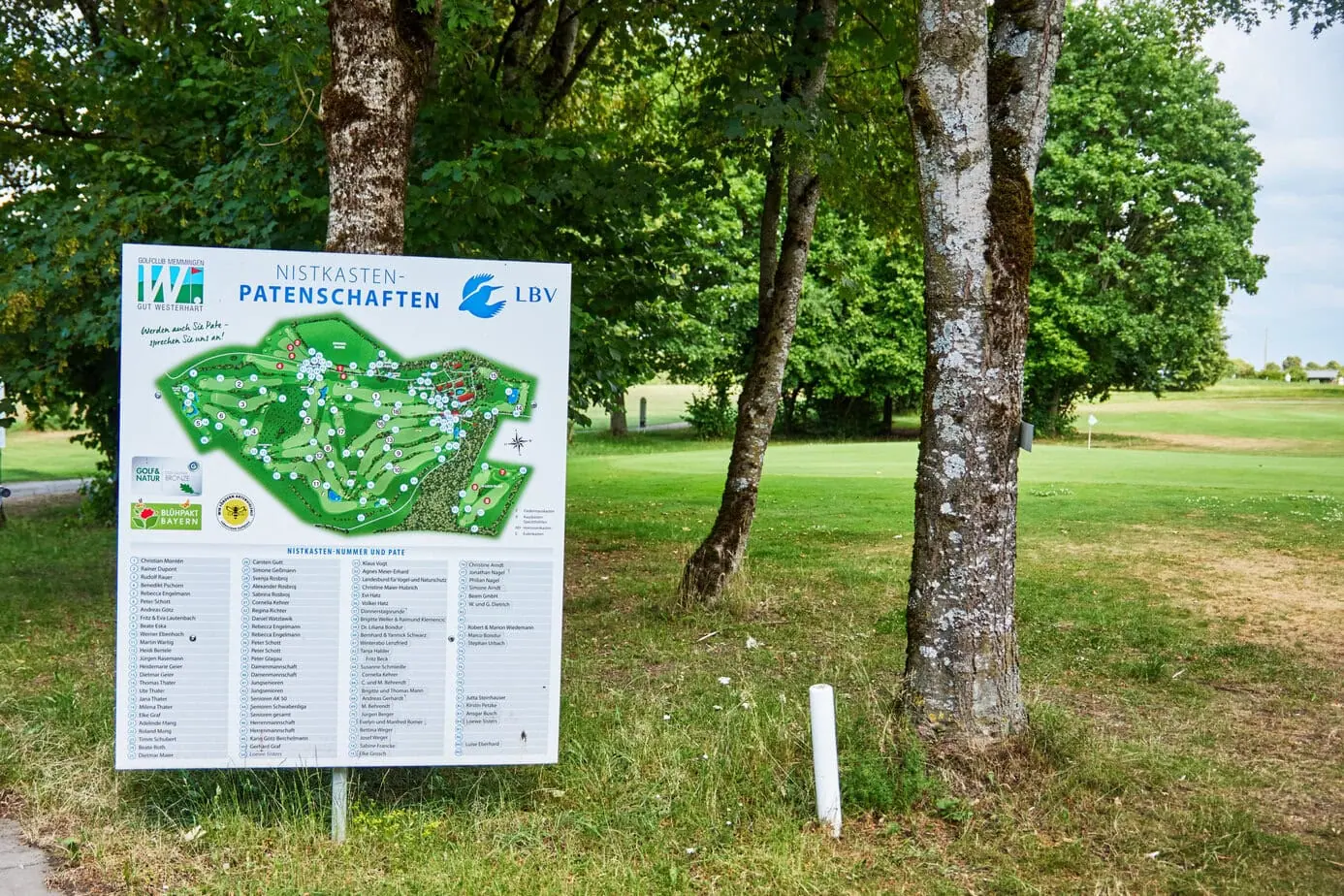
“The collaboration with the local LBV chapter is going really well here—you can really tell.” Dagmar Blacha, an expert with the Bavarian State Association for Bird Protection (LBV) working on the Bavarian Flowering Pact, stands pleasantly surprised in front of a large information board at the Memmingen Gut Westerhart Golf Club. Numerous nesting sponsorships are listed here, through which club members have committed to promoting biodiversity on the golf course by funding a nesting box made of wood-concrete.
The fundraising campaign has been running for several years, but the Memmingen Golf Club has been supporting the project on an ongoing basis. After all, simply buying and hanging up the birdhouses isn’t enough. “The birdhouses are thoroughly cleaned every year, and we check to see if they’ve been occupied,” explains Dr. Werner Eska, who, along with a small group of other members, has volunteered to take on this task. One member also takes care of feeding the birds. As Blacha notes, the GC Memmingen demonstrates just how much environmental and nature conservation depends on the commitment of individual member groups.
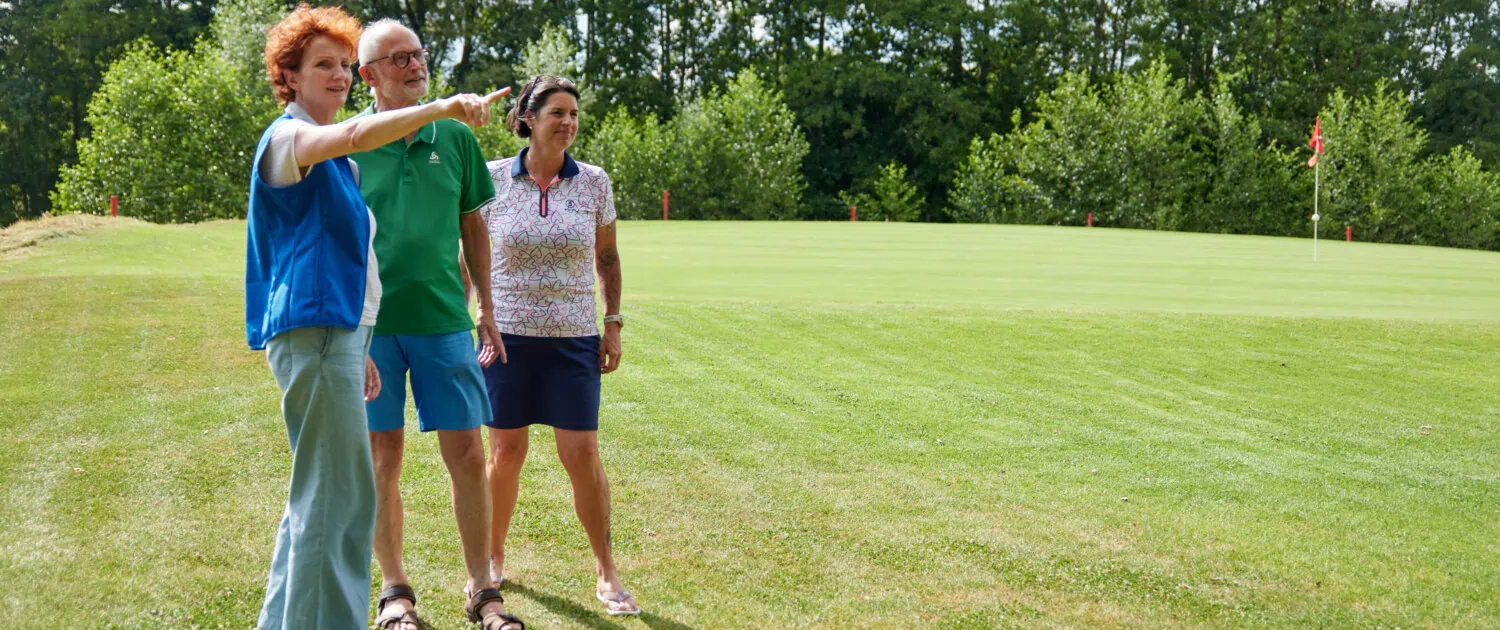
The golf course, located on former farmland near the Lindau highway, also stands out for its meadows, which are certified organic. Eska notes with satisfaction that this means they have no problem finding buyers for the hay. Blacha points out that certified organic hay is of particularly high quality and is also suitable for seed production. This means that seed for another area in the immediate vicinity could be harvested from the hay produced by the Memmingen Golf Club.
Best-practice tips on mowing, hedge and meadow maintenance, and the proper management of water features or wetland habitats are a key feature of golf course management under the Bavarian Flower Pact. Through this project, the Bavarian State Government has been working since 2018 to counteract the decline in biodiversity and, in particular, to sustainably improve living conditions for wild bees, butterflies, and other insects. The initiative is supported by the Bavarian State Ministry of the Environment and Consumer Protection. The Bavarian Golf Association was the first partner in the so-called “Blühpakt Alliance.” Together, they aim to ensure not only that new flowering areas are created, but also that the ecological enhancement of these areas is, above all, long-lasting.
In this context, the proper maintenance of near-natural areas plays a particularly important role. The State Association for Bird Protection provides a free initial consultation for all new golf courses and offers important tips on the proper management of meadows, woodlands, and water areas. With proper care, these areas can form valuable stepping-stone habitats within an intensively used agricultural landscape.
Golf courses that consistently implement the agreed-upon measures and can demonstrate their environmental progress will be recognized as “Blühpakt” facilities by Bavarian Environment Minister Thorsten Glauber during a formal ceremony. This already applies to 47 golf courses in Bavaria.
According to Blacha, what matters most is not the size of the golf course or its financial resources. Ultimately, promoting biodiversity has a lot to do with commitment. New areas that can be redesigned with biodiversity in mind are constantly being discovered. At the Memmingen Golf Club, visitors are immediately greeted at the entrance to the course by lush, flowering grasses and perennials that surround the tiny houses available for rent here. In doing so, the club has not only created a pretty attraction for guests and members but also provided a food source for the birds that nest on the golf course. The larger and more diverse the variety of blooms, the more insects there are in the meadow. No wonder that Werner Eska and his colleagues find numerous nesting boxes every year that have actually been used for breeding. The Memmingen Golf Course is a first-class habitat for numerous bird species.