
• Home
  • Subscribe to newsletter
  • The team
  • Goals
  • Deutsch Deutsch German de
  • English English English en
Golf Sustainable
  • News
    • Club News
  • Climate change
  • Water
  • Biodiversity
  • CO₂
  • Greenkeeping
  • Tourism
  • Other topics
    • Industry & Equipment
    • Best practice
    • Science
  • Click to open the search input field Click to open the search input field Search
  • Menu Menu
Collage mit Gras und Porträt

“Breeding turfgrass has become much more complex”

25. November 2025

Every four years, scientists from around the world gather at the International Turfgrass Research Conference to share information on the state of the art in turfgrass research. We spoke to Anne Mette Dahl Jensen, Product Development Manager at DLF, a global turfgrass seed company, after the recent International Turfgrass Research Conference ITRC2025 in Karuizawa, Japan, about current trends in the industry.

You just returned from a major turfgrass conference. What would you say was the dominant topic this year?
Dahl-Jensen: The overarching theme was sustainability and technology – especially in terms of breeding and maintaining turfgrass.

What are the main markets driving the turfgrass industry today?
Dahl-Jensen: We generally divide the market into two parts: the consumer market, which includes home lawns and private gardens, and the professional market, such as golf courses, football fields, cricket grounds and other sports areas. While the consumer market is large in volume, the professional side is where most of the innovation and research are focused, especially at conferences like this.

How has climate change impacted turfgrass development?
Dahl-Jensen: It has definitely made things more complex. In the past, we had access to herbicides, fungicides, insecticides and unlimited water – the main focus was on aesthetics: density, color and appearance. Today, especially in Europe, we’re facing strict regulations on pesticides and water use. That means we need grasses that are drought-tolerant, disease-resistant, and require fewer inputs. All of these traits have to be bred into a single plant – which makes the breeding process significantly more complicated.

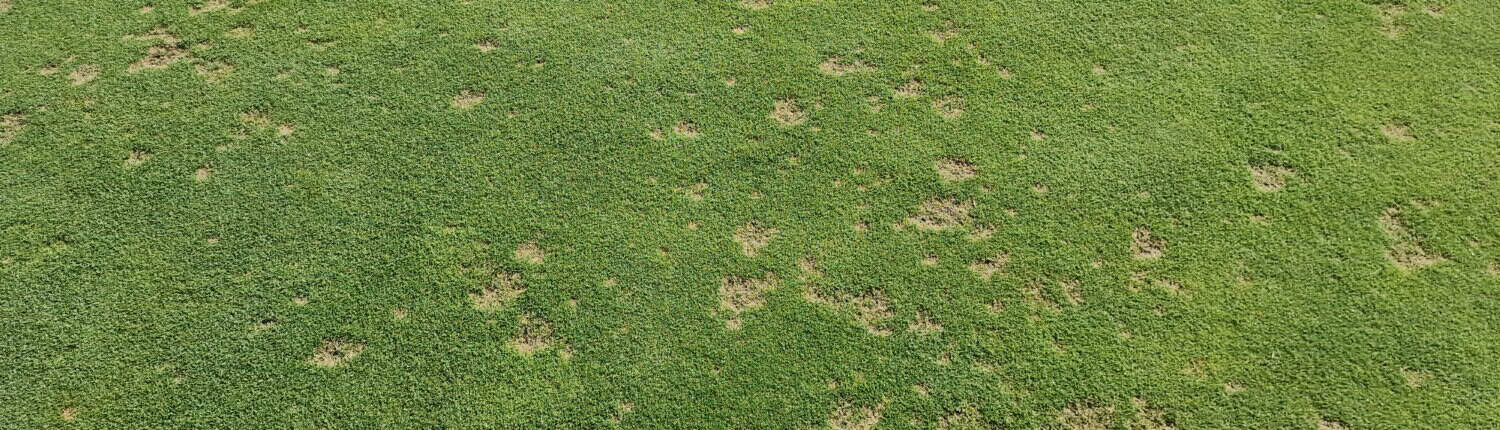
Dollar spot
Dollarspot is the most challenging illness at the moment (Foto: Petra Himmel)

Are some regions dealing with these challenges more easily than others?
Dahl Jensen: Not really. Every region has its own difficulties. In Japan and parts of Asia, they use warm-season grasses like Zoysia and Bermuda, which tolerate heat and salinity but still face disease issues. In Northern Europe, we’re restricted in herbicide and fungicide use, so weeds and diseases are a major problem. Southern Europe faces transitional zones with added stress. Even the U.S., with fewer restrictions, faces challenges – but often from a different perspective.

In golf equipment, the U.S. dominates global trends. Is it the same in seed development?
Dahl Jensen: Not to the same extent. While many U.S.-bred varieties are exported to regions like Southern Europe, the Middle East or Japan, it’s not a universal standard. U.S. breeders often focus on dark green, visually appealing varieties – and those are popular in certain regions for aesthetic reasons, even when they’re not ideal agronomically. Tradition and visual preferences play a huge role in variety selection.

What was your personal takeaway from the conference?
Dahl Jensen: For me, it confirmed that the path we’re taking in Europe – with more focus on sustainable turf and reduced pesticide use – is the right one. What surprised me is that many international researchers are still very focused on optimizing pesticide use instead of looking for alternatives. There’s still too little emphasis on pesticide-free management strategies.

Is the health impact of pesticides ever discussed at these conferences?
Dahl Jensen: Hardly at all.. The health topic simply isn’t part of the mainstream conversation. Maybe one session touched on it, but it’s not a major focus.

Were there any key disease or breeding topics that stood out?
Dahl Jensen: Yes, definitely. One whole session I attended was focused on turfgrass diseases, and two out of three presentations were about Dollar Spot. It’s now one of the most economically damaging turfgrass diseases globally – we’re seeing it across the U.S., Europe, and even the Nordic countries. Another major topic was water – both in terms of increasing drought, restrictions on irrigation water use and declining irrigation water quality. This has become a central issue worldwide and has gained importance even since the last conference four years ago.

Do you feel the golf industry is keeping up with these developments?
Dahl Jensen: Awareness is growing. At the last few conferences, there were seminars specifically for practitioners, and many people from the golf industry attended. But the problem is that we still lack enough region-specific research – especially in Europe. A lot of U.S. studies don’t translate directly to our conditions, and adapting them can be misleading. Climate change is moving faster than our research can keep up with.

How long does it actually take to develop and launch a new grass variety?
Dahl Jensen: It takes about 10 to 15 years from the start of a breeding project until a new variety is ready for market. That’s why events like this conference are so valuable – they help identify the most pressing challenges so we can start breeding today for the problems we’ll face in 10 to 15 years.

Subscribe to our newsletter!

News & trends about sustainability in golf

Share entry
  • Share on Facebook
  • Share on X
  • Share on WhatsApp
  • Share on Pinterest
  • Share on LinkedIn
  • Share by Mail

INSTAGRAM

golfsustainable

Golf Sustainable is an independent news platform, founded by Petra Himmel.

🌿✨ **Bois d’Arlon – Europe’s Living Lab for Next-G 🌿✨ **Bois d’Arlon – Europe’s Living Lab for Next-Gen Golf Resorts** ✨🌿

Nestled across 220 hectares of untouched nature in Belgian Luxembourg, the Bois d’Arlon Golf & Resort is more than just a golf destination – it is emerging as a future blueprint for sustainable, high-end golf resorts in Europe.

We visited the project, which was opened in 2024, to talk with the greenkeeping team and the investor Robert Schintgen about their vision of a high-end golf resort in Wallonie, where pesticides aren't allowed, and the rules for irrigation only allowed the use of collected rainwater and recycled water from the hotel. 

With two distinct courses – a challenging 18-hole Heathland layout and a scenic 9-hole Parkland course – the resort combines **world-class design, biodiversity-rich landscapes, and year-round playability on sandy soil**. The vision blends sport and nature seamlessly, creating an immersive experience for golfers of all levels. ⛳🌱 

But Bois d’Arlon goes far beyond golf. The 4-star château hotel with 64 rooms, spa, restaurant, and event spaces positions the estate as a **fully integrated luxury ecosystem** where hospitality, wellness, and outdoor sports meet. 🏨🌳

What makes it stand out is its positioning as a future laboratory for sustainable resort development – demonstrating how modern golf destinations can evolve with nature rather than against it, while still delivering premium guest experiences.

Bois d’Arlon isn’t just a resort. It’s a model for how European golf destinations can redefine luxury through sustainability, landscape design, and long-term environmental thinking.

📍 Belgium | Luxembourg province
⛳ Golf | 🌿 Nature | 🏨 Luxury | ♻️ Sustainability

#BoisDArlon #GolfSustainable #SustainableGolf #LuxuryResort #GolfArchitecture #EcoTourism #GolfCourseDesign #SustainableTourism #FutureOfGolf #BelgiumGolf #GreenResorts #HospitalityInnovation
What happens when a golf club completely stops usi What happens when a golf club completely stops using fungicides over the winter? 🚫🍄 The result might surprise you.
With pesticide regulations tightening across Europe (including strict bans in Switzerland, France, and Belgium), the question for greenkeepers is no longer if chemical restrictions are coming, but when.

Michael Scheffold, Head Greenkeeper at GC Wörthsee (Germany), decided to do a real-world test run. This past winter, he completely dispensed with fungicides on his greens to see how they would react.

The verdict? Better than expected! Despite a little more snow mold, the greens recovered beautifully and by mid-May, they were almost as good as usual. 🌿

This success didn't happen by accident. It is the result of years of prioritizing Integrated Pest Management (IPM) and mechanical measures to build robust, naturally resilient soil and grass. Supported fully by Club Managing Director Sven Hilgenberg, GC Wörthsee is actively future-proofing its course.

Proactive greenkeeping beats waiting for the ban! 📈⛳️

Call to Actions:
🔗 Read the full case study: Tap the link in our bio to read the detailed interview on Golf Sustainable.
🎓 Learn Sustainable Management: Want to implement pesticide-free strategies at your club? Explore our advanced courses at the Golf Sustainable Akademie (Link in Bio!).
📺 Subscribe for more insights: Check out our YouTube Channel for expert talks on the future of greenkeeping and eco-friendly golf operations!

Foto: Nicolas Martin Beaumont

#GolfSustainable #SustainableGolf #Greenkeeping #GCWörthsee #PesticideFree #IntegratedPest Management #GolfCourseManagement #EcoGolf #TurfManagement #SustainableTurf #GolfManager #GolfAkademie #GolfInspiration #GolfEnvironment #SnowMold #EcoFriendlySports
🚨 What does Donald Trump's new ballroom have to do 🚨 What does Donald Trump's new ballroom have to do with the environmental problems of East Potomac Golf Links? 

A growing environmental controversy is unfolding at East Potomac Golf Links: according to reports by the New York Times and the U.S. National Park Service, thousands of cubic meters of soil and construction debris from the demolition work at the White House East Wing were deposited on the public golf course — including material reportedly contaminated with lead, chromium, pesticides, and other hazardous substances. 

The site is planned to become part of a future championship golf course redevelopment. Environmental groups and local residents, however, are raising serious concerns about potential impacts on ecosystems, waterways, and public access to one of Washington’s most historic municipal golf facilities. 

What makes the case especially sensitive: the golf course sits directly along the Potomac River and has long served as an accessible public space for golfers, walkers, and families alike. Critics warn the project could come at a high environmental and social cost. 

💬 The story is another reminder of how closely golf, urban development, and environmental responsibility are connected — and why transparency and sustainable land management matter for the future of the game.

#GolfSustainable #Sustainability #Golf #Environment #GolfCourseManagement #EnvironmentalIssues #PublicGolf #Biodiversity #WashingtonDC
Mauritius, the island in the Indian Ocean, is firs Mauritius, the island in the Indian Ocean, is first and foremost a dream destination for many golfers. For Philippe Espitalier-Noël, who, as CEO of the ER Group, is also responsible for major golf destinations such as Beachcomber and Heritage Resorts, among others, this dream destination is extreme pressure. A recent report by the World Bank Group on climate and development on the island of Mauritius entitled CCDR has prompted him to call for significant changes in the direction of tourism on the island.

Read the whole interview on https://golfsustainable.com. Link in the first comment
Follow our You Tube channel https://www.youtube.com/@golfsustainable

#mauritius #golf #golftravel #tourism #sustainabletravel
Copernicus has published the European State of the Copernicus has published the European State of the Climate Report. The golf industry must learn from data and scientific research, as outdoors sports are challenged by the resulty of climate change.
New competition for Bavarian golf clubs 🌿🦋 The 'B New competition for Bavarian golf clubs 🌿🦋

The 'Blühpakt Bayern' has launched a new competition specifically for golf clubs, that have combined a biodiversity project with a successful communication idea.  This isn't just about aesthetics; it's a critical move to boost biodiversity and protect our essential insect populations on golf. 

Golf Sustainable founder, Petra Himmel:

"This competition is a great motivator. However, the real success lies in long-term strategy and understanding ecological systems. Communication is an important part of a successful biodiversity strategy. 

All information about the enrollment in the first comment. 

#SustainableGolf #GolfSustainable #BlühpaktBayern #Biodiversity #EcologicalGolf #GolfCourseManagement #PetraHimmel #GolfAkademie #Greenkeeping #EcoFriendlySports #GolfGermany
Burgenland in Austria is now the first region to b Burgenland in Austria is now the first region to be certified with the Austrian Environmental Label.
International Day of Orchards. There are so many o International Day of Orchards. There are so many orchards and fruit trees on golf courses. As an important habitat for insects, birds and even bats, they are so much more than just a wonderful aesthetic element for our sport. 
#golf #golfsustainable #biodiversity #orachards #streuobstwiese #
#Nature #Wildlife #Birdwatching #BeeEaters #Austri #Nature #Wildlife #Birdwatching #BeeEaters #Austria #Burgenland #Biodiversity #NaturePhotography #HiddenNature #Conservation #Golf
Yes, the Masters Tournament and Augusta National G Yes, the Masters Tournament and Augusta National Golf Club are all about exclusivity. But it is important to realise that the whole town of Augusta has to agree with this concept and tradition. 

There is a huge economic value that comes with the tournament week, but there are other soft factors that secure the acceptance of The Masters in the town. 

The renovation of the municipal course at The Patch, plus the opening of The Loop at The Patch, is good news for the local community. Affordable, good golf is important to grow the game. Here, the Masters Charity Funds, First Tee of Augusta, and Augusta Technical College have teamed up to finance this important project. 
#firsttee #golf #golfsustainable #golfforeverybody #themasters #augusta #growthegame
Instagram post 18158981992431306 Instagram post 18158981992431306
Golf without the use of #pesticides? This is the s Golf without the use of #pesticides? This is the scenario the Swiss golfing community will face from January 2027. Due to a new classification of land use, the use of herbicides will be completely banned, whilst other plant protection products will be subject to much stricter regulations. 
The issue of #health protection is becoming increasingly important on sports grounds. This development is also relevant for golf courses in Germany and Austria. Here too, plant protection products are often the last resort in combating fungal diseases on greens.
We have talked to experts in Switzerland. The good news: some agronomists also see positive consequences arising from the regulation. 
#golf #greenkeeping #turfgrass #nopesticides #golfmanagement #golfsustainable
#golfsustainable #golf #water #golfsustainable #golf #water
#energycrisis #saveenergy #golf #greenkeeper #ada #energycrisis  #saveenergy #golf #greenkeeper #adaptation #golfclubs #golfmanagement #golfsustainable
Another inspiring story of a woman in the golf ind Another inspiring story of a woman in the golf industry

“Getting up with the sunrise and getting going, I just love it” says Elin Foyle, 24-year-old Assistant Headgreenkeeper from Golf Club Chieming in Upper Bavaria, Germany. The 24-year-old is getting to know the world with her greenkeeping job: As one of the scholarship holders of the annual FEGGA program, she was allowed to work at the renowned Kristianstad’s Golf Club in Sweden for six months with six other scholarship holders.
At the DP World Tournament Betfred British Masters at The Belfry, she stood on the course early in the morning together with the other greenkeepers and prepared it for the tournament. Her next goal in the fall is the Solheim Cup at the Bernardus Golf Resort in the Netherlands. 
Read her story: Link in comments

#golfsustainable #golfinbayern #womeningolf #turfgrass #greenkeeper #fegga #youngcareer #femalecareer #golf #scholarships
Golf has no voice without data.📊⛳️ This was the w Golf has no voice without data.📊⛳️

This was the wake-up call at the recent @FEGGA (Federation of European Golf Greenkeepers Associations) General Assembly in Portugal. 

As the pressure from EU regulations on water usage and pesticide bans grows, the message for the industry is clear: We can no longer rely on "feeling" sustainable. We have to prove it.

Why does this matter for your club?
Policy Power: As Petra Himmel reports from FEGGA meeting, transparent data sets are the only way to persuade governments to grant exemptions or support.
Quality Control: Without chemical solutions for threats like *Dollar Spot*, data-driven greenkeeping is the only way to maintain the playing surfaces we love.
Social License: In a world competing for land and resources, golf must prove its added value to society—or risk losing its place.

At Golf Sustainable, we don’t just report the news; we analyze the strategies that will define the next decade of our sport. From the Dutch "Zero Pesticide" goal by 2032 to French resource management—we bring the global perspective to your screen.

How is your club handling the data challenge? Are you tracking every drop and gram, or is the transition to digital reporting still a hurdle? Let’s discuss in the comments! 👇

🔗 Read the full FEGGA report and deep-dive analysis at golfsustainable.com (Link in Bio).

📺 More Insights: Visit our YouTube channel for exclusive interviews with industry leaders. 

#GolfSustainable #FEGGA #Greenkeeping #DataInGolf #GolfIndustry #EcoFriendlyGolf #GolfCourseManagement #FutureOfGolf
Instagram post 18065912153650013 Instagram post 18065912153650013
Warum Design über Kosten und Impact Deines Golfpl Warum Design  über Kosten und Impact Deines Golfplatzes entscheidet! ⛳️📐

Wusstest du, dass ein Großteil der späteren Pflegekosten und des Ressourcenverbrauchs bereits beim Design eines Golfplatzes festgelegt werden?

Ein nachhaltiges Design ist kein Luxus, sondern die Antwort auf:
💧 Wasserknappheit und Extremwetter
🐝 Artensterben
📉 Steigende Instandhaltungskosten

In der Golf Sustainable Akademie zeigt die Nachhaltigkeits-Expertin Petra Himmel, wie modernes Redesign und kluge Architektur Golfanlagen zukunftssicher machen. Das Beste: Unsere Webinare  sind kostenfrei zugänglich!

👉 Klicke unten auf „Mehr dazu“ und entdecke die Welt des nachhaltigen Golfplatzdesigns.

#GolfDesign #Golfarchitektur #Greenkeeping #GolfBusiness #Nachhaltigkeit #Golfplatz #Greenkeeper #Golf #Golfmanagement #GolfSustainable #ZukunftGolf
Design mit Weitblick: So wird dein Golfplatz zukun Design mit Weitblick: So wird dein Golfplatz zukunftssicher! ⛳️📐
Nachhaltigkeit beginnt nicht erst beim Mähen, sondern bereits am Zeichentisch. Ein kluges Golfplatzdesign ist die effektivste Waffe gegen steigende Kosten und strengere Umweltauflagen.

In der Golf Sustainable Akademie blicken wir tief in die moderne Platzarchitektur:
🌿 Wie fördern wir Biodiversität durch kluges Routing?
💧 Wie reduzieren wir den Wasserverbrauch durch strategisches Redesign?
🛠 Warum weniger gepflegte Flächen oft mehr Spielspaß bedeuten.

👉 Klicke unten auf „Mehr dazu“ und entdecke die Welt des nachhaltigen Golfplatzdesigns.
An important day for the golfing world, which will An important day for the golfing world, which will largely go unnoticed because research rarely has a big stage. Yesterday, the ITRI International Turfgrass Research Initiative, launched by STERF, USGA and R&A, officially kicked off with the first three projects on existential issues in golf: 

Why are these research topics existential? 
1️⃣ Clean Water is globally a shrinking resource. Golf courses have to reduce their consumption - and can reduce costs. There is no outdoor golf without water. 
2️⃣ If you want to keep golf a healthy sport, you have to combat dollar spot permanently without using fungicides or using only the absolute minimum. Those who lose the battle against dollar spot lose customers, members and market acceptance. Economic problems arise.
3️⃣ CO2 emissions are harmful to humanity, cause climate change, and thus create problems for golf. However, the question of how high the CO2 emissions of a golf course and its operation are cannot be answered because there is no standard calculation formula. The golf industry is unable to speak on CO2. This damages its image. A poor image is never good for business. 
#golfsustainable #turfgrass #reasarch #usga #randa #sterf #greenkeeping #dollarspot #watermanagement  #golfer #golf #golfcourse
#kidsgolf #DigitalWellbeing #Digitaldetox #golfand #kidsgolf #DigitalWellbeing #Digitaldetox #golfandnature #juniorgolf #golfsustainable
Instagram post 18076579742102029 Instagram post 18076579742102029
Instagram post 18129593704521606 Instagram post 18129593704521606
The EU Restoration Act is being implemented. The n The EU Restoration Act is being implemented. The national restoration plans in the EU countries must be completed by September 1, 2026. What does this mean for the golf industry? Might this even be a chance for golf courses to play a bigger role in national projects to renaturalize? 

Read the story: https://golfsustainable.com/en/eu-law-renaturation/

#golf #restoration #golfmanagement #biodiversity #golfsustainable #Renaturierung
Follow me!

Follow us on Facebook

More news

  • Golf Resort Bois d'Arlon
    Bois d’Arlon: Europe’s future laboratory for top resorts23. May 2026 - 8:33
  • GC Kitzeberg: Doing something about CO221. May 2026 - 15:14
  • Raingear PFAS-free
    PFAS in golf rainwear: What you need to know19. May 2026 - 10:00
  • Sheep - biodiversity you can touch
    Biodiversity you can touch16. May 2026 - 14:49
  • Greenkeeper Michal Scheffold at GC Wörthsee
    GC Wörthsee: A winter without fungicides16. May 2026 - 13:59

Kooperationen

© Copyright - Golf Sustainable | Website [ Bottega Design ]
  • Link to Facebook
  • Link to Instagram
  • Contact
  • Imprint
  • Data protection
  • Privatsphäre-Einstellungen ändern
  • Einwilligungen widerrufen
Link to: Biodiversity lexicon: L for lupin Link to: Biodiversity lexicon: L for lupin Biodiversity lexicon: L for lupinLupine on the golf courseFoto: GC Lauterhofen Link to: GC Escheburg: Knick care means protection of species Link to: GC Escheburg: Knick care means protection of species GC Escheburg: Knick care means protection of species
Scroll to top Scroll to top Scroll to top
GDPR Cookie Consent with Real Cookie Banner