
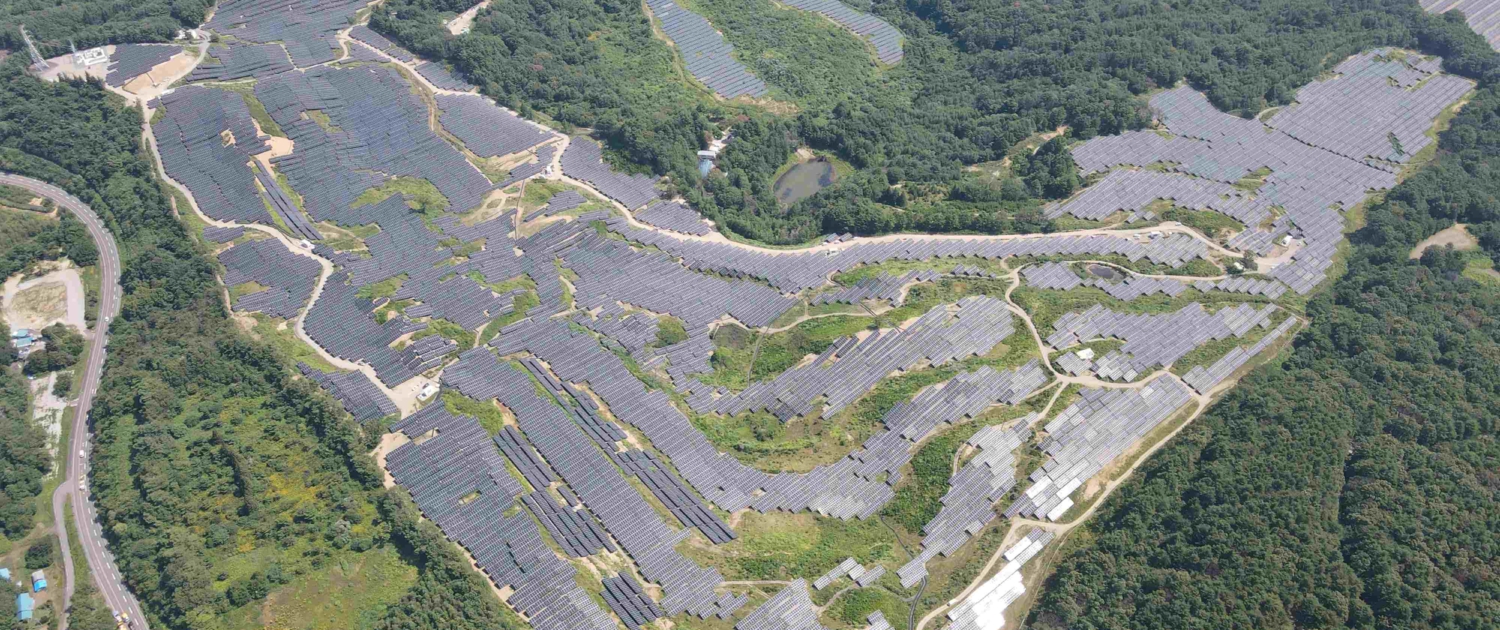
A Solar Farm Instead of Fairways
Japan faces a shortage of space – not only for housing but also for the expansion of renewable energy. In this densely populated and mountainous country, solar project developers are desperately searching for suitable sites. The surprising solution to this problem now comes from the remnants of the 1980s golf boom: abandoned golf courses.
In Japan, strict requirements apply to the construction of large-scale solar farms: They must have sufficient sunlight, be located a certain distance from residential areas, and have good access to the power grid. Solar farm developers are now finding that former golf courses meet these exact criteria.
Ideal conditions for green energy
From the perspective of project developers, a golf course is essentially a ready-to-go power plant that simply hasn’t been connected to the grid yet. The land has already been developed, trees have often been cut down, and the terrain is generally not too hilly or extremely uneven. Added to this are the underground irrigation systems that are still in place. The development work required for solar park operators is minimal.
Minohara Country Club is the next case
The Minohara Country Club in Gunma Prefecture, about a two-hour drive from Tokyo, illustrates how this transformation is actually taking place. Even now, you can still see fairways winding through the forest on Google Maps. According to the news service Bloomberg Green, however, the club is struggling significantly with demographic change in Japan. The generation of passionate players from the “Bubble Era” (the Japanese economic bubble) is increasingly passing the age of 75, and there is a lack of younger players. Although a daily greenfee for unlimited golf costs the equivalent of only 5,000 yen (about 31 euros), the course often remains empty. The club reports annual losses.
For this reason, the closure is scheduled for 2030. At the same time, the construction company Kamisato Kensetsu is set to begin building massive solar power plants. Solar panels with a capacity of 152 megawatts are planned for the site – it is set to become one of Japan’s largest solar farms. Until the permits are finalised, the company will continue to operate the golf courses itself.
Nine % of large-scale solar power plants are located on golf courses
The Minohara Country Club is just one example of this trend. Over the past ten years, decommissioned golf courses have become one of the most important pillars of Japan’s solar growth. According to an analysis by BloombergNEF, approximately nine % of Japan’s total solar capacity – with an output of 0.9 megawatts or more – is now located on former golf courses.
EDP SA, another solar farm developer, has taken over a golf course in Fukushima Prefecture. Here, too, the developers view the decommissioned golf course as a real stroke of luck. Speaking to Bloomberg Green, a company spokesperson commented on the conversion of the site as follows:
“Golf courses offer us the opportunity to use land effectively while minimising the number of trees we have to cut down. This is otherwise one of the most sensitive issues in the development of solar projects.”
INSERT_STEADY_NEWSLETTER_SIGNUP_HERE