
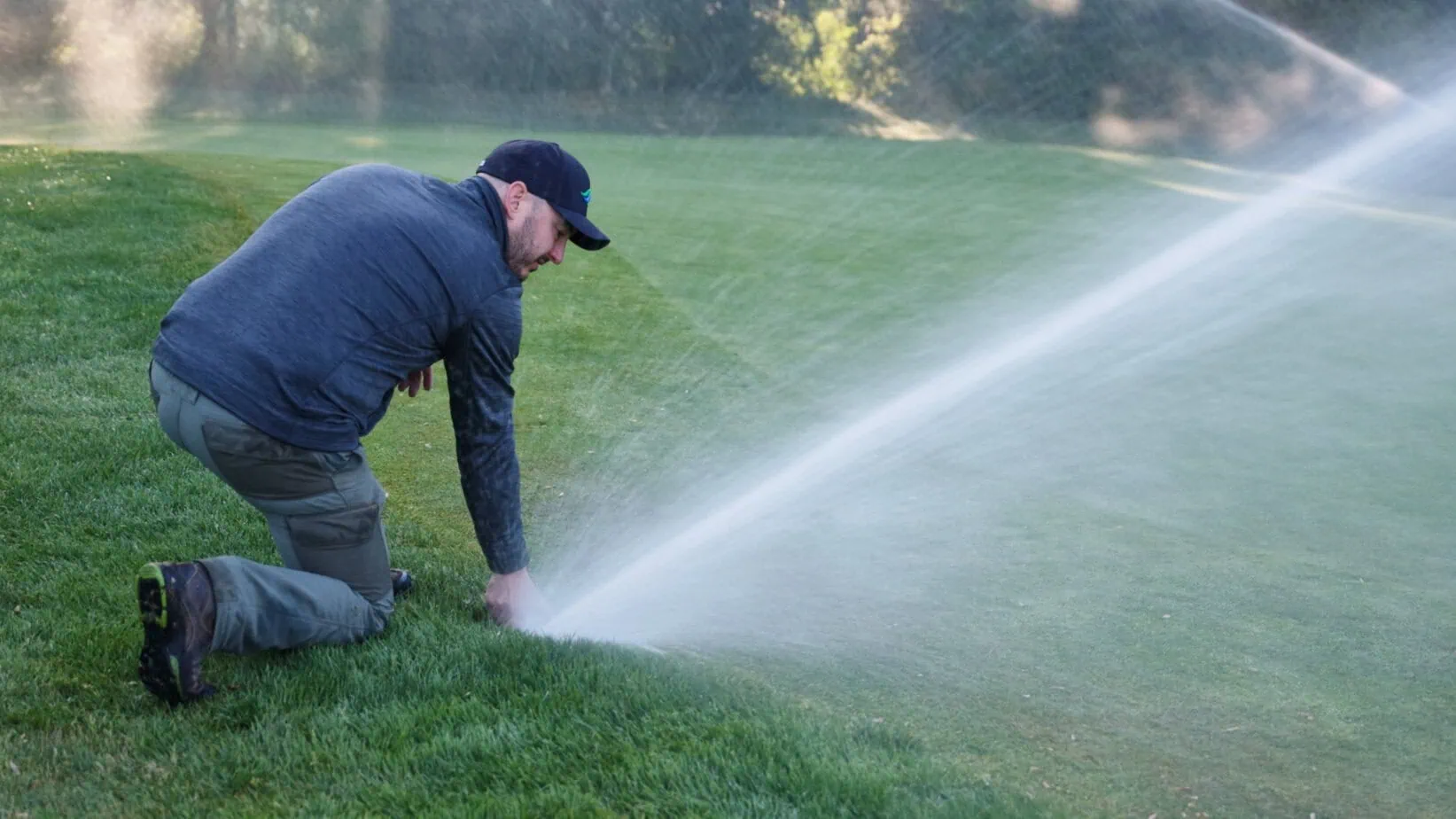
And what happens to the course quality? This is the big question on the minds of many greenkeepers when it comes to the end of the use of pesticides on golf courses. Although there is currently no definitive ban on the use of chemicals by the EU, a look at other European nations shows that stricter legislation or even a complete ban on herbicides or fungicides is definitely an issue. In parts of Belgium as well as in Switzerland and France, golf clubs have to deal with stricter pesticide laws than in Germany.
Michael Scheffold, head greenkeeper at GC Wörthsee in Germany, did a reality check this winter and completely dispensed with the use of fungicides. “I was interested in how the course would come out of the winter if I didn’t apply anything to the greens,” he explains his motivation. “If there really is a ban, at least you know how the greens react.”
From his point of view, the result is better than expected: “The greens had a little more snow mold than in previous years, but it was in an acceptable range.” The fact that the spring was cold and dry delayed the growth of the grasses, but by mid-May “the greens were almost as good as usual.” However, due to the drought, Scheffold has already had to start watering the playing surfaces.
But how does the membership feel about changed playing conditions due to reduced pesticide use? How do members react when the greens are less perfect than usual? “Yes, there have been one or two requests,” summarizes Michael Scheffold. “But the head greenkeeper is pretty free in his decision, we trust him,” explains Sven Hilgenberg, the club’s managing director. After all, he adds, the club also wants to be prepared for future scenarios without pesticides. For this reason, new working methods or applications are tested more frequently in order to be up-to-date in greenkeeping.
In Germany, the associations generally recommend that clubs follow what is known as Integrated Pest Management. IPM is an approach to the maintenance of golf courses in which diseases, pests and weeds are controlled in the most environmentally friendly way possible. Preventative measures such as site-appropriate grasses, optimized irrigation, soil care and biodiversity promotion are used before chemical pesticides are applied. The aim is to maintain the playing quality of the pitches while significantly reducing environmental pollution, risks to people and nature and the use of pesticides.
For years, Michael Scheffold has also increasingly relied on mechanical measures to maintain his playing areas, which help to promote the health of the soil and grasses. Although this costs more time and manpower, it ultimately ensures that the golf course is more robust and better able to withstand attacks from fungi, for example. His test run without fungicides last winter proves him right.