Biodiversity lexicon: V for vegetation connectivity
Connectivity is one of the central principles of nature conservation and biodiversity promotion. It describes the connection of habitats, species occurrences and ecological processes within a landscape. For animals and plants, it is not only the quality of an individual habitat that is decisive, but also the ability to move between suitable habitats, colonize new areas and maintain genetic exchange with other populations. Networking thus creates the conditions for stable ecosystems and resilient species populations.
In the modern cultural landscape, many habitats are separated from each other by settlements, roads, intensive agriculture or technical infrastructure. This fragmentation leads to populations becoming isolated. The consequences range from reduced genetic exchange and declining adaptability to the local extinction of species. Animals with limited mobility are particularly affected, as are plants whose dispersal depends on pollinators, wind or animals.
Against this backdrop, so-called biotope networks are becoming increasingly important. They consist of core habitats, stepping stone biotopes and connecting elements such as hedges, riparian strips, copses or extensively farmed areas. Together they form a network that enables migration and exchange processes. In many European countries, the creation of such network structures is now one of the most important goals of nature conservation.
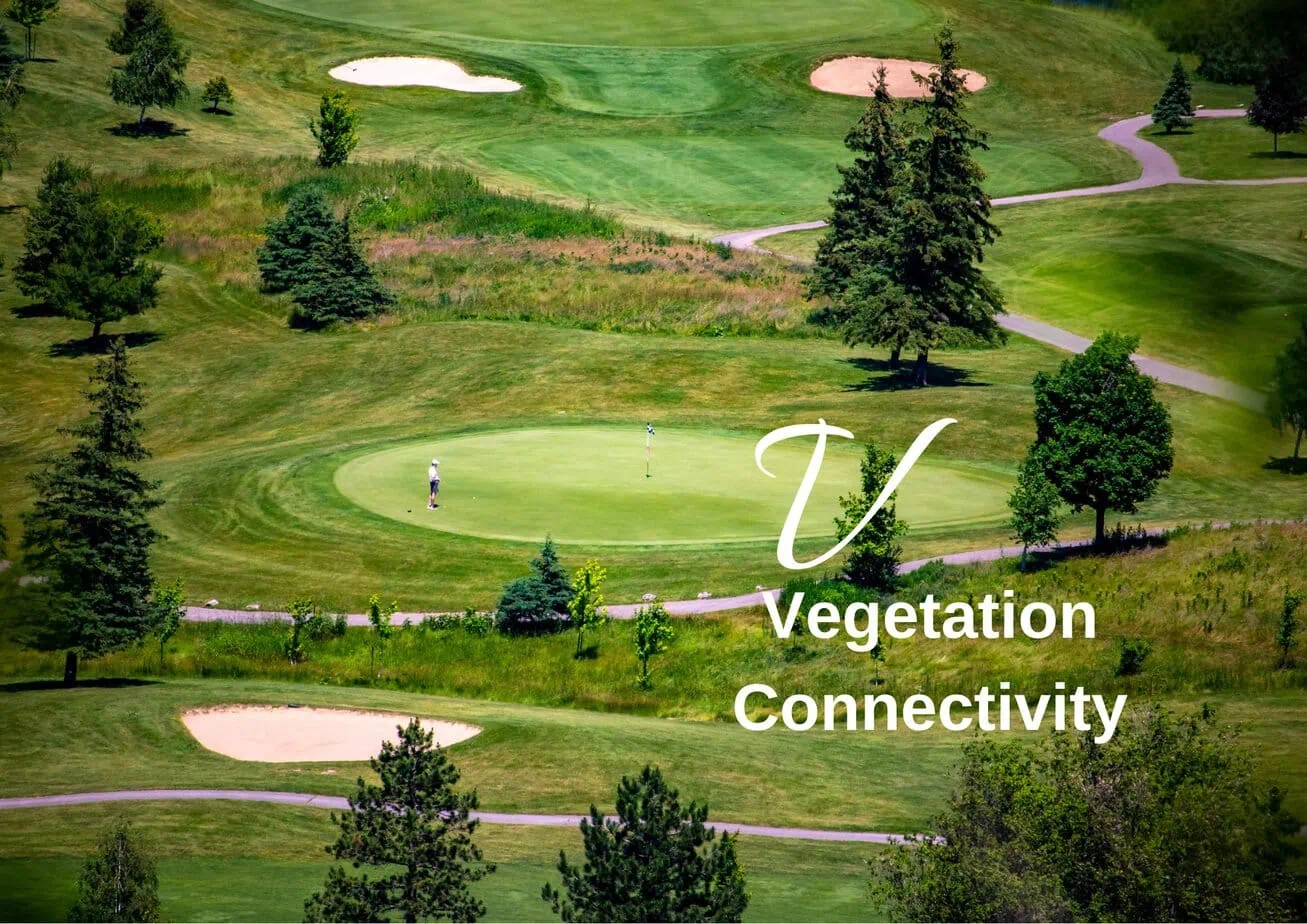
Golf courses can play a far greater role in this context than is often assumed. Although they are primarily used for sport, they often have extensive semi-natural areas that extend far beyond the actual playing areas. Depending on the location, these areas include meadows, copses, ponds, wetlands, fallow land or forest edges. As a result, golf courses can form important stepping stones within a regional biotope network.
Networking already begins within the golf course. Near-natural areas should not be regarded as isolated islands wherever possible. Instead, linear structures such as hedges, rows of trees, fringes or water corridors can connect different habitats. An insect that finds food in a flowering area can reach other suitable areas via such structures. Amphibians benefit from migration corridors between spawning waters and summer habitats. Birds also use networked woodland structures as feeding, breeding and retreat areas.
Transition areas between different habitats are of particular importance. Such so-called ecotones, for example between forest and open land or between water and meadow, often have a particularly high biodiversity. If these areas are specifically preserved and connected with each other, a mosaic of different habitats is created that benefits numerous species.
However, the importance of golf courses does not end at the property boundary. Many courses are located in regions where they can create a link between larger natural areas. A golf course on the edge of a forest, for example, can serve as a transitional space to an agricultural landscape. If it is located along a river or between protected areas, it can become part of a supra-regional ecological network. In heavily used landscapes, golf courses often take on a function that was previously fulfilled by hedgerows, extensive pastures or natural floodplains.
Networking is becoming increasingly important, particularly in the context of climate change. Many species react to rising temperatures and changing precipitation patterns by shifting their distribution areas. In order for them to reach new suitable habitats, they need permeable landscapes and functioning migration corridors. Connected habitats therefore increase the adaptability of species and ecosystems to future environmental changes.
For golf courses, this means not limiting biodiversity management to individual areas, but considering the entire course as part of a larger landscape. Cooperation with neighbors, local authorities, nature conservation organizations and land users can help to strengthen ecological connections beyond the boundaries of the golf course. This creates networks that benefit both nature and people.
Networking is therefore much more than a technical term for nature conservation. It is a fundamental principle of living landscapes. Where habitats are interconnected, species can migrate, populations can survive and ecosystems can fulfill their functions. Golf courses have the potential to be an important part of such networks – locally on the course as well as in the large-scale network of the landscape.