

• Home
  • Subscribe to newsletter
  • The team
  • Goals
  • Deutsch Deutsch German de
  • English English English en
Golf Sustainable
  • News
    • Club News
  • Climate change
  • Water
  • Biodiversity
  • Greenkeeping
  • Tourism
  • Diversity
  • Other topics
    • CO₂
    • Industry & Equipment
    • Best practice
    • Science
  • Click to open the search input field Click to open the search input field Search
  • Menu Menu
Golfball mit Ameisen
Golf Sustainable

Pesticide risk study reveals data dilemma

It is a conflict. It revolves around one topic: data collection on golf courses worldwide. On the one hand, golf courses are coming under increasing public pressure, especially regarding water consumption and pesticide use. Given dwindling water resources and increasing health concerns as well as biodiversity problems with the use of pesticides on green spaces, the golf scene increasingly has to prove that its consumption is harmless. The only problem is that reliable data is (almost nowhere) available from golf associations worldwide. The data owners are the golf clubs or course owners – and they are often extremely reluctant to publish the data.

Study with US and European partners

This problem can be substantiated by a scientific study entitled Analyzing golf course pesticide risk across the US and Europe-The importance of regulatory environment 2023, which was published in the scientific journal Science of the Total Environment, but has hardly reached the golfing public to date. Nine American and European universities, scientific associations and golf associations were involved in the study. With the help of a survey of superintendents in the USA and Europe, the aim was to determine how high the so-called pesticide risk is in the respective countries. If you read the study more closely, you will see that although the final figures provide information on the pesticide risk in individual countries, the main question is how golf should obtain data in the future. Through regulatory obligation or through voluntary submission? The study clarifies that golf courses obviously cannot be relied upon to provide data voluntarily, even if the data is anonymized.

Response rate in the USA below 50%

“This study was primarily limited by the hesitancy of US-based superintendents to share  pesticide records,” state the study’s authors, led by Michael A. Bekken. If all superintendents who participated in the resource efficiency survey had agreed to share anonymous pesticide data, the sample size in this study would have more than doubled. Of the golf courses contacted in the US, only 47 % shared their pesticide data, while in Europe 83 % were willing to communicate data. Where does this reluctance come from? The scientists do not provide a definitive answer but state: “It is unclear as to why US superintendents hesitate to share pesticide records which are reported in an anonymous manner but may be related to the concern that supplying records would damage the golf course’s reputation in its community, if published. Perhaps of greater concern to golf course superintendents may be that higher levels of public awareness of golf course pesticide use could lead to regulation that could limit the wide variety of pesticides currently available for use on golf courses in the US.”

FEGGA: Golf must proactively reduce pesticides

Significantly higher pesticide risk in the USA

The study also makes this clear: based on the available data, the pesticide risk in the USA is many times higher than in Europe. However, there are also considerable differences in Europe between EU countries and the UK. In Europe, the pesticide risk was lowest, particularly in Norway and Denmark, where strict government regulations severely restrict the supply of pesticides. While greenkeepers in Denmark and Norway, for example, had fewer than 20 active ingredients at their disposal at the time the three-year study was conducted, there were over 200 in the USA.
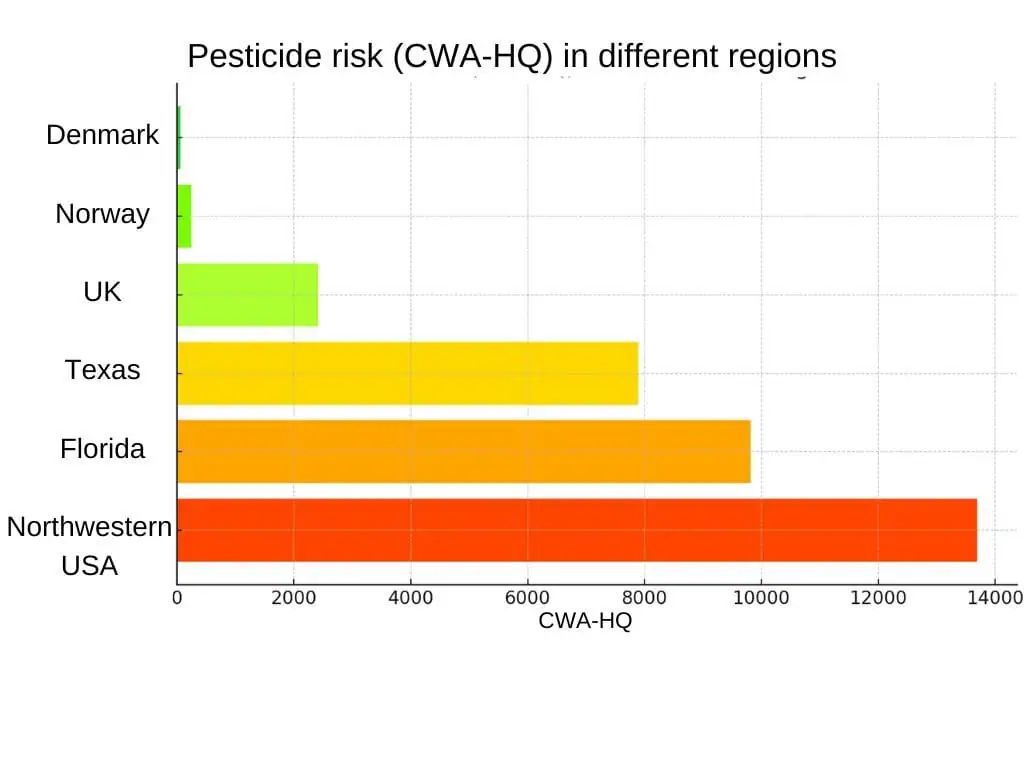
Graphic on golf course pesticide risk

What does the significantly higher pesticide risk mean for golfers? Anyone looking for relevant publications in scientific search engines will be disappointed. There are no recent studies. As a general rule, all products approved for use on golf courses are checked in advance by the national licensing authorities for health risks and, according to the authorities, are harmless. For example, the GCSAA, the Golf Course Superintendents Association of America, states: “Members are not only encouraged, but are required by law, to follow the product labels at all times.  They also rely on the pertinent scientists’ recommendations, state and federal regulations and established Best Management Practices.  This includes recommendations for selection, application, record keeping and more.” There is therefore no reason to assume that golfers’ health is at risk.

Pesticide use and biodiversity

The situation is different regarding biodiversity, which is known to play a major and very positive role for golf courses with their enormous areas. Numerous studies, particularly from the agricultural sector, point to the negative impact of pesticide use on pollinators, for example. But there is also a connection in golf. For example, the study Can a golf course support biodiversity and ecosystem services. from 2019 questions the extent to which the positive effects of a golf course on promoting biodiversity are counteracted by the negative effects of pesticide use on water quality or animal habitats. Given the extremely low use of pesticides in Europe, this question hardly arises, but because of the high levels in the USA, it certainly does.

So, what is the consequence of the realization that voluntary data submission is obviously a difficult issue? There was actually no reaction from the golf industry to the publication of the study, according to Michael Bakken. He was employed at the University of Wisconsin-Madison during the study, but now works for the Norwegian institute NIBIO. Both were involved in the research.

Obligation yes or no?

But how can the golf industry respond to the increasing demand for data from the public and the scientific community? Can golf associations oblige golf courses to publish water or pesticide consumption data? In principle, no. Only legislative authorities, such as the EU, the U.S. Environmental Protection Agency (EPA) in the USA or national and regional administrations are in a position to do so. This is another reason why the data situation in Danish golf, for example, is excellent by European standards. Here, the government’s permission to use pesticides in golf – albeit on an extremely small scale – is tied to the reporting of data.

Golf de Chantilly: Minimalist approach leads to top quality

This is why the United States Golf Association, which does a lot of training and information work in the field of greenkeeping with its Green Section and is also the most powerful golf association in the world alongside the R&A, points out that this power ends with the delivery of data: “The USGA is not a regulator, but a non-profit educator and investor that is one of many golf organizations that support best practices and widespread application of those practices. ,” says Janeen Driscoll, Director of Brand Communications. The same applies to the Golf Course Superintendent Association of America. When asked, however, the association did not explain why the willingness of their members to voluntarily disclose anonymous data during the study was so low.

A question of transparency

Does this leave regulation by the authorities as the last possibility to obtain data? Or is the negotiating position of the golf scene not much easier when balancing water, fertilizer or pesticide limits if an existing set of anonymous but meaningful data is already available? Ideally, this would prove that the consumption of water and the use of chemical fertilizers or pesticides on golf courses may be far lower than the public assumes. In general, data publication always paints a relatively positive picture of transparency. In most cases, Europe’s and America’s golf courses still need to be convinced of this transparent approach.

Currently, the golf club or golf course operator is the master of its data. They can decide whether to publish it or not. They cannot influence the public reaction to it: anyone who does not publish data and is not transparent quickly exposes themselves to the assumption that they are hiding something negative.

Conflict issues for the golf associations

The golf associations are therefore in a quandary: do they make themselves unpopular with golf courses and golf clubs because they are increasingly demanding voluntary data entry from them? Or do they continue to convey the image of a non-transparent industry to national or international authorities? The data dilemma is forcing the golf associations into a dilemma. Can they win this game?


Vision 2050: Bradley Klein calls for a reorientation of golf

Share this entry
  • Share on Facebook
  • Share on X
  • Share on WhatsApp
  • Share on Pinterest
  • Share on LinkedIn
  • Share by Mail

INSTAGRAM

golfsustainable

Golf Sustainable is an independent news platform, founded by Petra Himmel.

Visibility is so important.We love the Green Thurs Visibility is so important.We love the Green Thursday project of Eco Athletes. A perfect best-practice case for golf associations or clubs. An easy way to start a conversation about sustainability.

Four professional golfers promote a greener game. Camille Chevalier, Celina Sattelkau, Sára Kousková and Patricie Macková have joined the Green Month initiative of  EcoAthletes. The inaugural Green Sports Month is bringing athletes and the wider sports community together to raise awareness and drive climate action.

🟢 Green Thursdays

Throughout the October tournament weeks, the four players will wear green on Thursdays to make climate action visible on the golf course – and encourage fellow LET players to join them. First occasion: Yesterday during the LET tournament in Korea. 

♻️ Plogtober

They will also take part in EcoAthletes’ Plogtober initiative, combining physical activity with litter collection. The idea is simple: get outside, move, pick up waste and use social media to inspire others to do the same.

For golf, this message matters. First of all, sustainability is not only about golf-course management, water, biodiversity or energy. It is also about the people who represent the sport and promote sustainable behaviour. 
Foto: LET/Oliver Brady

#GreenSportsMonth #EcoAthletes #SustainableGolf #greensports #ClimateAction #LadiesEuropeanTour  #Golf #SportForClimateAction #golfsustainable #greensports #womeningolf
Sylt is a high-end hotspot for golf tourists. The Sylt is a high-end hotspot for golf tourists. The island is working on its mission statement, due to be unveiled at the end of the year. One thing is already certain: with the ‘Lebenswert – sustainable Sylt’ seal of approval, the ‘environmentally conscious travel’ segment will play a significant role in it.

But what is the reality? How many hoteliers and golf courses truly stand behind this seal, and how do they put it into practice in their catering, hotel management and greenkeeping? We visited some golf clubs and hotels -  the résumé: 

 💠  Landhaus Stricker, led by Michelin-starred chef and owner Holger Bodendorf, offers the perfect combination of luxury holidays and sustainability. Meticulous attention is paid here to regional supply chains, resource conservation, waste prevention and renewable energy. This ranges from the tea bags at the buffet to membership in the Feinheimisch association. GreenSign certification is the icing on the cake. Perfect choice. 

 💠  The island has four golf courses, three of which have been awarded the highest ‘Gold’ level of the German Golf Association’s ‘Golf and Nature’ certificate. The Marine Golf Club, GC Sylt and the Budersand Resort are therefore the top destinations for golf tourists who like to travel in an environmentally conscious manner. It was a welcome discovery that sustainability is also a major priority at the Budersand Resort with its 5-star hotel. Plastic, at any rate – a real problem at golf resorts, particularly in the catering sector – definitely has no place here.

So what's next? All that remains is to adapt the marketing. Because one thing is clear: right now, Germany’s top island isn’t really associated with sustainable golf tourism in the customer's mind. Sylt is known as a golf destination, but not yet as a sustainable golf destination. Hopefully, that will change in the near future. 

Fotos: Sylt Marketing e.v., Landhaus Stricker, Budersand Hotel - Golf & Spa -Sylt, Marine Golf Club, Petra Himmel 

#sylt #sustainabletravel #tourism #golfsustainable #golftravel #golfholiday #sustainablehotels #golf #golfer
In Japan, abandoned golf courses become solar park In Japan, abandoned golf courses become solar parks - like here in Fukushima, where the EDP Group has converted a 60-hectare golf course into a vast solar park comprising 63,000 solar panels. The plant is expected to generate over 48 GWh of energy annually. 

Japan faces a shortage of space – not only for housing but also for the expansion of renewable energy. In this densely populated and mountainous country, solar project developers are desperately searching for suitable sites. 

In Japan, strict requirements apply to large-scale solar farms: They must have sufficient sunlight, be located a certain distance from residential areas, and have good access to the power grid. Solar farm developers are now finding that former golf courses meet these exact criteria.

From a developer's perspective, a golf course is essentially a ready-to-go power plant that simply hasn’t been connected to the grid yet. The land has already been developed, trees have often been cut down, and the terrain is generally not too hilly or extremely uneven. Added to this are the underground irrigation systems that are still in place. The development work required for solar park operators is minimal.

The case of Japan shows that a golf course can be transformed – sometimes more rapidly than golfers can imagine. 
📷EDP APAC

#golf #golfmanagement #sustainable #solarenergy #golfsustainable #golfcourse
🔥 Burning trolley batteries inside buildings are a 🔥 Burning trolley batteries inside buildings are a real problem at golf courses. That’s why we liked this new product idea.
😄 A solar-powered battery charging station - with no underground wiring and available in custom sizes - solves the problem. The stainless steel frame can be placed anywhere outdoors. The golf club decides how many batteries shall be charged at the same time or how many e-trolleys shall be parked here. Golfers can use them during their drinks or lunch at the clubhouse. 
🤑 Plus: All surfaces can be used for advertising partners, so the charging station can pay for itself. The batteries hide behind the advertising surfaces. 
Great idea: We’re excited to see it on the first courses. 

Link for the full story in the first comment, or have a look at golfsustainable.com

#golf #golfmanagement #golfsustainable #smartideas #golfindustry #solarenergy 

Foto: Alexander Fend
🏌 Golf for the community - an approach that is oft 🏌 Golf for the community - an approach that is often missing in today’s booming American golf market. Starting in December, The Gate Golf Club will provide a counterbalance in the Naples region, which ranks among the top destinations when it comes to private, high-end country clubs. 
 😀 Golf for the community - this is the goal that President Kristina Schmieding is consistently pursuing, with a whole host of supporters from Collier County by her side. Among them is First Tee, which is finally finding a permanent home at The Gate Golf Club.
Social sustainability in golf means creating added value for many. The countdown to The Gate has begun. Good luck with this wonderful initiative.
Fotos: The Gate Golf Club
#TheGateGolfClub #GolfSustainable #NaplesFlorida #NaplesGolf #PublicGolf #GrowTheGame #FirstTee #FloridaGolf #CommunityFirst #GolfLife #InclusiveGolf
🏌️‍♂️💦 Dew might look beautiful and harmless, but 🏌️‍♂️💦 Dew might look beautiful and harmless, but it's actually one of the biggest seasonal challenges for greenkeepers!

Autumn is dew season. When nighttime temperatures drop and humidity rises, a fine film of water forms on the turf. For us golfers, it just means a slower rolling ball—but for the health of the course, it can be a real threat.

👉 Why?
When the turf remains damp for hours, it creates the perfect microclimate for aggressive fungal diseases like the dreaded Dollar Spot. The water on the leaves also draws out sugars and amino acids from the plant—an absolute feast for pathogens.

🌱 The Sustainable Solution:
The magic phrase is: Interrupt leaf wetness! Mechanically removing the dew—through early morning mowing (even with disengaged blades) or dragging hoses and nets—breaks the disease cycle.

Studies confirm it: Regular dew removal drastically reduces Dollar Spot outbreaks and minimizes the need for strictly regulated pesticides. A massive win for both the environment and your playing surface! 🌍💚

💡 Want to dive deeper?
Read the full article featuring exclusive insights from Christian Spring (STRI Group) on golfsustainable.com!
🔗 https://golfsustainable.com/en/dew-and-dollar-spot-strategy/

#GolfSustainable  #Greenkeeping #TurfManagement #SustainableGolf #DollarSpot #GolfCourseMaintenance #GolfAcademy #EcoFriendlyGolf #GolfIndustry #golf
💧 Let’s talk about water management! As water cons 💧 Let’s talk about water management! As water conservation becomes central to golf course design, storage ponds are playing a vital role in securing irrigation for dry periods.

But not all reservoirs are created equal. Depending on space, budget, and ecological goals, there are different ways to store water on a golf course. Here are the main variants:

⛳ 1. The on-course strategic pond
Beautiful, functional, and part of the game! These ponds are integrated into the playing areas. They serve as a strategic hazard and are visually appealing. When designed with shallow-water zones and shoreline planting, they become massive boosters for local biodiversity. 🌿🦆

🚜 2. The engineered "off-course" pond
Built out of sight, these are designed purely for function. They are typically much deeper with a smaller surface area to minimise evaporation. Because they are hidden from players, there's no need to worry about aesthetics.

☀️ 3. Covered ponds
 To stop water from evaporating in the heat, some reservoirs use floating covers like open cisterns. There are also examples for ponds with solar panels—preventing evaporation while simultaneously generating clean electricity for the club! ⚡💧

Whether for strategic gameplay, maximum storage, or clean energy, each variant has its own unique benefits and costs. Keep in mind, that each reservoir is part of the whole water management strategy of the golf club. 

Which solution fits your course best? Read the full breakdown of costs, sizes, and design strategies in our latest article! We talked to golf course designer Thomas Himmel about his recommendations for the construction process. 

Link in first comment

#GolfSustainable #WaterManagement #Greenkeeping #GolfCourseDesign #Sustainability #EcoGolf #Biodiversity #GolfCourseArchitecture #WaterConservation #FutureOfGolf
The Solheim Cup is all about empowering women in s The Solheim Cup is all about empowering women in sports,  a crucial part of social #sustainability 
🌍⛳It has grown into a global media product broadcast in over 170 countries, proving that when women are given a massive platform, they deliver unmatched passion, intensity, and teamwork. 

But this incredible event didn't just appear out of nowhere. We owe a massive debt to a female business pioneer behind the scenes,  Louise Solheim. Alongside her husband Karsten, Louise was the strategic business force behind the PING brand. Together, they guaranteed the sponsorship for the first ten Solheim Cups, laying a rock-solid foundation for the tournament's future. Louise's sharp management and business administration background showed that women in executive roles are essential to the game's growth. 

At Golf Sustainable, we celebrate the women who build the platforms for others to shine. ✨ Enjoy the Solheim Cup!

You want to read more about Female Success Stories in golf: Link to the (German) book in the first comment and in the profile. 

Fotos: Ping, Shutterstock

👇#GolfSustainable #WomenInGolf #SolheimCup #GrowTheGame #SustainableSport #InclusiveGolf #LouiseSolheim#Ping #golf #frauengolf
What does an inclusive golf club really look like? What does an inclusive golf club really look like?

It starts with more than accessible facilities. At Haxterpark in Paderborn, inclusion is part of the club’s DNA – on the course, in the workplace and in everyday club life.

Bunkers are designed to remain a sporting challenge while being accessible to wheelchair users. The course and facilities are designed around accessibility. But perhaps even more importantly, people with disabilities are not simply welcomed as golfers – they are colleagues.

Haxterpark operates as an inclusion business, with people with and without disabilities working side by side in golf administration, greenkeeping, gastronomy and service.

Rafa Lawah is a powerful example. She joined Haxterpark as an employee and discovered golf through her work. Today, she plays regularly and competes internationally.

That is what inclusion can look like when a golf club takes responsibility beyond the tee box: creating a place where people can work, play and participate – without their disability defining their role.

Inclusion is not a special programme. It is about designing the club so that more people can be part of it.

Link for full story in first comment. 

#GolfSustainable #InclusiveGolf #GolfForAll #Inclusion #AccessibleGolf #GolfAndSociety #SustainableGolf #GolfClub #paragolf 

Fotos: Rafa Lawah, Hardt
Learn more about the future of water & golf with o Learn more about the future of water & golf with our four-part webinar series. Water has been a hot topic across the European golfing world. Our new four-part series, ‘Golf & Water’ (in German with subtitles), provides board members, golf managers, association officials and indeed all amateur golfers with a straightforward overview of the topic of #irrigation. Together with the experts from Toro Germany and GC St. Leon-Rot, we aim to ensure that awareness of this issue increases amongst non-greenkeepers within the industry.

Anyone wishing to secure the future of a golf course must give serious consideration to irrigation. Only those with the necessary knowledge can make the right decisions. We look forward to welcoming everyone who wishes to treat themselves to a little further training with the help of these four free webinars.

👉 Golf & Water: Introduction https://www.youtube.com/watch?v=HPpf4Bnaytg
👉 Golf & Water: Technical basics of irrigation
https://www.youtube.com/watch?v=JQ8uVj5rcps
👉 Golf & Water: Most important irrigation tips
https://www.youtube.com/watch?v=Z3_7oZ5tYmg
👉 Golf & Water: https://www.youtube.com/watch?v=q43u0eK5ezE 

👉 Mehr insights: Golf Sustainable Akademie: https://golfsustainable.com/golf-sustainable-akademie/

#golf #education #water #irrigation #golfmanagement #TheFutureOfGolf #golfmanagement #golfclub #golf #golfer #golfdeutschland #greenkeeper #wasser #bewässerung
The end and the beginning: Heavy rain at the Husqv The end and the beginning: Heavy rain at the Husqvarna British Masters marks the end of England's extreme drought and the start of a transformation in the Hashtag#golf industry's use of water. But golf clubs have realised this summer - sustainable, efficient water management is necessary for a quality course. We talked to Jim Croxton from British & International Golf Greenkeepers Association (BIGGA) about the learnings of this summer. 

The Belfry Hotel & Resort is a positive example of a forward-thinking approach to irrigation. Most of the water for the Brabazon Course is reclaimed water from the hotel. Prioritising watered areas also saves water, carbon emissions, and money.

Conclusion: There are ways to transform golf in a positive way when it comes to the use of water as one of our most important resources. Hopefully every member of a committee or board has learned that this year. 

Full article: https://golfsustainable.com/en/england-drought-british-masters/
#golf #watermanagement#golfsustainable #dpworldtour #husqvarnabritishmasters #thebelfry #greenkeeping #golfer #water #irrigationsystem
How climate-friendly is a golf course – really? 🌍⛳ How climate-friendly is a golf course – really? 🌍⛳

Golf courses can store carbon in their soils. But they also generate CO₂ emissions through mowing, irrigation, energy use and maintenance.

So what is the actual balance?

A new international research initiative is tackling this question. The ITRI “Pathways to a Climate-Positive Future for Golf” project, supported by STERF, The R&A and the USGA, aims to develop a globally applicable methodology for measuring both CO₂ sequestration and emissions on golf courses.

Researcher Robert Kempster of NIBIO explains why this matters: without reliable data, golf clubs cannot know where their emissions come from – or where reductions will have the greatest impact.

Climate, grass species, irrigation, energy sources and even previous land use can all influence the carbon balance of a golf course.

The goal is not simply to make golf courses more resilient to climate change. It is to understand and reduce the emissions that contribute to it.

The key question for golf is no longer just: How do we adapt?
It is also: How much CO₂ do we emit – and how can we reduce it?

Read the full interview with Robert Kempster on Golf Sustainable

Foto: Robert Kempster

#GolfSustainable #GolfAndClimate #CO2 #CarbonEmissions #CarbonFootprint #ClimatePositive #ClimateAction #SustainableGolf #GolfCourses ##Freen#GolfCourseManagement #GolfIndustry #CarbonSequestration #GolfAndNature #Sustainability #ClimateChange #STERF #TheRA #USGA #NIBIO #ITRI
It’s time to talk about #carbon emissions. The sum It’s time to talk about #carbon emissions.
The summer of 2026  was dominated by two words: #adaptation and #resilience. But focusing only on adaptation and resilience misses the root of the problem.

Without reducing #CO₂ and other greenhouse gas emissions — including those generated by the golf industry itself — the costs of adaptation and resilience will continue to rise.

1⃣ At international management, greenkeeping, and golf travel conferences, carbon emissions have received little attention over the last two years.

2⃣ At the golf facility level very few lighthouse projects have begun active ESG reporting and are working toward a net-zero target.

3⃣ In professional golf, the picture is still limited. LIV Golf measures and reports its carbon emissions, as does the WM Phoenix Open. The DP World Tour has calculated emissions for eight events and its headquarters, including Rolex Series events, and has committed to achieving net-zero carbon emissions by 2040.

4⃣ In golf equipment, carbon footprints still play only a very limited role in corporate communication and public reporting.

5⃣ And in science, research into the carbon emissions and carbon balance of golf course management remains relatively scarce and fragmented. Earlier studies have examined greenhouse gas emissions from turf management and the energy and carbon footprint of golf course maintenance. But the international evidence base is still limited.

📍 Conclusion:
Carbon emissions are currently receiving far less attention within the golf industry than they need to if golf wants to establish itself as a credible contributor to climate action and environmental protection.

⛳ Let’s talk about carbon emissions:
Starting next week, Golf Sustainable will report on the people, projects, institutions, and companies pushing this issue forward.

We’ll start with an interview with Robert Kempster of NIBIO Norwegian Institute of Bioeconomy Research, Principal Investigator of “Pathways to a climate-positive future for golf.”

It’s time to talk about carbon. If you are driving the topic, send me a DM. 

#golf #golfmanagement #climatechange #lesscarbon #netzero #greenkeeping #golfsustainable #golfer
🌳 Did you know that perfectly healthy-looking tree 🌳 Did you know that perfectly healthy-looking trees can suddenly drop large branches? It’s called "Summer Branch Drop" , and it's a growing safety issue on golf courses. ⚠️

Record temperatures and long droughts are putting massive stress on trees. But why do healthy branches fall?
☀️ Due to severe heat and a lack of water, the cell pressure inside the tree drops.
📉 This causes the internal tension that stabilises the branches to suddenly disappear.
🔥 Additionally, the breaking strength of wood significantly decreases as temperatures rise.

The tricky part is that these branches can snap completely unexpectedly, even when they are totally healthy and their crowns are full of green leaves. This poses a major safety risk for golfers who might be standing underneath them seeking shade.

**How golf clubs are responding & how you can stay safe:**

* Golf clubs are working closely with arborists and tree experts to conduct regular, detailed tree inspections to ensure player safety.
* Always pay attention to warning signals like sudden cracking or unusual noises coming from the canopy.
* Avoid lingering under trees during extreme heat and prolonged dry spells.
* Pay attention to course communications—some clubs are actively warning members via their websites or may even temporarily close the course during dangerous wind conditions.

Stay safe out on the fairways and respect course warnings! 🏌️‍♂️⛳ Have you ever witnessed a sudden branch drop on your home course? Let us know in the comments! 👇
Images: Frankfurter GC

#GolfSustainable #SummerBranchDrop #Grünastbruch #Greenkeeping #GolfCourseMaintenance #TreeCare #GolfSafety #ClimateChange #SustainableGolf
Heat can be deadly. Precautions against extreme he Heat can be deadly. Precautions against extreme heat on golf courses are essential, as summers are getting hotter because of climate change. This mist shower, situated in a central position at Golf & Country Club de Bossey in France, is a wonderful idea - and extremely refreshing. 
#golf #heat #golfmanagement #golfsustainable #golfinfrance
It is during crises that it becomes clear where th It is during crises that it becomes clear where the problems lie. The current heatwave and drought are putting golf courses in Central Europe to the test in terms of irrigation management and infrastructure. One thing is clear: the ‘champions’ are those golf courses that have long been investing in modern infrastructure for water collection and irrigation, whilst also taking a strategic approach to site selection, education and new grasses.

Nevertheless, this picture shows that there is still room for improvement to ensure that precisely such a scenario – automatic standard irrigation during rain and hail – does not occur. We spoke to five experts and asked them for their tips on improving irrigation.
Full article on our website https://golfsustainable.com, and the link is in the first comment. 
#greenkeeping #golfsustainable #golf #golfmanagement #sustainablefuture
The AIG Women's Open at Royal Lytham & St. Annes G The AIG Women's Open at Royal Lytham & St. Annes Golf Club demonstrates what top tournament conditions are. Depending on the dry and hot weather the course is presented with hard, fast and running fairways.
A home for reptiles – and so much more. 🦎🌿 Health A home for reptiles – and so much more. 🦎🌿

Healthy ecosystems are built on habitat diversity. At Golf Club St. Leon-Rot, this carefully designed reptile habitat demonstrates how golf courses can provide valuable refuges for wildlife.

Combining natural stone, deadwood and open sandy ground, the site offers ideal conditions for reptiles such as lizards. The stones absorb and retain heat, while the deadwood and crevices provide shelter, nesting opportunities and safe places to overwinter.

These seemingly simple structures also benefit a wide range of insects and other small animals, making them an important part of a connected, biodiverse landscape.

Creating habitats like this is a powerful reminder that sustainable golf course management goes far beyond maintaining playing surfaces—it means making space for nature to thrive.

🌱 Every habitat counts. Every species matters.

#GolfSustainable #GolfAndNature #Biodiversity #ReptileHabitat #NaturePositive #Sustainability #WildlifeConservation #HabitatCreation #GolfCourseManagement #Ecology #StLeonRot
With temperatures reaching 33 degrees, the golf in With temperatures reaching 33 degrees, the golf industry in Central Europe is breaking a sweat. Extreme heat is directly linked to two other issues: customer service and occupational safety. We wanted to know from experts on the subject of heat how this works. Tom Rourke, General Manager at The Els Club in Dubai, deals with extreme heat on a daily basis. He can list a whole range of services that are part of everyday life at The Els Club in Dubai.

1. Early start times as early as 6 a.m. to take advantage of the most pleasant temperatures.
2. Extend the clubhouse’s hours so that breakfast and coffee are available before the first tee time.
3. Additional drinking water and hydration stations throughout the facility.
4. Golf carts equipped with coolers and ice to keep drinks cold throughout the round.
5. USB ports on the golf carts that can be used to power portable fans.
6. Chilled towels provide a small but effective way to cool off during the round.
7. Free ice cream or fresh snacks to cool off quickly.
8. More shaded areas and places to relax, especially at the halfway houses and on the terraces.
9. Player assistants or beverage carts that actively deliver chilled drinks and refreshments onto the course.
#golfindubai #troongolf #golfsustainable #extremeheat #customerservice #golf #golfmanagement #elsclubdubai #dubaigolf 

Fotos: The Els Club Dubai
A crazy idea? Maybe. But now it is a global instit A crazy idea? Maybe. But now it is a global institution in golf: The Amundi Evian Championship

32 years ago, the idea seemed almost impossible. A small Ladies European Tour event on the shores of Lake Geneva. Most industry experts believed the project would fail. Instead, it became one of the greatest success stories in global sports as one of the five majors in women's golf. 

1️⃣ A long-term vision instead of short-term returns
From the very beginning, the ambition was to create a tournament that would still matter decades later. 

2️⃣ Putting athletes before the event
Many tournaments are designed around sponsors. Evian was designed around the players. Exceptional hospitality, attention to every detail, support for caddies, coaches and media created a tournament family. 

3️⃣ Excellence is found in the details
The Amundi Evian Championship is famous for its spectacular setting. Every element contributes to one coherent experience. 

4️⃣ Investing in women's sport before it became fashionable
Long before gender equality became mainstream, Riboud and Bungert believed in the commercial and sporting potential of women's golf. The arrival of Amundi as title partner accelerated that commitment. Prize money has grown from US$4.5 million in 2021 to US$9.1 million in 2026.

5️⃣ Building an ecosystem, not just a tournament
The road to Evian begins long before players reach the major. The Amundi Evian Kids Cup and Juniors Cup introduce the world's best young golfers to the venue.  Haeran Ryu is the perfect example. She won the Evian Juniors Cup in 2015. Eleven years later, she returned to set a new women's major championship scoring record with a brilliant 60 before lifting the trophy. Childhood dreams are connected with professional success.

For me The Amundi Evian Championship has become much more than a golf tournament. It demonstrates what is possible when leadership is guided by vision, consistency, excellence and genuine belief in women.

📷  Philippe Millereau
#Golf #WomensGolf #Leadership #SportsBusiness #SportsMarketing #EventManagement #WomenInSport #Diversity #BrandBuilding #GolfSustainable
⚡️ Can a world-class golf tournament run without d ⚡️ Can a world-class golf tournament run without diesel? The 2026 Genesis Scottish Open is proving that it can.

The DP World Tour is taking one of its biggest steps yet towards decarbonising tournament operations by replacing conventional diesel-powered infrastructure with an integrated renewable energy system at The Renaissance Club.

Here's how it works:

🔋 Two 250 kWh Green Hydrogen Power Units (HPUs), each equipped with an integrated Battery Energy Storage System (BESS), form the heart of the tournament's new energy infrastructure. Positioned between the 1st and 15th holes, they provide reliable power for one of the busiest areas of the championship site.

📺 The hydrogen units supply electricity for the hospitality facilities around the 15th hole, the Genesis Public Lounge, the merchandise area and the large LED video screens—critical infrastructure that has traditionally relied on diesel generators.

☀️ For the first time, the Fan Village's main stage and the merchandise shop are powered entirely by solar energy, demonstrating how temporary event infrastructure can successfully transition to renewable electricity.

🔋 The integrated battery storage balances demand peaks, stores excess renewable energy and ensures a stable electricity supply throughout the tournament while reducing the need for backup generators.

🌍 The impact is measurable:
• Approximately 16,200 kg of CO₂e are saved compared with a conventional diesel-powered energy system.
• Even compared with the tournament's 2025 setup, emissions are expected to be reduced by around 600 kg CO₂e.
• At the point of use, green hydrogen produces zero carbon emissions—its only by-product is water.

The Genesis Scottish Open is demonstrating that renewable energy is no longer a concept for the future—it is ready to power major international sporting events today. 
Foto: DP World Tour

#GolfSustainable #GenesisScottishOpen #DPWorldTour #GreenHydrogen #HydrogenPower #BatteryStorage #SolarEnergy #RenewableEnergy #Decarbonisation #SportsSustainability #ClimateAction #NetZero #Innovation #VisitScotland #GolfIndustry #FutureOfGolf
From groundwater to reclaimed water: Since July 8, From groundwater to reclaimed water: Since July 8, the Evian Golf Resort has been completely self-sufficient when it comes to water management. 

Through a partnership with Danone’s Evian bottling plant, treated industrial water is pumped via a five-kilometer pipeline to the Golf Academy and the golf resort, where it is used for irrigation. 

“We made this decision 18 months ago,” explains Franck Riboud, Honorary President of the Danone Group, which also owns the Evian Golf Resort. “We wanted freedom, and now we have it.” When Riboud speaks of freedom, he is referring to the increasingly strict French regulations governing the use of groundwater for irrigating sports fields. 

By installing a completely closed-loop system—which ensures full self-sufficiency for the golf courses—the golf club is no longer dependent on government regulations.

Fotos: The Amundi Evian Championship /Philippe Millereau, Petra Himmel
#amundi #evian #eviangolfresort #amundievianchampionship #lpga #let #professionalgolf #golfsustainable #SustainableGolf #watermanagement #greenkeeping #golf #golfer #womeningolf #resilience #innovation #water

The overall project is called “REUT” (Réutilisation des Eaux Usées Traitées)
At the Amundi Evian Championship meadows create ha At the Amundi Evian Championship meadows create habitats for insects between the playing area. This is the backdrop of hole No. 18.
This is history: A winner's cheque worth 1,950.000 This is history: A winner's cheque worth 1,950.0000 US dollars for Hae-Ran Ryu. The KPMG Women's PGA Championship has made a statement: Equal pay and gender equality are relevant topics in golf. 

Yes, there are still differences between the payouts for male and female golfers, but especially at the Majors, the gaps are closing. The KPMG Women's PGA Championship is the most recent striking example.

🔹 For the 2026 season, the prize money for the KPMG Women's PGA Championship has surged to $13.1 million. For context, the purse was just $10.4 million in 2025.

🔹 Narrowing the Divide: The men's PGA Championship currently sits at $20.5 million. While a gap still exists, it is shrinking at a record pace. At $13.1 million, the pay gap has been reduced to approximately 1.56x.

🔹 Equality by Exception: Unlike the regular tour, where the structural gap remains wider, these Majors are closing the gap massively.  The Amundi Evian Championship has also increased the prize money to $ 9,1 million. 

#Golf #KPMGWomensPGA #PGAChampionship #SportsBusiness #EqualPay #Leadership #LPGA #GenderEquality #womeningolf #femalegolfer #golf #prizemoney #golfsustainable

Foto: Scott Taetsch/PGA of America

#Golf #KPMGWomensPGA #PGAChampionship #SportsBusiness #EqualPay #Leadership #LPGA #GenderEquality
Follow me!

Follow us on Facebook

More news

  • Raingear PFAS-free
    PFAS in golf rainwear: What you need to know7. October 2026 - 10:00
  • A young little owl in front of a golf course
    Success for G&CC Seddiner See in the Largest Little Owl Project30. September 2026 - 23:15
  • Aerial photo of holes 5 and 6
    The Gate: Golf for the Entire Community30. September 2026 - 4:27
  • Battery-powered vehicles with wheels and electric trolleys
    Akkustation Solves the Fire Problem and Charges for Free29. September 2026 - 10:44
  • Solar park on a golf courseFoto: EPD
    A Solar Farm Instead of Fairways28. September 2026 - 18:47

Kooperationen

© Copyright - Golf Sustainable | Website [ Bottega Design ]
  • Link to Facebook
  • Link to Instagram
  • Contact
  • Imprint
  • Data protection
  • Privatsphäre-Einstellungen ändern
  • Einwilligungen widerrufen
Link to: Looking to the future with an eye on the past Link to: Looking to the future with an eye on the past Looking to the future with an eye on the past Link to: LTGK focuses on sustainable management Link to: LTGK focuses on sustainable management Drohnenfoto des Lübeck-Travemünder Golf-KlubsLTGK focuses on sustainable management
Scroll to top Scroll to top Scroll to top
GDPR Cookie Consent with Real Cookie Banner