

• Home
  • Newsletter abonnieren
  • Das Team
  • Ziele
  • Deutsch Deutsch Deutsch de
  • English English Englisch en
Golf Sustainable
  • News
    • Club-News
  • Klimawandel
  • Wasser
  • Biodiversität
  • CO₂
  • Greenkeeping
  • Tourismus
  • Weitere Themen
    • Industrie & Equipment
    • Best Practice
    • Science
  • Click to open the search input field Click to open the search input field Suche
  • Menü Menü
Golfball mit Ameisen
Golf Sustainable

Studie zu Pestizidrisiko legt Daten-Dilemma offen

Es ist ein Konflikt. Er dreht sich um ein Thema: Die Datenerhebung auf Golfplätzen weltweit. Auf der einen Seite sehen sich Golfanlagen, vor allem bei den Themen Wasserverbrauch sowie Pestizidanwendung, zunehmend unter öffentlichem Druck. Angesichts nachlassender Ressourcen beim Thema Wasser und zunehmender Gesundheitsbedenken sowie Biodiversitätsproblemen bei der Anwendung von Pestiziden auf Grünflächen muss die Golfszene immer häufiger belegen, dass ihre Verbräuche unbedenklich sind. Die Sache ist nur: Belastbare Daten sind (fast nirgendwo) weltweit bei Golfverbänden vorhanden. Besitzer der Daten sind die Golfanlagen – und die veröffentlichen die Daten oftmals nur höchst ungern.

Studie mit US und europäischen Partnern

Belegen lässt sich diese Problematik anhand einer wissenschaftlichen Studie, die unter dem Titel Analyzing golf course pesticide risk across the US and Europe—The importance of regulatory environment 2023 im Wissenschaftsmagazin Science of the Total Environment veröffentlicht wurde, bis dato aber kaum bis in die Golf-Öffentlichkeit vordrang. An der Studie waren neun amerikanische und europäische Universitäten, Wissenschaftsverbünde und Golfverbände beteiligt. Mit Hilfe einer Umfrage unter Superintendents in den USA und Europa sollte ermittelt werden, wie hoch das sogenannte Pestizidrisiko in den jeweiligen Ländern ist.

Wer die Studie genauer liest, stellt fest, dass am Ende zwar Zahlen stehen, die Auskunft über das Pestizidrisiko in den einzelnen Ländern geben, dass vor allem aber auch die Frage im Raum steht, wie der Golfsport in Zukunft überhaupt an Daten gelangen soll. Durch regulatorische Verpflichtung oder durch freiwillige Abgabe. Dabei macht die Studie eines klar: Auf die freiwillige Herausgabe durch die Golfanlagen kann man sich offenbar nicht verlassen, selbst dann nicht, wenn die Daten anonymisiert werden.

Antwortquote in den USA unter 50% 

„Diese Studie wurde in erster Linie durch die zögerliche Bereitschaft der in den USA ansässigen Superintendents eingeschränkt, ihre Pestiziddaten weiterzugeben“, stellen die Autoren der Studie rund um Michael A. Bekken fest. Hätten alle Superintendents, die an der Umfrage zur Ressourceneffizienz teilgenommen haben, der Weitergabe von anonymen Pestiziddaten zugestimmt, hätte sich die Stichprobengröße in dieser Studie mehr als verdoppelt“. Von den kontaktierten Golfplätzen in den USA teilten nur 47 Prozent ihre Pestiziddaten mit, während in Europa 83 Prozent bereit waren, Daten zu kommunizieren.

Woher kommt diese Zurückhaltung? Die Wissenschaftler geben darauf keine gesicherte Antwort, stellen aber fest: „Es ist unklar, warum die Verantwortlichen in den USA zögern, anonym gemeldete Pestiziddaten weiterzugeben, aber möglicherweise hängt dies mit der Sorge zusammen, dass die Veröffentlichung der Daten dem Ruf des Golfplatzes innerhalb seiner Umgebung schaden könnte. Ein noch größeres Problem für die Golfplatzbetreiber könnte darin bestehen, dass eine stärkere Sensibilisierung der Öffentlichkeit für den Einsatz von Pestiziden auf Golfplätzen zu einer Regulierung führen könnte, die das breite Spektrum der Pestizide, die derzeit auf Golfplätzen in den USA eingesetzt werden, einschränken könnte.“

FEGGA: Golfszene muss proaktiv Pestizide reduzieren

Deutlich höheres Pestizidrisiko in den USA

Auch das nämlich macht die Studie klar: Basierend auf den verfügbaren Daten ist das Pestizidrisiko in den USA um ein Vielfaches höher als in Europa. Wobei auch in Europa erhebliche Unterschiede zwischen EU-Ländern und Großbritannien bestehen. In Europa war das Pestizidrisiko am niedrigsten, insbesondere in Norwegen und Dänemark, wo strenge staatliche Regulierungen das Pestizidangebot stark einschränken. Während den Greenkeepern etwa in Dänemark und Norwegen zum Zeitpunkt der Durchführung der insgesamt dreijährigen Studie weniger als 20 Wirkstoffe zur Verfügung standen, waren es in den USA über 200.
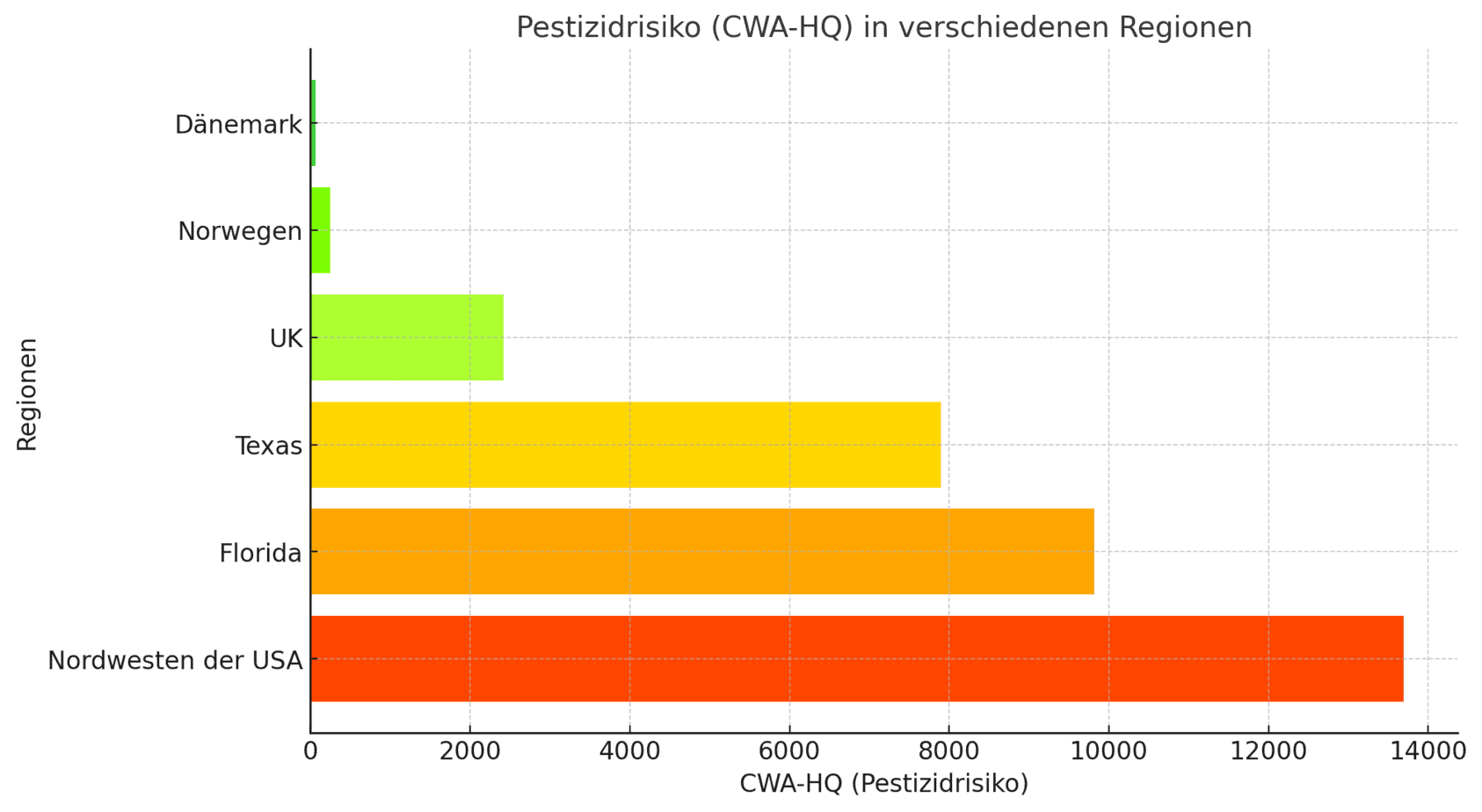
Graphische Darstellung des Pestizidrisikos in verschiedenen Ländern.

Was bedeutet das deutlich höhere Pestizidrisiko für den Golfer? Wer in wissenschaftlichen Suchmaschinen nach entsprechenden Publikationen sucht, wird enttäuscht. Neuere Untersuchungen gibt es nicht. Grundsätzlich gilt: Alle auf Golfplätzen zugelassenen Mittel werden von den nationalen Zulassungsbehörden vorab auf Gesundheitsrisiken überprüft und sind den Behörden zufolge unbedenklich. So stellt etwa die GCSAA als Verband der amerikanischen Greenkeeper fest: „Mitglieder werden nicht nur ermutigt, sondern sind gesetzlich verpflichtet, die Produktkennzeichnungen stets zu beachten. Sie verlassen sich auch auf die Empfehlungen der einschlägigen Wissenschaftler, auf staatliche und bundesstaatliche Vorschriften und auf bewährte Managementpraktiken.“ Von einer Gesundheitsgefährdung des Golfers ist also nicht auszugehen.

Pestizideinsatz und Biodiversität

Anders sieht es beim Thema Artenvielfalt auf, das für Golfanlagen mit ihren enormen Flächen bekanntlich eine große und sehr positive Rolle spielt. Zahlreiche Studien, vor allem aus der Landwirtschaft weisen auf den negativen Einfluss von Pestizidverwendung zum Beispiel auf Bestäuber hin. Aber auch im Golfsport wird eine Verbindung gezogen. So wird zum Beispiel in der Studie Can a golf course support biodiversity and ecosystem services. A landscape context matter aus dem Jahr 2019 hinterfragt, inwieweit die positiven Auswirkungen einer Golfanlage auf die Förderung der Artenvielfalt durch die negativen Folgen von Pestizideinsatz auf die Wasserqualität oder die Lebensräume der Tiere konterkariert werden. Angesichts des extrem geringen Einsatzes der Mittel in Europa stellt sich die Frage wohl kaum, angesichts der hohen Werte in den USA aber durchaus.

Was also ist die Konsequenz aus der Erkenntnis, dass freiwillige Datenabgabe offenbar ein schwieriges Thema ist. Eine Reaktion aus der Golfbranche auf die Veröffentlichung der Studie habe es eigentlich nicht gegeben, lässt Michael Bakken wissen. Er war während der Studie an der University of Wisconsin-Madison beschäftigt war, arbeitet inzwischen aber für das norwegische Institut NIBIO arbeitet. Beide waren an der Studie beteiligt und sind wissenschaftlich anerkannt.

Verpflichtung oder Freiwilligkeit? 

Wie aber kann die Golfindustrie auf das zunehmende Verlangen nach Daten aus der Öffentlichkeit und der Wissenschaft reagieren? Können Golfverbände Golfanlagen zur Herausgabe von Wasser- oder Pestizidverbrauchsdaten verpflichten? Grundsätzlich erst einmal nein. Allein gesetzgebende Behörden, also etwa die EU, die U.S. Environmental Protection Agency (EPA) in den USA oder nationale und regionale Verwaltungen sind dazu in der Lage. Auch deshalb ist etwa im dänischen Golfsport im europaweiten Vergleich die Datenlage exzellent. Hier ist die Erlaubnis der Regierung, im Golfsport – wenn auch in extrem geringem Maße – Pestizide zu verwenden, an das Reporting von Daten gebunden.

Golf in Frankreich: 67.445 Artendaten registriert

Deshalb verweist die United States Golf Association, die mit ihrer Green Section viel Schulungs- und Informationsarbeit im Bereich des Greenkeepings leistet und gleichzeitig neben dem R&A der mächtigste Golfverband der Welt ist, darauf, dass diese Macht bei der Auslieferung von Daten endet: „Die USGA ist keine Regulierungsbehörde, sondern eine Non-Profit Ausbildungsorganisation“, stellt Janeen Driscoll, Director of Brand Communications, fest. Man unterstütze Best Practice Beispiele und bemühe sich, diese möglichst breit zu verteilen. Gleiches gilt für die Golf Course Superintendent Association of America. Auf Nachfrage liefert diese allerdings auch keine Erklärung dafür, warum die Bereitwilligkeit zur freiwilligen Herausgabe anonymer Daten so gering ist.

Eine Frage der Transparenz

Bleibt damit die Verordnung von Behördenseite als letztes Mittel, um an Daten zu gelangen? Oder ist die Verhandlungsposition der Golfszene beim Austarieren von Wasser-, Dünger-, oder Pestizidgrenzen nicht viel einfacher, wenn man bereits über einen vorhandenen Satz anonymer aber aussagekräftiger Daten verfügt. Im Idealfall belegt dieser, dass der Verbrauch von Wasser, der Einsatz von chemischem Dünger oder Pestiziden auf Golfplätzen womöglich weit geringer ist, als von der Öffentlichkeit vermutet. Generell lässt sich mit einer Veröffentlichung von Daten immer ein eher positives Bild von Transparenz zeichnen.

Von dieser transparenten Herangehensweise müssen Europas und Amerikas Golfanlagen in den meisten Fällen noch überzeugt werden. Im Moment ist der Golfclub oder Golfanlagenbetreiber Herrscher über seine Daten. Er kann entscheiden, ob er sie publiziert oder nicht.  Was er nicht beeinflussen kann, ist die öffentliche Reaktion darauf: Wer Daten nicht veröffentlicht, intransparent ist, setzt sich schnell der Vermutung aus, etwas Negatives zu verheimlichen.

Konfliktthema für die Golfverbände

Die Golfverbände also sind in der Zwickmühle: Machen sie sich unbeliebt bei Golfanlagen und Golfclubs, weil sie verstärkt die freiwillige Dateneingabe von diesen einfordern? Oder vermitteln sie gegenüber nationalen oder internationalen Behörden weiter das Bild einer intransparenten Branche. Das Daten-Dilemma zwingt die Golfverbände in eine Zwickmühle. Kann man in diesem Spiel gewinnen?

Burnham & Berrow: First-Class Golf & Ökologie

Teile diesen Eintrag
  • Teilen auf Facebook
  • Teilen auf X
  • Teilen auf WhatsApp
  • Teilen auf Pinterest
  • Teilen auf LinkedIn
  • Per E-Mail teilen

INSTAGRAM

golfsustainable

Golf Sustainable is an independent news platform, founded by Petra Himmel.

🌿✨ **Bois d’Arlon – Europe’s Living Lab for Next-G 🌿✨ **Bois d’Arlon – Europe’s Living Lab for Next-Gen Golf Resorts** ✨🌿

Nestled across 220 hectares of untouched nature in Belgian Luxembourg, the Bois d’Arlon Golf & Resort is more than just a golf destination – it is emerging as a future blueprint for sustainable, high-end golf resorts in Europe.

We visited the project, which was opened in 2024, to talk with the greenkeeping team and the investor Robert Schintgen about their vision of a high-end golf resort in Wallonie, where pesticides aren't allowed, and the rules for irrigation only allowed the use of collected rainwater and recycled water from the hotel. 

With two distinct courses – a challenging 18-hole Heathland layout and a scenic 9-hole Parkland course – the resort combines **world-class design, biodiversity-rich landscapes, and year-round playability on sandy soil**. The vision blends sport and nature seamlessly, creating an immersive experience for golfers of all levels. ⛳🌱 

But Bois d’Arlon goes far beyond golf. The 4-star château hotel with 64 rooms, spa, restaurant, and event spaces positions the estate as a **fully integrated luxury ecosystem** where hospitality, wellness, and outdoor sports meet. 🏨🌳

What makes it stand out is its positioning as a future laboratory for sustainable resort development – demonstrating how modern golf destinations can evolve with nature rather than against it, while still delivering premium guest experiences.

Bois d’Arlon isn’t just a resort. It’s a model for how European golf destinations can redefine luxury through sustainability, landscape design, and long-term environmental thinking.

📍 Belgium | Luxembourg province
⛳ Golf | 🌿 Nature | 🏨 Luxury | ♻️ Sustainability

#BoisDArlon #GolfSustainable #SustainableGolf #LuxuryResort #GolfArchitecture #EcoTourism #GolfCourseDesign #SustainableTourism #FutureOfGolf #BelgiumGolf #GreenResorts #HospitalityInnovation
What happens when a golf club completely stops usi What happens when a golf club completely stops using fungicides over the winter? 🚫🍄 The result might surprise you.
With pesticide regulations tightening across Europe (including strict bans in Switzerland, France, and Belgium), the question for greenkeepers is no longer if chemical restrictions are coming, but when.

Michael Scheffold, Head Greenkeeper at GC Wörthsee (Germany), decided to do a real-world test run. This past winter, he completely dispensed with fungicides on his greens to see how they would react.

The verdict? Better than expected! Despite a little more snow mold, the greens recovered beautifully and by mid-May, they were almost as good as usual. 🌿

This success didn't happen by accident. It is the result of years of prioritizing Integrated Pest Management (IPM) and mechanical measures to build robust, naturally resilient soil and grass. Supported fully by Club Managing Director Sven Hilgenberg, GC Wörthsee is actively future-proofing its course.

Proactive greenkeeping beats waiting for the ban! 📈⛳️

Call to Actions:
🔗 Read the full case study: Tap the link in our bio to read the detailed interview on Golf Sustainable.
🎓 Learn Sustainable Management: Want to implement pesticide-free strategies at your club? Explore our advanced courses at the Golf Sustainable Akademie (Link in Bio!).
📺 Subscribe for more insights: Check out our YouTube Channel for expert talks on the future of greenkeeping and eco-friendly golf operations!

Foto: Nicolas Martin Beaumont

#GolfSustainable #SustainableGolf #Greenkeeping #GCWörthsee #PesticideFree #IntegratedPest Management #GolfCourseManagement #EcoGolf #TurfManagement #SustainableTurf #GolfManager #GolfAkademie #GolfInspiration #GolfEnvironment #SnowMold #EcoFriendlySports
🚨 What does Donald Trump's new ballroom have to do 🚨 What does Donald Trump's new ballroom have to do with the environmental problems of East Potomac Golf Links? 

A growing environmental controversy is unfolding at East Potomac Golf Links: according to reports by the New York Times and the U.S. National Park Service, thousands of cubic meters of soil and construction debris from the demolition work at the White House East Wing were deposited on the public golf course — including material reportedly contaminated with lead, chromium, pesticides, and other hazardous substances. 

The site is planned to become part of a future championship golf course redevelopment. Environmental groups and local residents, however, are raising serious concerns about potential impacts on ecosystems, waterways, and public access to one of Washington’s most historic municipal golf facilities. 

What makes the case especially sensitive: the golf course sits directly along the Potomac River and has long served as an accessible public space for golfers, walkers, and families alike. Critics warn the project could come at a high environmental and social cost. 

💬 The story is another reminder of how closely golf, urban development, and environmental responsibility are connected — and why transparency and sustainable land management matter for the future of the game.

#GolfSustainable #Sustainability #Golf #Environment #GolfCourseManagement #EnvironmentalIssues #PublicGolf #Biodiversity #WashingtonDC
Mauritius, the island in the Indian Ocean, is firs Mauritius, the island in the Indian Ocean, is first and foremost a dream destination for many golfers. For Philippe Espitalier-Noël, who, as CEO of the ER Group, is also responsible for major golf destinations such as Beachcomber and Heritage Resorts, among others, this dream destination is extreme pressure. A recent report by the World Bank Group on climate and development on the island of Mauritius entitled CCDR has prompted him to call for significant changes in the direction of tourism on the island.

Read the whole interview on https://golfsustainable.com. Link in the first comment
Follow our You Tube channel https://www.youtube.com/@golfsustainable

#mauritius #golf #golftravel #tourism #sustainabletravel
Copernicus has published the European State of the Copernicus has published the European State of the Climate Report. The golf industry must learn from data and scientific research, as outdoors sports are challenged by the resulty of climate change.
New competition for Bavarian golf clubs 🌿🦋 The 'B New competition for Bavarian golf clubs 🌿🦋

The 'Blühpakt Bayern' has launched a new competition specifically for golf clubs, that have combined a biodiversity project with a successful communication idea.  This isn't just about aesthetics; it's a critical move to boost biodiversity and protect our essential insect populations on golf. 

Golf Sustainable founder, Petra Himmel:

"This competition is a great motivator. However, the real success lies in long-term strategy and understanding ecological systems. Communication is an important part of a successful biodiversity strategy. 

All information about the enrollment in the first comment. 

#SustainableGolf #GolfSustainable #BlühpaktBayern #Biodiversity #EcologicalGolf #GolfCourseManagement #PetraHimmel #GolfAkademie #Greenkeeping #EcoFriendlySports #GolfGermany
Burgenland in Austria is now the first region to b Burgenland in Austria is now the first region to be certified with the Austrian Environmental Label.
International Day of Orchards. There are so many o International Day of Orchards. There are so many orchards and fruit trees on golf courses. As an important habitat for insects, birds and even bats, they are so much more than just a wonderful aesthetic element for our sport. 
#golf #golfsustainable #biodiversity #orachards #streuobstwiese #
#Nature #Wildlife #Birdwatching #BeeEaters #Austri #Nature #Wildlife #Birdwatching #BeeEaters #Austria #Burgenland #Biodiversity #NaturePhotography #HiddenNature #Conservation #Golf
Yes, the Masters Tournament and Augusta National G Yes, the Masters Tournament and Augusta National Golf Club are all about exclusivity. But it is important to realise that the whole town of Augusta has to agree with this concept and tradition. 

There is a huge economic value that comes with the tournament week, but there are other soft factors that secure the acceptance of The Masters in the town. 

The renovation of the municipal course at The Patch, plus the opening of The Loop at The Patch, is good news for the local community. Affordable, good golf is important to grow the game. Here, the Masters Charity Funds, First Tee of Augusta, and Augusta Technical College have teamed up to finance this important project. 
#firsttee #golf #golfsustainable #golfforeverybody #themasters #augusta #growthegame
Instagram-Beitrag 18158981992431306 Instagram-Beitrag 18158981992431306
Golf without the use of #pesticides? This is the s Golf without the use of #pesticides? This is the scenario the Swiss golfing community will face from January 2027. Due to a new classification of land use, the use of herbicides will be completely banned, whilst other plant protection products will be subject to much stricter regulations. 
The issue of #health protection is becoming increasingly important on sports grounds. This development is also relevant for golf courses in Germany and Austria. Here too, plant protection products are often the last resort in combating fungal diseases on greens.
We have talked to experts in Switzerland. The good news: some agronomists also see positive consequences arising from the regulation. 
#golf #greenkeeping #turfgrass #nopesticides #golfmanagement #golfsustainable
#golfsustainable #golf #water #golfsustainable #golf #water
#energycrisis #saveenergy #golf #greenkeeper #ada #energycrisis  #saveenergy #golf #greenkeeper #adaptation #golfclubs #golfmanagement #golfsustainable
Another inspiring story of a woman in the golf ind Another inspiring story of a woman in the golf industry

“Getting up with the sunrise and getting going, I just love it” says Elin Foyle, 24-year-old Assistant Headgreenkeeper from Golf Club Chieming in Upper Bavaria, Germany. The 24-year-old is getting to know the world with her greenkeeping job: As one of the scholarship holders of the annual FEGGA program, she was allowed to work at the renowned Kristianstad’s Golf Club in Sweden for six months with six other scholarship holders.
At the DP World Tournament Betfred British Masters at The Belfry, she stood on the course early in the morning together with the other greenkeepers and prepared it for the tournament. Her next goal in the fall is the Solheim Cup at the Bernardus Golf Resort in the Netherlands. 
Read her story: Link in comments

#golfsustainable #golfinbayern #womeningolf #turfgrass #greenkeeper #fegga #youngcareer #femalecareer #golf #scholarships
Golf has no voice without data.📊⛳️ This was the w Golf has no voice without data.📊⛳️

This was the wake-up call at the recent @FEGGA (Federation of European Golf Greenkeepers Associations) General Assembly in Portugal. 

As the pressure from EU regulations on water usage and pesticide bans grows, the message for the industry is clear: We can no longer rely on "feeling" sustainable. We have to prove it.

Why does this matter for your club?
Policy Power: As Petra Himmel reports from FEGGA meeting, transparent data sets are the only way to persuade governments to grant exemptions or support.
Quality Control: Without chemical solutions for threats like *Dollar Spot*, data-driven greenkeeping is the only way to maintain the playing surfaces we love.
Social License: In a world competing for land and resources, golf must prove its added value to society—or risk losing its place.

At Golf Sustainable, we don’t just report the news; we analyze the strategies that will define the next decade of our sport. From the Dutch "Zero Pesticide" goal by 2032 to French resource management—we bring the global perspective to your screen.

How is your club handling the data challenge? Are you tracking every drop and gram, or is the transition to digital reporting still a hurdle? Let’s discuss in the comments! 👇

🔗 Read the full FEGGA report and deep-dive analysis at golfsustainable.com (Link in Bio).

📺 More Insights: Visit our YouTube channel for exclusive interviews with industry leaders. 

#GolfSustainable #FEGGA #Greenkeeping #DataInGolf #GolfIndustry #EcoFriendlyGolf #GolfCourseManagement #FutureOfGolf
Instagram-Beitrag 18065912153650013 Instagram-Beitrag 18065912153650013
Warum Design über Kosten und Impact Deines Golfpl Warum Design  über Kosten und Impact Deines Golfplatzes entscheidet! ⛳️📐

Wusstest du, dass ein Großteil der späteren Pflegekosten und des Ressourcenverbrauchs bereits beim Design eines Golfplatzes festgelegt werden?

Ein nachhaltiges Design ist kein Luxus, sondern die Antwort auf:
💧 Wasserknappheit und Extremwetter
🐝 Artensterben
📉 Steigende Instandhaltungskosten

In der Golf Sustainable Akademie zeigt die Nachhaltigkeits-Expertin Petra Himmel, wie modernes Redesign und kluge Architektur Golfanlagen zukunftssicher machen. Das Beste: Unsere Webinare  sind kostenfrei zugänglich!

👉 Klicke unten auf „Mehr dazu“ und entdecke die Welt des nachhaltigen Golfplatzdesigns.

#GolfDesign #Golfarchitektur #Greenkeeping #GolfBusiness #Nachhaltigkeit #Golfplatz #Greenkeeper #Golf #Golfmanagement #GolfSustainable #ZukunftGolf
Design mit Weitblick: So wird dein Golfplatz zukun Design mit Weitblick: So wird dein Golfplatz zukunftssicher! ⛳️📐
Nachhaltigkeit beginnt nicht erst beim Mähen, sondern bereits am Zeichentisch. Ein kluges Golfplatzdesign ist die effektivste Waffe gegen steigende Kosten und strengere Umweltauflagen.

In der Golf Sustainable Akademie blicken wir tief in die moderne Platzarchitektur:
🌿 Wie fördern wir Biodiversität durch kluges Routing?
💧 Wie reduzieren wir den Wasserverbrauch durch strategisches Redesign?
🛠 Warum weniger gepflegte Flächen oft mehr Spielspaß bedeuten.

👉 Klicke unten auf „Mehr dazu“ und entdecke die Welt des nachhaltigen Golfplatzdesigns.
An important day for the golfing world, which will An important day for the golfing world, which will largely go unnoticed because research rarely has a big stage. Yesterday, the ITRI International Turfgrass Research Initiative, launched by STERF, USGA and R&A, officially kicked off with the first three projects on existential issues in golf: 

Why are these research topics existential? 
1️⃣ Clean Water is globally a shrinking resource. Golf courses have to reduce their consumption - and can reduce costs. There is no outdoor golf without water. 
2️⃣ If you want to keep golf a healthy sport, you have to combat dollar spot permanently without using fungicides or using only the absolute minimum. Those who lose the battle against dollar spot lose customers, members and market acceptance. Economic problems arise.
3️⃣ CO2 emissions are harmful to humanity, cause climate change, and thus create problems for golf. However, the question of how high the CO2 emissions of a golf course and its operation are cannot be answered because there is no standard calculation formula. The golf industry is unable to speak on CO2. This damages its image. A poor image is never good for business. 
#golfsustainable #turfgrass #reasarch #usga #randa #sterf #greenkeeping #dollarspot #watermanagement  #golfer #golf #golfcourse
#kidsgolf #DigitalWellbeing #Digitaldetox #golfand #kidsgolf #DigitalWellbeing #Digitaldetox #golfandnature #juniorgolf #golfsustainable
Instagram-Beitrag 18076579742102029 Instagram-Beitrag 18076579742102029
Instagram-Beitrag 18129593704521606 Instagram-Beitrag 18129593704521606
The EU Restoration Act is being implemented. The n The EU Restoration Act is being implemented. The national restoration plans in the EU countries must be completed by September 1, 2026. What does this mean for the golf industry? Might this even be a chance for golf courses to play a bigger role in national projects to renaturalize? 

Read the story: https://golfsustainable.com/en/eu-law-renaturation/

#golf #restoration #golfmanagement #biodiversity #golfsustainable #Renaturierung
Follow me!

Follow us on Facebook

Weitere News

  • Golf Resort Bois d'ArlonFoto: Golfresort Bois d'Arlon
    Bois d’Arlon: Europas Zukunftslabor für Top-Resorts23. Mai 2026 - 8:33
  • GC Kitzeberg: Machbares machen beim Thema CO221. Mai 2026 - 15:14
  • Raingear PFAS-freeFoto: Canva/AI generated
    PFAS in der Golf-Regenbekleidung: Das müssen Sie wissen19. Mai 2026 - 10:00
  • Schafe - Biodiversität zum AnfassenFoto: Märkischer GC Potsdam
    Biodiversität zum Anfassen16. Mai 2026 - 14:49
  • Greenkeeper Michal Scheffold im GC WörthseeFoto: Nicolas Martin-Beaumont
    GC Wörthsee: Ohne Fungizide durch den Winter16. Mai 2026 - 13:59

Kooperationen

© Copyright - Golf Sustainable | Website [ Bottega Design ]
  • Link zu Facebook
  • Link zu Instagram
  • Kontakt
  • Impressum
  • Datenschutzerklärung
  • Privatsphäre-Einstellungen ändern
  • Einwilligungen widerrufen
Link to: Ein Blick in die Zukunft – mit dem Wissen aus 50 Jahren Golf Link to: Ein Blick in die Zukunft – mit dem Wissen aus 50 Jahren Golf Ein Blick in die Zukunft – mit dem Wissen aus 50 Jahren GolfFotos: The Links Trust St. Andrews/ Denis Pugh Link to: LTGK: „Wir machen aus Mitwissern Mittäter“ Link to: LTGK: „Wir machen aus Mitwissern Mittäter“ LTGK: „Wir machen aus Mitwissern Mittäter“
Nach oben scrollen Nach oben scrollen Nach oben scrollen
DSGVO Cookie Consent mit Real Cookie Banner