

• Home
  • Newsletter abonnieren
  • Das Team
  • Ziele
  • Deutsch Deutsch Deutsch de
  • English English Englisch en
Golf Sustainable
  • News
    • Club-News
  • Klimawandel
  • Wasser
  • Biodiversität
  • Greenkeeping
  • Tourismus
  • Diversität
  • Weitere Themen
    • CO₂
    • Industrie & Equipment
    • Best Practice
    • Science
  • Click to open the search input field Click to open the search input field Suche
  • Menü Menü
Golfer und CO2-Fußabdruck

Tau: Unscheinbar aber gefährlich

15. September 2026

Im Herbst gehört Tau zum Alltag auf dem Golfplatz. Wenn die Temperaturen nachts sinken und die Luft feucht ist, liegt am frühen Morgen häufig ein feiner Wasserfilm auf den Gräsern. Was für Golfer zunächst nur bedeutet, dass die Schuhe nass werden und der Ball weniger weit rollt, spielt bei der Pflege der Rasenflächen eine wesentliche Rolle. Denn bleibt die Grasnarbe über viele Stunden feucht, können sich bestimmte Rasenkrankheiten leichter entwickeln. Spricht man mit Christian Spring, Principal Scientist bei der STRI Group, einem der weltweit führenden Forschungs- und Beratungsunternehmen für Golf- und Sportrasen, so erkennt man, wie komplex das Thema Tau ist und welch‘ weitreichende Folgen für die Qualität eines Golfplatzes es haben kann. Tau – so die Erkenntnis – mag harmlos aussehen – kann aber echte Probleme verursachen, wenn auf das regelmäßige Entfernen verzichtet wird.  Mit Blick auf die Personalproblematik bei so mancher Golfanlage ist genau das nämlich ein Thema – zeitintensive manuelle Aufgaben stehen zur Disposition, wenn nicht genügend Greenkeeper vorhanden sind.

Was ist Tau eigentlich?

Tau entsteht, wenn sich die Luft und insbesondere die Oberfläche der Gräser während der Nacht abkühlen. Die Feuchtigkeit aus der Luft schlägt sich als kleine Wassertropfen auf den Blättern nieder. Je nach Wetterlage kann dieser Zustand viele Stunden anhalten – typischerweise von den späten Abendstunden bis in den Vormittag. Dabei kann sich die Gesamtmenge an Tau im Spätsommer durchaus auf deutlich über 1000 Liter pro 18 Löcher ansammeln.

INSERT_STEADY_NEWSLETTER_SIGNUP_HERE

Für den Golfplatz ist Tau deshalb nicht einfach nur „ein bisschen Wasser“. Die lange Feuchtigkeit auf den Blättern verändert das Mikroklima unmittelbar an der Grasoberfläche. Gleichzeitig enthält der Belag neben kondensiertem Wasser auch Flüssigkeit, die aus den Pflanzen selbst stammt und unter anderem Zucker und Aminosäuren enthält.

Warum muss Tau entfernt werden?

Der wichtigste Grund ist die Gesundheit des Rasens. Eine dauerhaft feuchte Blattoberfläche schafft günstige Bedingungen für verschiedene Pilzkrankheiten. Besonders bekannt ist dabei Dollarspot, eine Rasenkrankheit, die sehr schnell größere Schäden auf Spielflächen anrichten kann und vor allem auf Grüns die Spielqualität massiv beeinträchtigt.

Dabei ist nicht der Tau selbst das Problem. Entscheidend ist die sogenannte Blattnässe: Je länger die Blätter ohne Unterbrechung feucht bleiben, desto günstiger können die Bedingungen für Krankheitserreger sein. Wird die Feuchtigkeit dagegen regelmäßig unterbrochen, wird dessen Entwicklung erschwert.

Das ist insbesondere im Herbst relevant. Kühle Nächte, ausreichend Feuchtigkeit und noch relativ warme Tage können Bedingungen schaffen, unter denen der Krankheitsdruck steigt. Tauentfernung ist deshalb ein Baustein, mit dem Golfanlagen versuchen können, Krankheiten möglichst früh und möglichst ohne zusätzlichen Einsatz von Pflanzenschutzmitteln unter Kontrolle zu halten.

Eine Untersuchung der Pennsylvania State University aus dem Jahr 2011 bestätigt diesen Zusammenhang. Bei den dort untersuchten Fairwayflächen führte die tägliche Tauentfernung in den Spätsommer-Versuchen zu einer deutlichen Verringerung des Dollarspot-Befalls. Gleichzeitig verlängerte sich die Schutzwirkung von Fungiziden, deren Einsatz in weiten Teilen Europas ohnehin streng reguliert ist. Die Autoren kamen außerdem zu dem Schluss, dass der positive Effekt des häufigen Mähens unter anderem darauf zurückzuführen war, dass beim Mähen gleichzeitig der Tau mechanisch von den Blättern entfernt wurde.
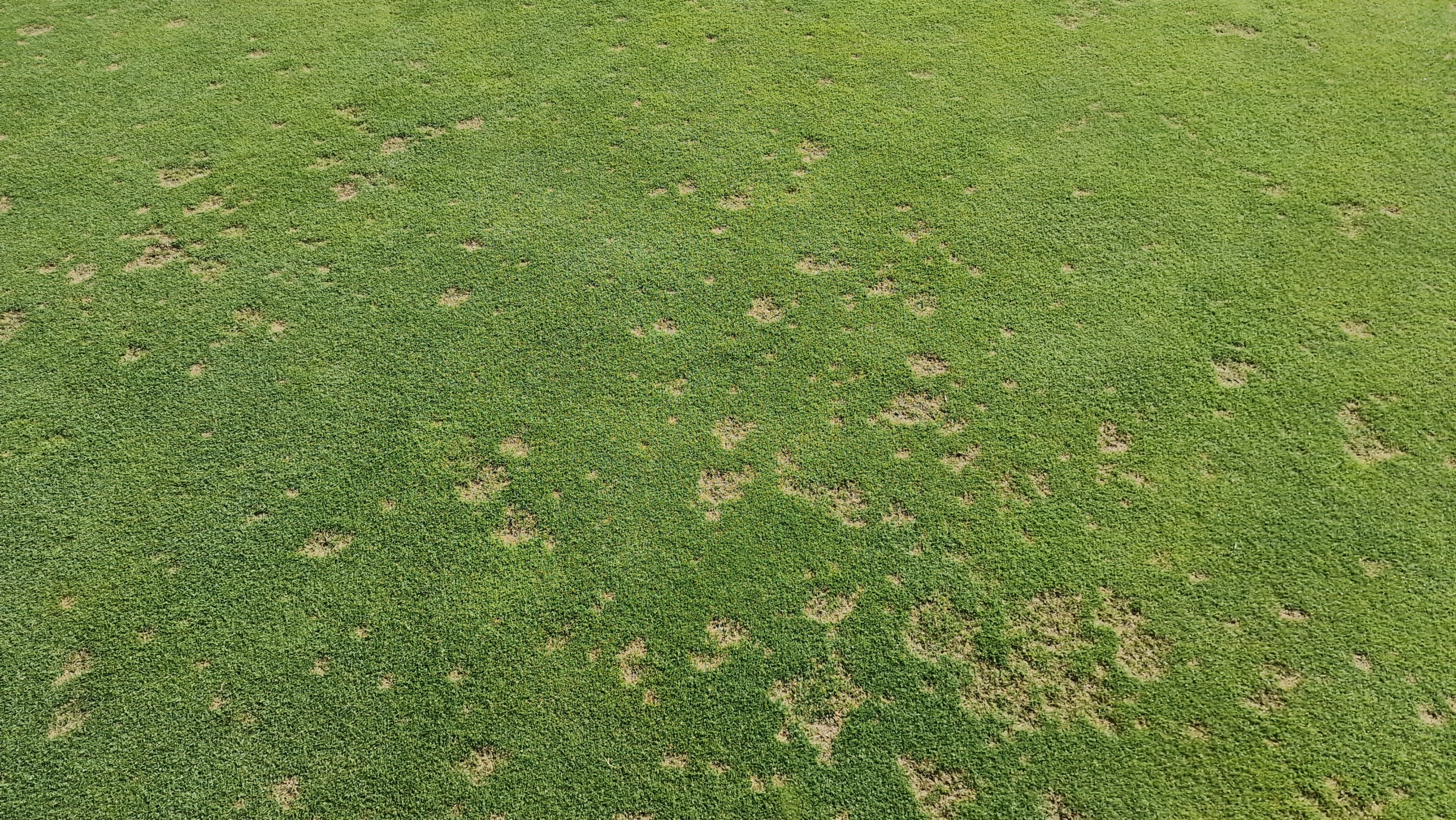
Rasen mit Dollarspot

Wie entfernt man Tau?

Die einfachste Methode ist das Mähen am frühen Morgen. Die Bewegung der Maschine entfernt dabei nicht nur einen Teil der Grasoberfläche, sondern streift gleichzeitig den Tau von den Blättern. Deshalb kann auch ein Überfahren mit ausgekuppelten Mähspindeln sinnvoll sein, wenn an diesem Tag eigentlich nicht gemäht werden soll.

Eine weitere traditionelle Methode ist das Abziehen der Fläche. Dafür können beispielsweise Schläuche, Seile, Ketten oder spezielle Netze über den Rasen gezogen werden. Auch Gummischieber oder saugfähige Materialien kommen zum Einsatz. Leichtes Walzen kann ebenfalls dazu beitragen, die Feuchtigkeit von der Grasoberfläche zu entfernen.

Entscheidend ist dabei weniger eine bestimmte Methode als der Zeitpunkt. Wird der Tau früh am Morgen entfernt, wird die lange ununterbrochene Phase der Blattnässe unterbrochen. Wartet man dagegen bis zum späten Vormittag, hat die Sonne den Tau häufig bereits weitgehend verschwinden lassen – die Phase der anhaltenden Blattnässe war dann unter Umständen bereits zu lang und hat das Aufkommen von Krankheiten gefördert. Und: Verlässt man sich ausschließlich auf das mechanische Abziehen des Taus, kann es – so der STRI-Experte Spring – auch dazu kommen, dass sich die Tautropfen neu bilden, wenn die Bedingungen dafür günstig sind.

Auch das Aufstellen von Ventilatoren an den Grünrändern kann positive Auswirkungen haben. „Ich habe bei einigen Studien selbst deren positiven Effekt gesehen“, resümiert Christian Spring. „Sie sorgen für zusätzliche Luftbewegung auf der Grasoberfläche, reduzieren die Luftfeuchtigkeit an der Oberfläche und das Risiko der Entstehung von Tautropfen.“

„Die Züchtung von Gras ist viel komplexer geworden“

Kann man Tau auch chemisch verhindern?

Ja. Auf dem Markt gibt es spezielle Tau-Dispergiermittel, häufig auf Basis von Tensiden. Sie verändern die Oberflächenspannung des Wassers. Dadurch entstehen auf den Gräsern keine zusammenhängenden Wassertropfen beziehungsweise die Feuchtigkeit verteilt sich anders auf der Oberfläche. Je nach Produkt und Bedingungen kann der Effekt mehrere Tage anhalten.

„Ich kann die positiven Effekte aus eigener Erfahrung bestätigen“, erklärt Christian Spring, der selbst an Studien zum Thema „Tauentfernung und Tau-Dispergiermittel“ beteiligt war. „Ihr Vorteil besteht darin, dass sie Schutz während der Nacht gewährleisten und dieser mehrere Tage anhält“. Spring macht aber auch klar, dass die Tau-Dispergiermittel nicht die alleine Lösung sein dürfen. „Wenn ich selbst eine hochwertige Rasenfläche managen müsste und wüsste wie anfällig diese im Herbst für Krankheiten ist, würde ich die Tau-Dispergiermittel begleitend zu meinen physischen Arbeitsmethoden in Erwägung ziehen.“

Es geht in der Praxis also darum, die verschiedenen Möglichkeiten sinnvoll miteinander zu kombinieren und den Einsatz von Produkten auf Situationen zu konzentrieren, in denen sie tatsächlich einen zusätzlichen Nutzen bringen.
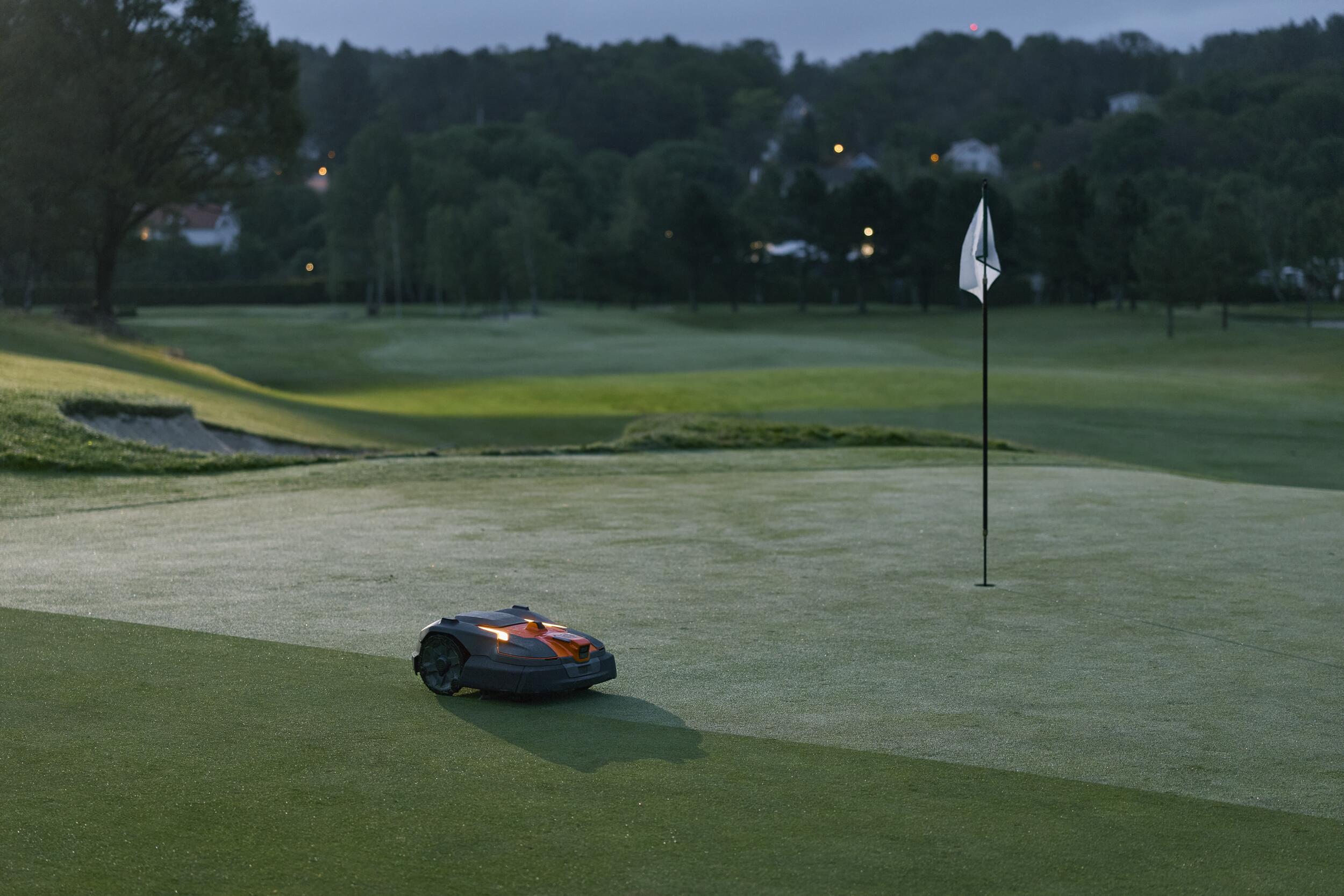
Foto: Husqvarna

Tauentfernung mit dem Roboter

Eine neue Entwicklung ist die automatisierte Tauentfernung. Denn gerade am frühen Morgen entsteht für Greenkeeping-Teams ein organisatorisches Problem: Die Zeit, in der der Tau möglichst effektiv entfernt werden sollte, fällt mit zahlreichen anderen Pflegearbeiten zusammen.

Hier setzt eine neue Variante autonomer Mähtechnik an. Der Automower 580L EPOS von Husqvarna kann mit einem speziellen Aufsatz statt mit der normalen Schneideinheit ausgestattet werden. Der Roboter fährt dann selbstständig über die definierten Flächen und entfernt den Tau mechanisch. Zwischen einzelnen Greens wird der Aufsatz angehoben, um eine Übertragung von Krankheitserregern von einer Fläche auf die nächste zu vermeiden.

Entscheidend an dieser Methode ist der Zeitgewinn: Die Maschine kann bereits in den frühen Morgenstunden arbeiten, während das Greenkeeping-Team andere Aufgaben vorbereitet oder durchführt. Gerade auf größeren Anlagen könnte eine solche Automatisierung deshalb interessant werden. Superintendents haben vor allem am Wochenende oftmals nicht genügend Personal und das mehrstündige manuelle Abziehen des Taus ist dann eine Aufgabe, die gut ersetzt werden könnte. Die Technologie des „Taumähers“ wird gerade im Rahmen eines internationalen Forschungsprojekts der International Turfgrass Research Initiative untersucht, das sich mit integrierten und möglichst umweltschonenden Strategien gegen Dollarspot beschäftigt.

Tau richtig managen

Das Fazit ist klar: Tau ist grundsätzlich ein natürlicher Bestandteil des Wasserhaushalts der Grasflächen. Problematisch wird er vor allem dann, wenn die Blätter über lange Zeit nass bleiben und gleichzeitig günstige Bedingungen für Rasenkrankheiten herrschen. Tauentfernung ist deshalb eine Maßnahme, die unverzichtbar ist. Wetterbedingungen, die Beschaffenheit der Fläche und der tatsächliche Krankheitsdruck entscheiden über die Kombination der Maßnahmen , die man dafür einsetzt.


Erlösung von Englands Rekorddürre bei Husqvarna British Masters

Teile diesen Eintrag
  • Teilen auf Facebook
  • Teilen auf X
  • Teilen auf WhatsApp
  • Teilen auf Pinterest
  • Teilen auf LinkedIn
  • Per E-Mail teilen

Neuerscheinung

INSTAGRAM

golfsustainable

Golf Sustainable is an independent news platform, founded by Petra Himmel.

💧 Let’s talk about water management! As water cons 💧 Let’s talk about water management! As water conservation becomes central to golf course design, storage ponds are playing a vital role in securing irrigation for dry periods.

But not all reservoirs are created equal. Depending on space, budget, and ecological goals, there are different ways to store water on a golf course. Here are the main variants:

⛳ 1. The on-course strategic pond
Beautiful, functional, and part of the game! These ponds are integrated into the playing areas. They serve as a strategic hazard and are visually appealing. When designed with shallow-water zones and shoreline planting, they become massive boosters for local biodiversity. 🌿🦆

🚜 2. The engineered "off-course" pond
Built out of sight, these are designed purely for function. They are typically much deeper with a smaller surface area to minimise evaporation. Because they are hidden from players, there's no need to worry about aesthetics.

☀️ 3. Covered ponds
 To stop water from evaporating in the heat, some reservoirs use floating covers like open cisterns. There are also examples for ponds with solar panels—preventing evaporation while simultaneously generating clean electricity for the club! ⚡💧

Whether for strategic gameplay, maximum storage, or clean energy, each variant has its own unique benefits and costs. Keep in mind, that each reservoir is part of the whole water management strategy of the golf club. 

Which solution fits your course best? Read the full breakdown of costs, sizes, and design strategies in our latest article! We talked to golf course designer Thomas Himmel about his recommendations for the construction process. 

Link in first comment

#GolfSustainable #WaterManagement #Greenkeeping #GolfCourseDesign #Sustainability #EcoGolf #Biodiversity #GolfCourseArchitecture #WaterConservation #FutureOfGolf
The Solheim Cup is all about empowering women in s The Solheim Cup is all about empowering women in sports,  a crucial part of social #sustainability 
🌍⛳It has grown into a global media product broadcast in over 170 countries, proving that when women are given a massive platform, they deliver unmatched passion, intensity, and teamwork. 

But this incredible event didn't just appear out of nowhere. We owe a massive debt to a female business pioneer behind the scenes,  Louise Solheim. Alongside her husband Karsten, Louise was the strategic business force behind the PING brand. Together, they guaranteed the sponsorship for the first ten Solheim Cups, laying a rock-solid foundation for the tournament's future. Louise's sharp management and business administration background showed that women in executive roles are essential to the game's growth. 

At Golf Sustainable, we celebrate the women who build the platforms for others to shine. ✨ Enjoy the Solheim Cup!

You want to read more about Female Success Stories in golf: Link to the (German) book in the first comment and in the profile. 

Fotos: Ping, Shutterstock

👇#GolfSustainable #WomenInGolf #SolheimCup #GrowTheGame #SustainableSport #InclusiveGolf #LouiseSolheim#Ping #golf #frauengolf
What does an inclusive golf club really look like? What does an inclusive golf club really look like?

It starts with more than accessible facilities. At Haxterpark in Paderborn, inclusion is part of the club’s DNA – on the course, in the workplace and in everyday club life.

Bunkers are designed to remain a sporting challenge while being accessible to wheelchair users. The course and facilities are designed around accessibility. But perhaps even more importantly, people with disabilities are not simply welcomed as golfers – they are colleagues.

Haxterpark operates as an inclusion business, with people with and without disabilities working side by side in golf administration, greenkeeping, gastronomy and service.

Rafa Lawah is a powerful example. She joined Haxterpark as an employee and discovered golf through her work. Today, she plays regularly and competes internationally.

That is what inclusion can look like when a golf club takes responsibility beyond the tee box: creating a place where people can work, play and participate – without their disability defining their role.

Inclusion is not a special programme. It is about designing the club so that more people can be part of it.

Link for full story in first comment. 

#GolfSustainable #InclusiveGolf #GolfForAll #Inclusion #AccessibleGolf #GolfAndSociety #SustainableGolf #GolfClub #paragolf 

Fotos: Rafa Lawah, Hardt
Learn more about the future of water & golf with o Learn more about the future of water & golf with our four-part webinar series. Water has been a hot topic across the European golfing world. Our new four-part series, ‘Golf & Water’ (in German with subtitles), provides board members, golf managers, association officials and indeed all amateur golfers with a straightforward overview of the topic of #irrigation. Together with the experts from Toro Germany and GC St. Leon-Rot, we aim to ensure that awareness of this issue increases amongst non-greenkeepers within the industry.

Anyone wishing to secure the future of a golf course must give serious consideration to irrigation. Only those with the necessary knowledge can make the right decisions. We look forward to welcoming everyone who wishes to treat themselves to a little further training with the help of these four free webinars.

👉 Golf & Water: Introduction https://www.youtube.com/watch?v=HPpf4Bnaytg
👉 Golf & Water: Technical basics of irrigation
https://www.youtube.com/watch?v=JQ8uVj5rcps
👉 Golf & Water: Most important irrigation tips
https://www.youtube.com/watch?v=Z3_7oZ5tYmg
👉 Golf & Water: https://www.youtube.com/watch?v=q43u0eK5ezE 

👉 Mehr insights: Golf Sustainable Akademie: https://golfsustainable.com/golf-sustainable-akademie/

#golf #education #water #irrigation #golfmanagement #TheFutureOfGolf #golfmanagement #golfclub #golf #golfer #golfdeutschland #greenkeeper #wasser #bewässerung
The end and the beginning: Heavy rain at the Husqv The end and the beginning: Heavy rain at the Husqvarna British Masters marks the end of England's extreme drought and the start of a transformation in the Hashtag#golf industry's use of water. But golf clubs have realised this summer - sustainable, efficient water management is necessary for a quality course. We talked to Jim Croxton from British & International Golf Greenkeepers Association (BIGGA) about the learnings of this summer. 

The Belfry Hotel & Resort is a positive example of a forward-thinking approach to irrigation. Most of the water for the Brabazon Course is reclaimed water from the hotel. Prioritising watered areas also saves water, carbon emissions, and money.

Conclusion: There are ways to transform golf in a positive way when it comes to the use of water as one of our most important resources. Hopefully every member of a committee or board has learned that this year. 

Full article: https://golfsustainable.com/en/england-drought-british-masters/
#golf #watermanagement#golfsustainable #dpworldtour #husqvarnabritishmasters #thebelfry #greenkeeping #golfer #water #irrigationsystem
How climate-friendly is a golf course – really? 🌍⛳ How climate-friendly is a golf course – really? 🌍⛳

Golf courses can store carbon in their soils. But they also generate CO₂ emissions through mowing, irrigation, energy use and maintenance.

So what is the actual balance?

A new international research initiative is tackling this question. The ITRI “Pathways to a Climate-Positive Future for Golf” project, supported by STERF, The R&A and the USGA, aims to develop a globally applicable methodology for measuring both CO₂ sequestration and emissions on golf courses.

Researcher Robert Kempster of NIBIO explains why this matters: without reliable data, golf clubs cannot know where their emissions come from – or where reductions will have the greatest impact.

Climate, grass species, irrigation, energy sources and even previous land use can all influence the carbon balance of a golf course.

The goal is not simply to make golf courses more resilient to climate change. It is to understand and reduce the emissions that contribute to it.

The key question for golf is no longer just: How do we adapt?
It is also: How much CO₂ do we emit – and how can we reduce it?

Read the full interview with Robert Kempster on Golf Sustainable

Foto: Robert Kempster

#GolfSustainable #GolfAndClimate #CO2 #CarbonEmissions #CarbonFootprint #ClimatePositive #ClimateAction #SustainableGolf #GolfCourses ##Freen#GolfCourseManagement #GolfIndustry #CarbonSequestration #GolfAndNature #Sustainability #ClimateChange #STERF #TheRA #USGA #NIBIO #ITRI
It’s time to talk about #carbon emissions. The sum It’s time to talk about #carbon emissions.
The summer of 2026  was dominated by two words: #adaptation and #resilience. But focusing only on adaptation and resilience misses the root of the problem.

Without reducing #CO₂ and other greenhouse gas emissions — including those generated by the golf industry itself — the costs of adaptation and resilience will continue to rise.

1⃣ At international management, greenkeeping, and golf travel conferences, carbon emissions have received little attention over the last two years.

2⃣ At the golf facility level very few lighthouse projects have begun active ESG reporting and are working toward a net-zero target.

3⃣ In professional golf, the picture is still limited. LIV Golf measures and reports its carbon emissions, as does the WM Phoenix Open. The DP World Tour has calculated emissions for eight events and its headquarters, including Rolex Series events, and has committed to achieving net-zero carbon emissions by 2040.

4⃣ In golf equipment, carbon footprints still play only a very limited role in corporate communication and public reporting.

5⃣ And in science, research into the carbon emissions and carbon balance of golf course management remains relatively scarce and fragmented. Earlier studies have examined greenhouse gas emissions from turf management and the energy and carbon footprint of golf course maintenance. But the international evidence base is still limited.

📍 Conclusion:
Carbon emissions are currently receiving far less attention within the golf industry than they need to if golf wants to establish itself as a credible contributor to climate action and environmental protection.

⛳ Let’s talk about carbon emissions:
Starting next week, Golf Sustainable will report on the people, projects, institutions, and companies pushing this issue forward.

We’ll start with an interview with Robert Kempster of NIBIO Norwegian Institute of Bioeconomy Research, Principal Investigator of “Pathways to a climate-positive future for golf.”

It’s time to talk about carbon. If you are driving the topic, send me a DM. 

#golf #golfmanagement #climatechange #lesscarbon #netzero #greenkeeping #golfsustainable #golfer
🌳 Did you know that perfectly healthy-looking tree 🌳 Did you know that perfectly healthy-looking trees can suddenly drop large branches? It’s called "Summer Branch Drop" , and it's a growing safety issue on golf courses. ⚠️

Record temperatures and long droughts are putting massive stress on trees. But why do healthy branches fall?
☀️ Due to severe heat and a lack of water, the cell pressure inside the tree drops.
📉 This causes the internal tension that stabilises the branches to suddenly disappear.
🔥 Additionally, the breaking strength of wood significantly decreases as temperatures rise.

The tricky part is that these branches can snap completely unexpectedly, even when they are totally healthy and their crowns are full of green leaves. This poses a major safety risk for golfers who might be standing underneath them seeking shade.

**How golf clubs are responding & how you can stay safe:**

* Golf clubs are working closely with arborists and tree experts to conduct regular, detailed tree inspections to ensure player safety.
* Always pay attention to warning signals like sudden cracking or unusual noises coming from the canopy.
* Avoid lingering under trees during extreme heat and prolonged dry spells.
* Pay attention to course communications—some clubs are actively warning members via their websites or may even temporarily close the course during dangerous wind conditions.

Stay safe out on the fairways and respect course warnings! 🏌️‍♂️⛳ Have you ever witnessed a sudden branch drop on your home course? Let us know in the comments! 👇
Images: Frankfurter GC

#GolfSustainable #SummerBranchDrop #Grünastbruch #Greenkeeping #GolfCourseMaintenance #TreeCare #GolfSafety #ClimateChange #SustainableGolf
Heat can be deadly. Precautions against extreme he Heat can be deadly. Precautions against extreme heat on golf courses are essential, as summers are getting hotter because of climate change. This mist shower, situated in a central position at Golf & Country Club de Bossey in France, is a wonderful idea - and extremely refreshing. 
#golf #heat #golfmanagement #golfsustainable #golfinfrance
It is during crises that it becomes clear where th It is during crises that it becomes clear where the problems lie. The current heatwave and drought are putting golf courses in Central Europe to the test in terms of irrigation management and infrastructure. One thing is clear: the ‘champions’ are those golf courses that have long been investing in modern infrastructure for water collection and irrigation, whilst also taking a strategic approach to site selection, education and new grasses.

Nevertheless, this picture shows that there is still room for improvement to ensure that precisely such a scenario – automatic standard irrigation during rain and hail – does not occur. We spoke to five experts and asked them for their tips on improving irrigation.
Full article on our website https://golfsustainable.com, and the link is in the first comment. 
#greenkeeping #golfsustainable #golf #golfmanagement #sustainablefuture
The AIG Women's Open at Royal Lytham & St. Annes G The AIG Women's Open at Royal Lytham & St. Annes Golf Club demonstrates what top tournament conditions are. Depending on the dry and hot weather the course is presented with hard, fast and running fairways.
A home for reptiles – and so much more. 🦎🌿 Health A home for reptiles – and so much more. 🦎🌿

Healthy ecosystems are built on habitat diversity. At Golf Club St. Leon-Rot, this carefully designed reptile habitat demonstrates how golf courses can provide valuable refuges for wildlife.

Combining natural stone, deadwood and open sandy ground, the site offers ideal conditions for reptiles such as lizards. The stones absorb and retain heat, while the deadwood and crevices provide shelter, nesting opportunities and safe places to overwinter.

These seemingly simple structures also benefit a wide range of insects and other small animals, making them an important part of a connected, biodiverse landscape.

Creating habitats like this is a powerful reminder that sustainable golf course management goes far beyond maintaining playing surfaces—it means making space for nature to thrive.

🌱 Every habitat counts. Every species matters.

#GolfSustainable #GolfAndNature #Biodiversity #ReptileHabitat #NaturePositive #Sustainability #WildlifeConservation #HabitatCreation #GolfCourseManagement #Ecology #StLeonRot
With temperatures reaching 33 degrees, the golf in With temperatures reaching 33 degrees, the golf industry in Central Europe is breaking a sweat. Extreme heat is directly linked to two other issues: customer service and occupational safety. We wanted to know from experts on the subject of heat how this works. Tom Rourke, General Manager at The Els Club in Dubai, deals with extreme heat on a daily basis. He can list a whole range of services that are part of everyday life at The Els Club in Dubai.

1. Early start times as early as 6 a.m. to take advantage of the most pleasant temperatures.
2. Extend the clubhouse’s hours so that breakfast and coffee are available before the first tee time.
3. Additional drinking water and hydration stations throughout the facility.
4. Golf carts equipped with coolers and ice to keep drinks cold throughout the round.
5. USB ports on the golf carts that can be used to power portable fans.
6. Chilled towels provide a small but effective way to cool off during the round.
7. Free ice cream or fresh snacks to cool off quickly.
8. More shaded areas and places to relax, especially at the halfway houses and on the terraces.
9. Player assistants or beverage carts that actively deliver chilled drinks and refreshments onto the course.
#golfindubai #troongolf #golfsustainable #extremeheat #customerservice #golf #golfmanagement #elsclubdubai #dubaigolf 

Fotos: The Els Club Dubai
A crazy idea? Maybe. But now it is a global instit A crazy idea? Maybe. But now it is a global institution in golf: The Amundi Evian Championship

32 years ago, the idea seemed almost impossible. A small Ladies European Tour event on the shores of Lake Geneva. Most industry experts believed the project would fail. Instead, it became one of the greatest success stories in global sports as one of the five majors in women's golf. 

1️⃣ A long-term vision instead of short-term returns
From the very beginning, the ambition was to create a tournament that would still matter decades later. 

2️⃣ Putting athletes before the event
Many tournaments are designed around sponsors. Evian was designed around the players. Exceptional hospitality, attention to every detail, support for caddies, coaches and media created a tournament family. 

3️⃣ Excellence is found in the details
The Amundi Evian Championship is famous for its spectacular setting. Every element contributes to one coherent experience. 

4️⃣ Investing in women's sport before it became fashionable
Long before gender equality became mainstream, Riboud and Bungert believed in the commercial and sporting potential of women's golf. The arrival of Amundi as title partner accelerated that commitment. Prize money has grown from US$4.5 million in 2021 to US$9.1 million in 2026.

5️⃣ Building an ecosystem, not just a tournament
The road to Evian begins long before players reach the major. The Amundi Evian Kids Cup and Juniors Cup introduce the world's best young golfers to the venue.  Haeran Ryu is the perfect example. She won the Evian Juniors Cup in 2015. Eleven years later, she returned to set a new women's major championship scoring record with a brilliant 60 before lifting the trophy. Childhood dreams are connected with professional success.

For me The Amundi Evian Championship has become much more than a golf tournament. It demonstrates what is possible when leadership is guided by vision, consistency, excellence and genuine belief in women.

📷  Philippe Millereau
#Golf #WomensGolf #Leadership #SportsBusiness #SportsMarketing #EventManagement #WomenInSport #Diversity #BrandBuilding #GolfSustainable
⚡️ Can a world-class golf tournament run without d ⚡️ Can a world-class golf tournament run without diesel? The 2026 Genesis Scottish Open is proving that it can.

The DP World Tour is taking one of its biggest steps yet towards decarbonising tournament operations by replacing conventional diesel-powered infrastructure with an integrated renewable energy system at The Renaissance Club.

Here's how it works:

🔋 Two 250 kWh Green Hydrogen Power Units (HPUs), each equipped with an integrated Battery Energy Storage System (BESS), form the heart of the tournament's new energy infrastructure. Positioned between the 1st and 15th holes, they provide reliable power for one of the busiest areas of the championship site.

📺 The hydrogen units supply electricity for the hospitality facilities around the 15th hole, the Genesis Public Lounge, the merchandise area and the large LED video screens—critical infrastructure that has traditionally relied on diesel generators.

☀️ For the first time, the Fan Village's main stage and the merchandise shop are powered entirely by solar energy, demonstrating how temporary event infrastructure can successfully transition to renewable electricity.

🔋 The integrated battery storage balances demand peaks, stores excess renewable energy and ensures a stable electricity supply throughout the tournament while reducing the need for backup generators.

🌍 The impact is measurable:
• Approximately 16,200 kg of CO₂e are saved compared with a conventional diesel-powered energy system.
• Even compared with the tournament's 2025 setup, emissions are expected to be reduced by around 600 kg CO₂e.
• At the point of use, green hydrogen produces zero carbon emissions—its only by-product is water.

The Genesis Scottish Open is demonstrating that renewable energy is no longer a concept for the future—it is ready to power major international sporting events today. 
Foto: DP World Tour

#GolfSustainable #GenesisScottishOpen #DPWorldTour #GreenHydrogen #HydrogenPower #BatteryStorage #SolarEnergy #RenewableEnergy #Decarbonisation #SportsSustainability #ClimateAction #NetZero #Innovation #VisitScotland #GolfIndustry #FutureOfGolf
From groundwater to reclaimed water: Since July 8, From groundwater to reclaimed water: Since July 8, the Evian Golf Resort has been completely self-sufficient when it comes to water management. 

Through a partnership with Danone’s Evian bottling plant, treated industrial water is pumped via a five-kilometer pipeline to the Golf Academy and the golf resort, where it is used for irrigation. 

“We made this decision 18 months ago,” explains Franck Riboud, Honorary President of the Danone Group, which also owns the Evian Golf Resort. “We wanted freedom, and now we have it.” When Riboud speaks of freedom, he is referring to the increasingly strict French regulations governing the use of groundwater for irrigating sports fields. 

By installing a completely closed-loop system—which ensures full self-sufficiency for the golf courses—the golf club is no longer dependent on government regulations.

Fotos: The Amundi Evian Championship /Philippe Millereau, Petra Himmel
#amundi #evian #eviangolfresort #amundievianchampionship #lpga #let #professionalgolf #golfsustainable #SustainableGolf #watermanagement #greenkeeping #golf #golfer #womeningolf #resilience #innovation #water

The overall project is called “REUT” (Réutilisation des Eaux Usées Traitées)
At the Amundi Evian Championship meadows create ha At the Amundi Evian Championship meadows create habitats for insects between the playing area. This is the backdrop of hole No. 18.
This is history: A winner's cheque worth 1,950.000 This is history: A winner's cheque worth 1,950.0000 US dollars for Hae-Ran Ryu. The KPMG Women's PGA Championship has made a statement: Equal pay and gender equality are relevant topics in golf. 

Yes, there are still differences between the payouts for male and female golfers, but especially at the Majors, the gaps are closing. The KPMG Women's PGA Championship is the most recent striking example.

🔹 For the 2026 season, the prize money for the KPMG Women's PGA Championship has surged to $13.1 million. For context, the purse was just $10.4 million in 2025.

🔹 Narrowing the Divide: The men's PGA Championship currently sits at $20.5 million. While a gap still exists, it is shrinking at a record pace. At $13.1 million, the pay gap has been reduced to approximately 1.56x.

🔹 Equality by Exception: Unlike the regular tour, where the structural gap remains wider, these Majors are closing the gap massively.  The Amundi Evian Championship has also increased the prize money to $ 9,1 million. 

#Golf #KPMGWomensPGA #PGAChampionship #SportsBusiness #EqualPay #Leadership #LPGA #GenderEquality #womeningolf #femalegolfer #golf #prizemoney #golfsustainable

Foto: Scott Taetsch/PGA of America

#Golf #KPMGWomensPGA #PGAChampionship #SportsBusiness #EqualPay #Leadership #LPGA #GenderEquality
Prepared for extreme heat? Here’s what’s really ha Prepared for extreme heat? Here’s what’s really happening out here - some personal impressions from the last days in Munich: 

🤣 During my fitting session, the portable TrackMan keeps breaking down. At one point, we’re cooling it down with a wet towel just to get through. Poor thing. 

😉 The early morning round starts at 6:30. The temperature is perfect, and the course is surprisingly busy. But once you finish, don’t expect coffee—like always, the club restaurant doesn’t open until ten.

😅 Wednesday’s tournament? The organisers wisely moved the start-up to 11 am instead of noon. That hour makes really all the difference in beating the heat.

🙁 The club secretary’s phone won’t stop ringing with buggy requests. The only snag: most of the clubs don't have enough buggies to go around.

😩 Water stations on the course are another story. On most courses, you only find a refill station after nine holes. If you want more, you’d better pack an extra bottle or two. 

Conclusion: Extreme heat isn't just a health issue but also a management question. Clubs in cooler countries, which aren't used to heat,  have to adapt to different playing times and consumer needs in the future.
 Yes: This is also a business opportunity. 

📷 Generated by AI

#golf #golfmanagement #transformation #adaptation #extremeheat #golfer #golfinglife #golfclub #extremeheat #golfplatz
What happens when world-class links golf meets a p What happens when world-class links golf meets a perfectly closed ecological cycle? 🌿⛳️🌊

At Prince’s Golf Club on the Kent coast, they aren't just maintaining a stunning 27-hole Open Qualifying course—they are developing new dune habitats. 

Course Manager Aaron Launchbury and his team excavate and reuse sand directly from the site. By removing invasive species, they create moist microhabitats in the winter and nutrient-poor havens in the summer. The result? An ecosystem where 100 of their 134 hectares are reserved entirely for nature, welcoming rare orchids and specialized wildlife. 🌸🦅

👉 Link in the first comment: Read the full story on Golf Sustainable!
📺 Watch the breakdown: Head over to our YouTube channel for more expert insights on the future of sustainable golf, and make sure to subscribe!
Fotos: Prince's Golf Club, Petra Himmel
#golfinengland #linksgolf #greatgolfcourses #golfsustainable #sustainablegolf #naturalengland #golfandnature #golf #golfclub #golftravel
Is your golf course ready for the climate of tomor Is your golf course ready for the climate of tomorrow? 🌡️⛳️ TV weather expert Karsten Schwanke shares a clear forecast – and concrete solutions.

In an exclusive interview with leading sustainability consultant and golf strategist Petra Himmel, Schwanke breaks down exactly what changing weather patterns mean for the sport. With 2027 projected to be the hottest year on record globally, the DACH region needs to prepare for a Mediterranean climate: significantly drier summers, more intense thunderstorms, and much higher evaporation rates.

For regions like the Berlin area , which are already experiencing enormous drought stress, it is high time to act. Schwanke strongly warns against letting drainage water simply flow into the sewage system – calling it the "greatest sin." Instead, clubs need intelligent water retention strategies, fully in the spirit of the Sponge City concept, to capture heavy winter rainfall in storage ponds for the dry months. Furthermore, we must protect existing, often older tree populations from unprecedented heat.

The good news? The solutions for climate adaptation are already here; we just need to implement them much faster. 🌍💧

Read the full interview on Golf Sustainable to find out how to future-proof your course. Link in bio! 🔗

Foto: Ralf Wilschewski

#GolfSustainable #ClimateAdaptation #WaterManagement #SpongeCity #Greenkeeping #SustainableGolf #KarstenSchwanke #FutureOfGolf #GolfCourseManagement #GolfStrategy
Get on your bike for the Solheim Cup 😃 With fewer Get on your bike for the Solheim Cup 😃

With fewer than 90 days to go until the 2026 Solheim Cup, European PING Junior Solheim Cup Captain and Solheim Cup Vice Captain Anne van Dam completed the fan cycle route today in The Netherlands.

The Dutch star is back on home soil this week for the Dutch Ladies Open on the Ladies European Tour (LET) taking place at Goyer Golf & Country Club .
Get on your bike for the Solheim Cup

Van  Dam cycled from ’s-Hertogenbosch (known as Den Bosch) station to Bernardus Golf alongside Eva-Lotta Strömlid, Head of Client Partnerships at the LET, to replicate the scenic 9km route that fans will be completing in September.

Van Dam said: “As we get closer to the 2026 Solheim Cup, it’s great to be back in the Netherlands this week and to visit Bernardus. Cycling is such a key part of Dutch culture, I love being on my bike and I hope fans will take the option to cycle to Bernardus from Den Bosch station. It’s going to be an unforgettable week, and I can’t wait to have you all there with us.”

This journey is also a follow-up ride to the Road to Bernardus, which saw Strömlid complete a 1,000km journey from her home in Sweden to Bernardus Golf to mark one year until the 2026 Solheim Cup and showcase smarter eco-friendly travel options, as part of the LET Sustainability Initiative (LETSI).

#sustainabletravel #golfsustainable #SustainableGolf #SolheimCup #Bernardus #fantravel #sustainableevents
🏌️‍♀️ Elite Sports and Climate Action – An Unsolva 🏌️‍♀️ Elite Sports and Climate Action – An Unsolvable Conflict? 🌍

"I see myself as a bridge builder," says German professional golfer Celina Sattelkau in her new interview with Golf Sustainable. As an EcoAthlete she proves that high-performance golf and environmental awareness don't have to be a contradiction. 🌱

From offsetting her travel emissions through wind power projects in India to driving an EV on the Ladies European Tour – Celina is leading the way. But she also addresses the hard truth: our sport is already feeling the massive impacts of climate change, particularly through extreme weather. We simply can't afford to ignore this topic!

👉 Read the full, in-depth interview with fascinating insights now on golfsustainable.com! (Link in Bio 🔗)

Fotos: LET / Tristan Jones 

#GolfSustainable #NachhaltigkeitimSport #GolfundNatur #SustainableGolf #WomeninGolf #Frauengolf #Wassermanagement
Which golf club knows its carbon footprint? In gen Which golf club knows its carbon footprint? In general, the topic of the golf industry's carbon footprint is difficult, as there are few published numbers and only a few event hosts, federations, or tour officials have developed strategies to reduce their emissions. 

GC Kitzeberg in Germany is a well-known but not very big club whose board members decided to act positively: They commissioned a report from a credible external consultancy, realised that "we have to become better," and started working on the first projects. Buying some new electric mowers is one of the steps. Communication with the membership was important, but successful. 

The journey isn't finished; many projects remain for the future. But what we like is the commitment to improve. Good luck for the next steps. 
#golf #greenkeeping #golfer #co2 #carbonemissions
Follow me!

Follow us on Facebook

Weitere News

  • Fotos: Petra Himmel/GC Würzburg
    Bayern nach dem Extremsommer: Resilienz ist wichtig11. September 2026 - 10:00
  • Speicherteich - GC Hetzenhof - Bau - Golf Sustainable - Foto GC Hetzenhof
    Speicherteich: Die wichtigsten Fakten9. September 2026 - 11:23
  • Rafa Lawah beim Handisport Mallorca Open 2025. Golf lernte sie erst kennen, nachdem sie im Haxterpark zu arbeiten begonnen hatte. Foto: © Rafa LawahFoto: Rafa Lawah
    Wenn Handicap keine Rolle mehr spielt4. September 2026 - 9:44
  • Golf & Wasser: Das müssen Sie wissen1. September 2026 - 10:25
  • Golf & Wasser: Technische Grundlagen der Beregnung1. September 2026 - 10:24

Kooperationen

© Copyright - Golf Sustainable | Website [ Bottega Design ]
  • Link zu Facebook
  • Link zu Instagram
  • Kontakt
  • Impressum
  • Datenschutzerklärung
  • Privatsphäre-Einstellungen ändern
  • Einwilligungen widerrufen
Link to: Bayern nach dem Extremsommer: Resilienz ist wichtig Link to: Bayern nach dem Extremsommer: Resilienz ist wichtig Bayern nach dem Extremsommer: Resilienz ist wichtigFotos: Petra Himmel/GC Würzburg
Nach oben scrollen Nach oben scrollen Nach oben scrollen
DSGVO Cookie Consent mit Real Cookie Banner