
First Golf Biodivers results in Escheburg and Wulfsmühle
Golf Biodivers is entering the second half of the six-year project phase. The Wulfsmühle golf course and GC Escheburg are among the 16 project participants where standardized enhancement measures were carried out along forest edges or in rough areas on three hectares as part of the nationwide Golf Biodivers 2023 research project. Following initial monitoring at the start of the project, a second survey will now determine whether the enhancement measures were successful in increasing biodiversity.
Each golf course has its own special characteristics in terms of landscape, soil, vegetation and microclimate. While the GC Escheburg, on largely flat terrain, is particularly notable for its extremely large number of bends, the proximity to the floodplain of the River Pinnau is a special feature of the Wulfsmühle golf course.
The seeds for the Golf Biodivers project were specially tailored for each golf course. Following a comprehensive analysis of the area, a team from Kiel University, one of four universities involved in the research project, also defined the exact measures for both golf courses.
The initial results of the fauna and flora survey are already clear ahead of the second monitoring, which is due to take place at the Wulfsmühle golf course this year and at GC Escheburg in 2027. In Escheburg, for example, the wild bee species “small bellflower scissor bee” (Chelostoma campanularum) has been identified. As the name suggests, this tiny bee specializes in bluebells and nests in holes in dead wood, for example. In addition, according to doctoral student Pia Tappe, “at least 29 bird species suspected of breeding on the golf course and 15 other species that breed either on the golf course or in the immediate vicinity were identified. Most of them are typical residential, field and forest bird species. The yellowhammer, for example, is a bird that breeds in meadows and fields structured with hedges and bends and therefore certainly benefits from the bend structure on the golf course.”
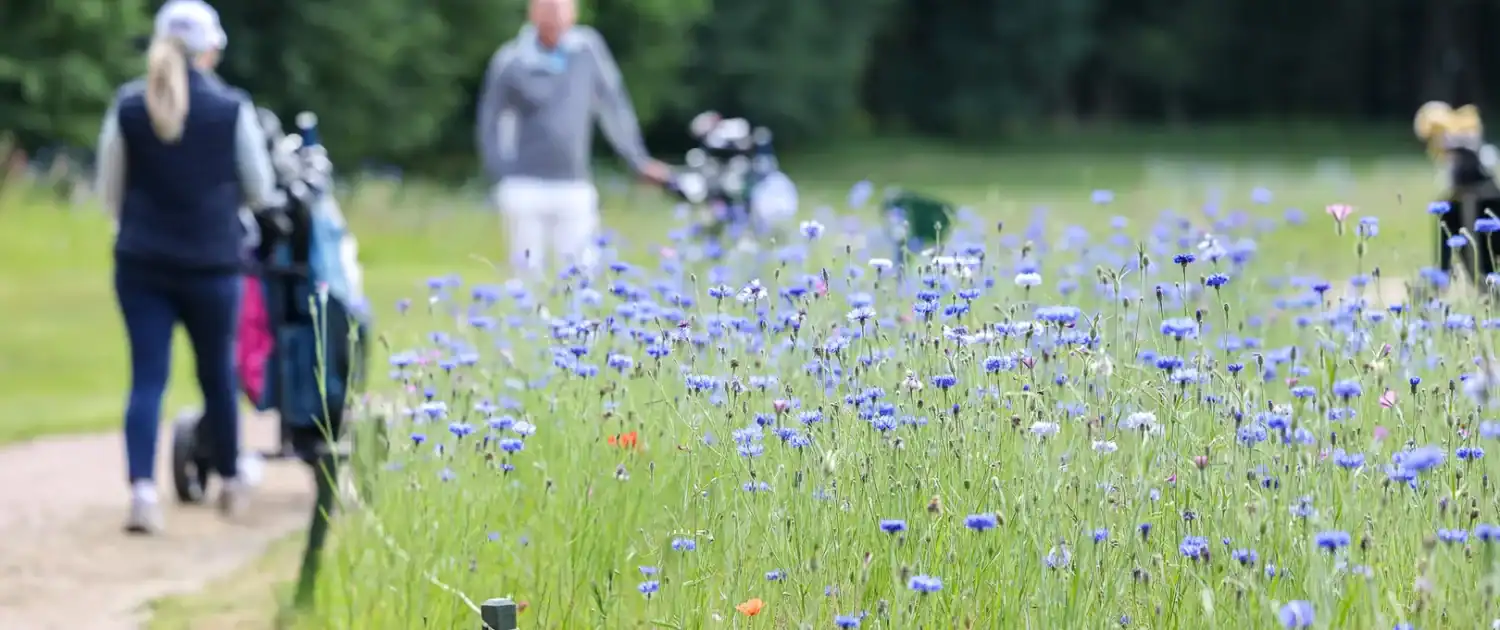
This means that GC Escheburg, Germany’s golf course with the most bends, now has proof of its successful nature conservation work. Ideally, the second monitoring in 2027 will result in an increase in species diversity. After all, the three-year enhancement phase on the areas lies between the two reports. This includes, above all, improved mowing of the meadows.
Waterfowl at Gut Wulfsmühle
The evaluation of the first monitoring for the Gut Wulfsmühle golf course alone identified 51 bird species that are highly likely to breed on the golf course or in the immediate vicinity. These included – unsurprisingly for Pia Tappe from Kiel University – a number of inland water birds such as the mallard and coot.
Of particular interest to many golfers in Wulfsmühle is the evidence of the kingfisher, which is more spectacular than many other Central European bird species due to its bright colors. The Pinnau river, which runs across the golf course and has drop-off edges as a possible breeding ground, provides a suitable habitat for this bird.
The second monitoring will definitely be exciting for the golf course operators. After all, both the Wulfsmühle and Escheburg golf courses have dispensed with intensive maintenance of the enhancement area thanks to their participation in the Golf Biodivers research project, which is being carried out by the German Golf Association in cooperation with the four universities in Kiel, Freiburg, Münster and Munich. According to Christina Druve, operator of the Wulfsmühle, one or two flower strips between the fairways have been criticized by golfers who had problems with a straight trajectory. However, this has not impressed Druve, who has long been committed to reconciling golf with environmental protection: “The golf course has already gained visually from the project.”