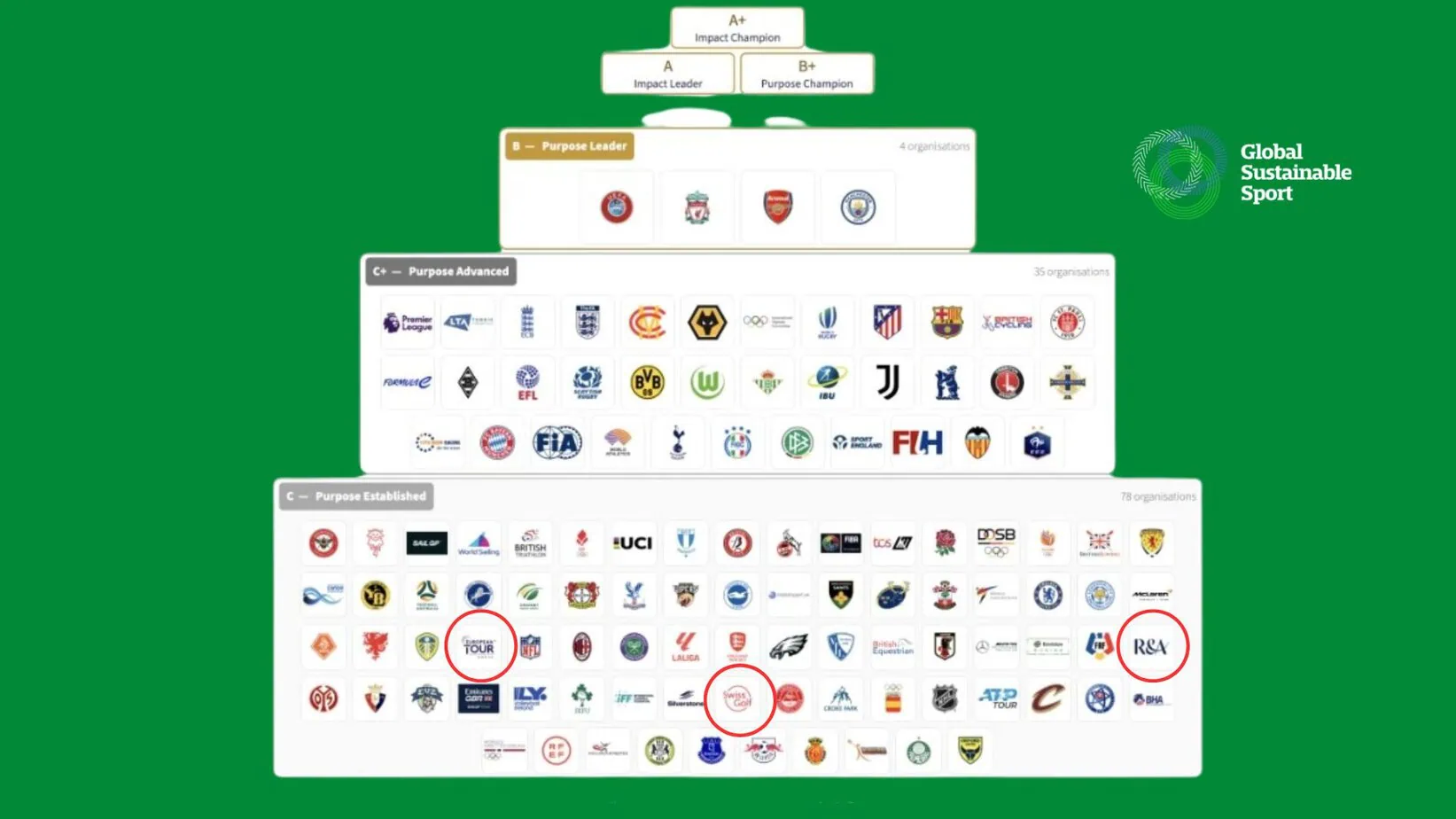
More than 50 leading international golf associations and professional tours have been evaluated as part of a new AI-powered sustainability assessment by Global Sustainable Sport (GSS), for which an initial interim report is now available. To cut to the chase: Within the golf industry , the DP World Tour, the R&A, and Swiss Golf have performed the best so far. Compared to other sports, however, the golf industry is only moderately represented overall. “There are four teams on the B podium—UEFA, Liverpool, Arsenal, and Manchester City,” explains GSS founder Mike Laflin. “These are currently the four leading organizations. There are no golf organizations in this group.” The same applies to Group C+. There are 38 sports organizations, but no golf. In Group C, which currently consists of 5 out of a total of 93 golf organizations, Swiss Golf tops the list at No. 84, followed by the R&A at No. 94. Currently, of the 135 organizations that have made it onto the “Purpose Podiums,” 5 are from golf, which represents less than 4 percent.”
The results are surprising even within the golf industry: While some golf associations rank among the world’s best in terms of social engagement, partnerships, and working with people, there is significant room for improvement in other areas—particularly the environment, governance, and communication.
However, when looking at the results, it is crucial to note that the evaluation did not focus primarily on how sustainably a sports federation actually operates, but rather on how comprehensively and transparently it documents and communicates its activities to the public. In the opinion of GSS founder Mike Laflin, however, this point is particularly important: “Sports federations must raise awareness of this issue among their athletes and fans; accessible documentation and communication play a key role in this.”
With the new GSS SPI Assessment Program, Global Sustainable Sport has developed an assessment approach that takes a much broader view of sustainability in sports than the traditional focus on climate and environmental protection. While the program is based on the United Nations Sustainable Development Goals (SDGs), these goals have been adapted to a sports-specific context. The assessment covers all areas in which sports organizations can have a social, environmental, and economic impact—from promoting physical activity to biodiversity and climate protection, as well as governance, economic responsibility, communication, and stakeholder dialogue.
“We want to know how sustainable, purposeful, and effective a sports organization is across all areas of sustainability—not just from an environmental perspective,” explains Laflin. “It’s a holistic look at the impact of sports.”
More than 150 indicators and 6,500 search terms
The process is based entirely on publicly available information. The AI automatically scans an organization’s websites, sustainability reports, strategy papers, and other published documents in a total of 134 languages. In doing so, the system searches for more than 6,500 keywords that identify statements regarding sustainability and social impact.
The content is then evaluated based on more than 150 weighted indicators. For each indicator, the system assesses three stages of development:
- Awareness: Is the organization aware of a sustainability issue?
- Active: Are specific measures being implemented?
- Impact: Are results measured and reported transparently?
Only when all three levels can be verified does the rating increase significantly. The AI uses this data to generate a detailed analysis, which can exceed 500 pages for large organizations. Each report also undergoes human quality control.
What makes this special is that it requires virtually no additional work on the part of the organizations being evaluated. All analyses are based exclusively on previously published material. However, this also means that the results depend directly on the quality and completeness of public communications. Missing information on websites or in reports has a correspondingly negative impact on the evaluation—even if measures have already been implemented internally.
Seven Pillars Instead of a Pure Environmental Assessment
The focus is on seven pillars of sustainability in sports: partnerships, participation, people, the environment, governance, communication, and economic performance. This sets the methodology apart from traditional ESG or environmental rankings.
“We hope this will lead to the establishment of a new way of evaluating sports, one that focuses on the SPI rather than media rights and viewership ratings—in other words, one that takes into account purpose, profit, and visibility.” The long-term goal is to guide sports organisations through a four-stage development journey by 2030, progressing from “Starter” through “Sustainable” and “Purposeful” to the highest category, “Impactful.” According to GSS, more than 5,000 sports organisations have already been analysed over the past three years, and over 3,000 detailed assessments have been conducted. So far, no organisation has reached the highest rating level.
Swiss Golf: The Leading National Association
The first interim report on golf compared international federations, tours, and national golf associations.
The European Tour Group tops the overall rankings with an SPI index of 4.62, followed by The R&A (4.46) and Swiss Golf (4.36). Next in line are England Golf, the International Golf Federation, the Finnish Golf Union, the Danish Golf Union, and the PGA Tour. With an SPI score of 2.80, the German Golf Association ranks 15th among the golf organisations evaluated and, as the second-largest European association, ranks 403rd among all sports organisations surveyed, while England, as the largest federation, ranks 123rd, and Swiss Golf ranks 103rd. Both federations have had a sustainability strategy in place for years and are actively implementing it through concrete projects.
It is interesting to take a closer look at the individual pillars of sustainability. Among the golf organisations surveyed, Swiss Golf ranks first in the area of Participation and is also among the leading organisations in Partnerships, Governance, and Economic Sustainability. The R&A leads the categories of Partnerships, People, and Prosperity. The European Tour Group achieves top scores in the areas of Planet and Profile. In the area of Governance (Power), the International Golf Federation ranks first.
The Austrian Golf Association’s results are also noteworthy. While Austria ranks only in the middle of the overall standings, the association ranks third in the “Participation” category and fourth in the “People” category. In the environmental category, however, it does not rank among the top five organizations. This underscores the holistic nature of the study: Strong performance in individual sustainability dimensions cannot fully compensate for shortcomings in other areas.
Communication Is Becoming a Competitive Advantage
The interim report makes it clear that, in the future, sustainability will no longer be measured solely by environmental measures. Social impact, economic responsibility, good governance, and transparent communication will be just as important.
The latter aspect, in particular, is likely to pose a challenge for many associations. This is because the analysis evaluates only publicly documented activities. Sustainability must therefore not only be implemented but also communicated in a transparent manner. The first GSS interim report is thus intended less as a final judgment on an organization’s actual sustainability performance and more as a snapshot of its publicly verifiable activities—and as a starting point for continuous improvement through 2030. At the end of the year, GSS will present its first final report. It will be interesting to see what further shifts occur by then.
After all, the Ladies European Tour—which, through its Ambassador Program, actively promotes sustainability to the public—is not yet included in the list, as the final evaluation is still pending. One thing is clear: the program is not a 100 percent AI-driven analysis. In the end, Mike Laflin and his team review the evaluations himself to check for anomalies or unexpected deviations.
However, when it comes to golf as a whole, the initial results reflect reality in many ways. For years, the DP World Tour has been actively involved in strong initiatives—particularly at Rolex events—in the areas of mobility, energy, and CO2 tracking. The R&A has long since become a key pioneer in sustainability strategies and, since the launch of Course 2030, has emphasized the importance of developing such strategies. Finally, Swiss Golf—though a small association—declared sustainability a priority area under the leadership of President Reto Bieler. The AI has now recognized this effort.