“We are in a problematic situation, but we are trying to get back into a position in front of the train and not be overrun.” Alexander De Vries, sustainability advisor to the Dutch Golf Association, is open about the current state of golf in his home country. “Golf is growing – but the number of courses is decreasing.” The fact that, despite an increase in golfers by around 32,000 players in the past five years to a total of around 440,000 people, the number of golf courses has stagnated at around 250 is mainly due to the fact that, in this relatively small European country, the issue of land use is causing problems for golf. Golf courses on municipal land, in particular, are increasingly facing the fact that leases are not being extended because the land is being used instead for housing construction, infrastructure, solar plants, or retention areas.
Progressive sustainability strategy published
The Dutch Golf Association is now responding with a progressive sustainability strategy that aims to better position golf within society and in the political arena in the long term. “We are trying to fundamentally shift the approach away from ‘we take everything from the planet’. Instead, we are focusing on an approach that sees people, and therefore golfers, as an integral part of the ecosystem and as its supporter.”
In concrete terms, this means an ambitious plan for the association’s sustainability goals:
- Water consumption on golf courses is to be reduced by 30% within five years.
- The use of pesticides is to be reduced to zero by 2023.
- Measures to promote biodiversity must be improved.
- Accessibility for golf courses is to be improved.
- The aim is for as many plants as possible to seek GEO certification.
- The CO2 footprint of golf in the Netherlands is to be reduced.
Anyone looking at these goals may ask themselves why the Dutch sustainability concept even goes beyond the legal requirements in some areas – such as the ban on pesticides. According to Alexander de Vries and his colleague Jannes Landkroon, who visited many of the golf courses, the reasons are clear.
“There is a lot of pressure on golf in the Netherlands. Pressure from the climate, nature and the image of golf.”
- Climate change manifests as extreme drought, flooding, severe storms, and an increasing risk of fire, which impacts sport and land use in the Netherlands.
- Biodiversity: According to De Vries, the Netherlands has one of the worst biodiversity scores in the world. This includes a 76% decline in insect populations over 27 years. Golf courses face the challenge of helping to reverse this trend.
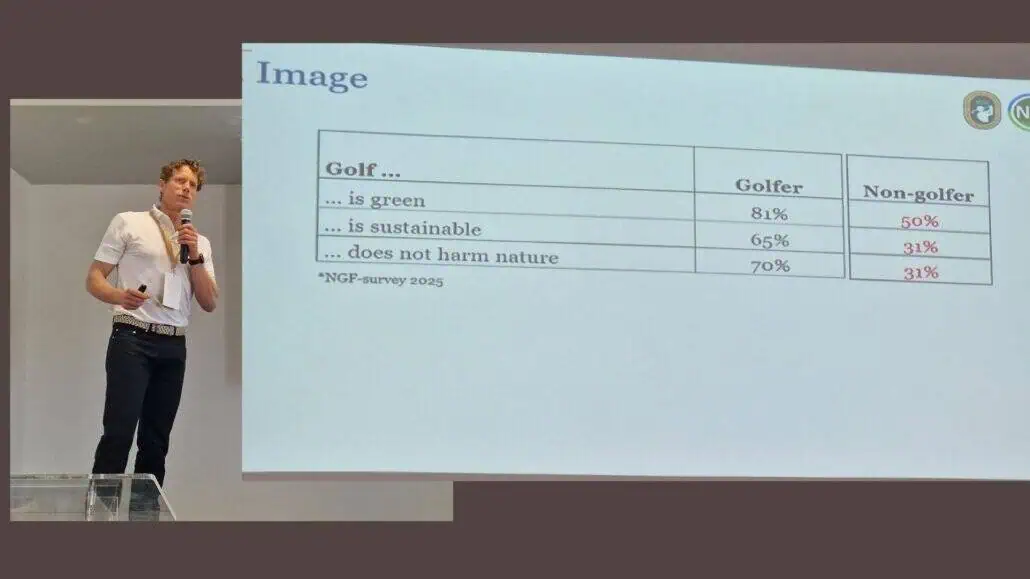
- Image: While golfers perceive the sport as natural and sustainable, two-thirds of non-golfers consider it unsustainable. This negative public sentiment leads to pressure from activists and public criticism.
The Dutch Golf Association’s sustainability team has already begun implementing the strategy, even though it had to be published earlier than planned. The pressure from the public and the authorities had simply become too great to wait any longer, according to the sustainability experts. They are having good experiences with their projects in the local clubs.
The first events, where golf clubs closed individual parts of the golf course for a day and instead opened them to the general public with family activities and information about golf, “were surprisingly well received and the club members were also fully behind them,” summarizes Jannes Landkroon. In his experience, many golf courses are also stepping up their efforts when it comes to biodiversity.
The Dutch Golf Association has given the issue very high priority and supports golf courses across the board. “We try to help with scientific research, advice, financial support and best practice cases,” explains de Vries.
However, like many other European golf associations, the challenge here is to provide reliable data on the consumption of water and pesticides as well as biodiverse areas. A national platform is now to be developed for this purpose. At the same time, the association is becoming more involved in the field of research and is making use of its links to Scandinavia in particular, where two recognized research institutions, NIBIO and STERF, are located.
With all these activities, the Dutch Golf Association is setting a new pace in terms of sustainability strategy. “We hope that we can inspire other golf associations,” says de Vries. Otherwise, he fears, the pressure on golf could soon become too great there too.