

It’s about pressure, mandatory laws, data and communication. In short, there is a lot going on in the European greenkeeping sector. At least that is the impression of the observer leaving the FEGGA General Assembly in Faro, Portugal, after two days, which brought together all European greenkeeping associations.
Greenkeeper associations take a back seat in many European golfing nations, and their importance is often underestimated. The fact is that this professional group has a decisive influence on many aspects of a golf course: the course’s quality, the use of resources such as water and energy, and even the use of pesticides. A picture of the mood in the industry, therefore, tells us a lot about the state of the golf industry as a whole.
Data at the centre of the discussion
The topic of data collection, regardless of whether it concerns the consumption of water, pesticides or fertilisers, is causing a stir because owners or managers of golf courses often refuse to provide information about their consumption. The question of how to overcome this resistance is now a concern for all European golf institutions. “The greenkeeper associations must set the pace here,” urges FEGGA President Joel Nunes, referring to his colleagues’ own experiences in Portugal, which has been struggling with water shortages for years. “The discussion about water has become much calmer and more transparent” since the golf industry’s consumption data was presented.
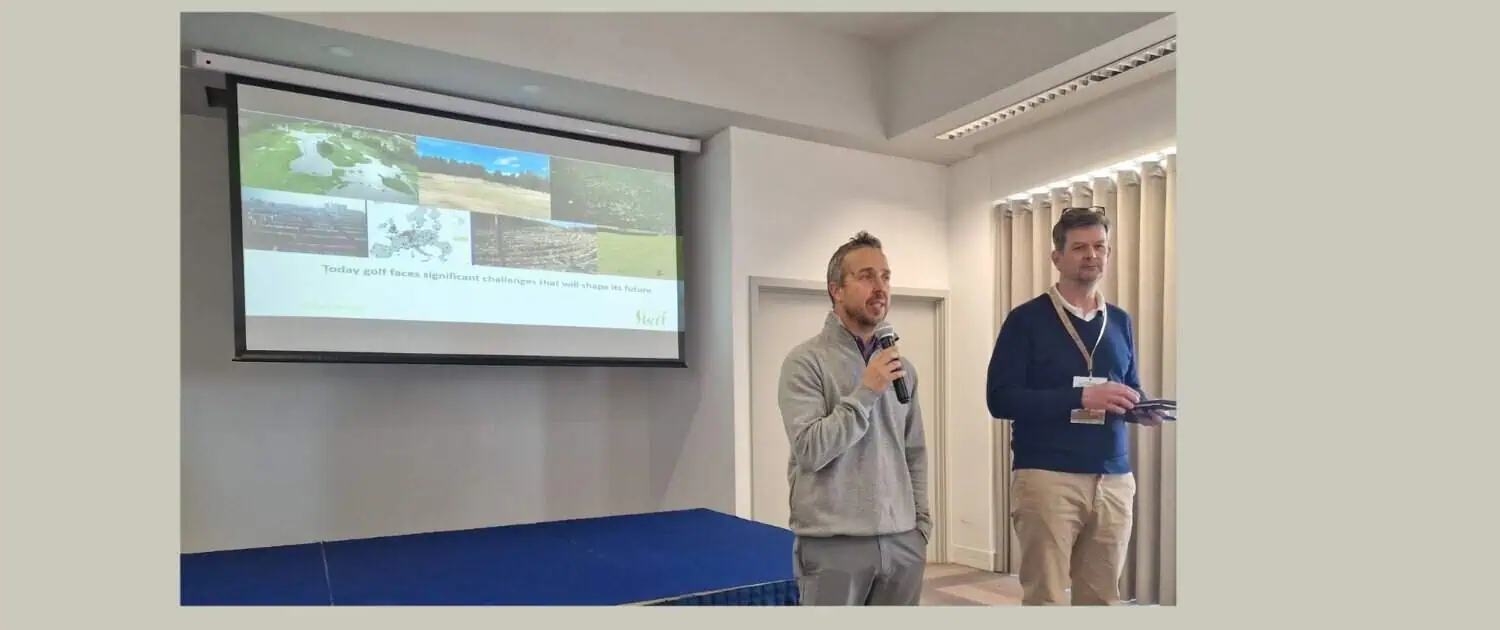
Across Europe, however, the greenkeeping sector is faced with a “patchwork quilt” of regional and national regulations, whether for water consumption or pesticide use. Many greenkeepers would welcome uniform, EU-wide standards for data delivery in order to compensate for competitive disadvantages – after all, regions with pesticide bans suffer from competitive pressure from neighbours that still have exemptions.
Dollar spot stubbornly remains the number one disease threat for which no non-chemical treatments are currently available on the market. Maria Strandberg, Director of Research at the Scandinavian Institute STERF, pointed to the increased research efforts of STERF, R&A and USGA, but emphasised that knowledge in this area is becoming outdated extremely quickly: “What we learned three years ago may no longer be relevant today. We need to continuously acquire new knowledge.” Research is becoming an essential element for golf associations.
At least when it comes to the dollar spot, the discussion makes it clear that the fungus has the golf industry under control. Practical examples from Wallonia in Belgium and other regions that have completely abandoned the use of pesticides also show that completely pesticide-free work on golf courses requires a high level of knowledge, preparation and commitment. If a ban on pesticides comes up against an unprepared golf industry, there is a risk of a massive ban on the quality of the courses.
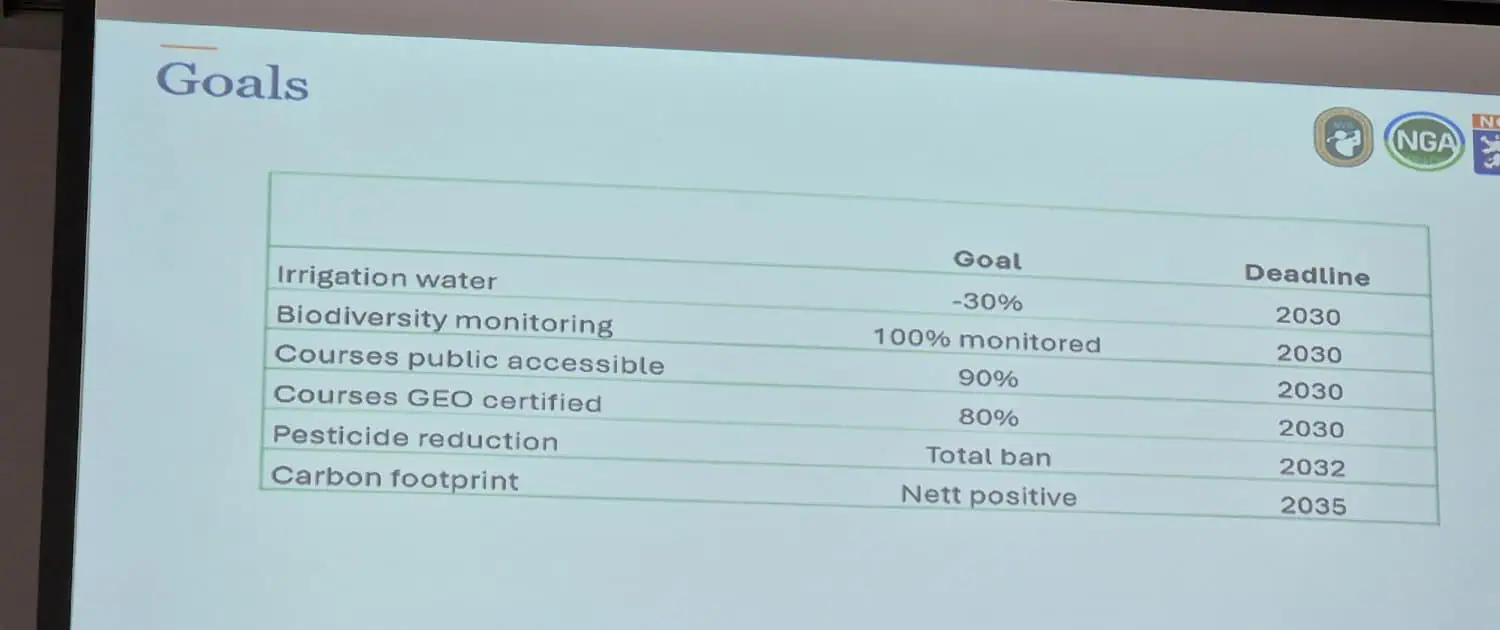
As part of its current sustainability strategy, the Dutch Golf Association has now decided to completely phase out the use of pesticides by 2032. Not because the government is demanding it, “but because the use of pesticides damages the entire image of the golf industry”, as Alexander de Vries, responsible for sustainability in the association, emphasises. But the country’s golf industry cannot afford that. Golf courses now have to make way for housing and infrastructure projects; competition for land is fierce. In this environment, the Dutch golf industry has to prove its added value for society. “Otherwise,” says de Vries, more golf clubs may close.
A look at Europe as a whole shows this: Only in countries with clear concepts, binding guidelines and a good database will the starting position of the golf industry improve. According to Rémy Dorbeau, President of the French Greenkeepers’ Association and Director of the RDGI, responsible for the complete transformation of all French grass sports, France has at least found a transitional solution for managing resources and pesticides. But Dorbeau also makes it clear that only complete and transparent data sets have persuaded the French government to give in.
EGA’s role is strengthened
In view of the complexity of the tasks, many greenkeeper organisations are turning their attention to Lausanne, the headquarters of the European Golf Association. The once rather insignificant association, which focused on the organisation of European amateur tournaments, has become a central figure in the European golf industry with the EU laws on pesticides and re-naturalisation. The EGA is also currently working with association representatives and experts on various committees and working groups to find solutions to the data collection issue. Even at the EU level, the golf industry can only argue its case to the authorities if it has sufficient data.
Agreeing on the approach to data is “not an easy process, we are more at the strategic level here,” Jonathan Smith made clear on behalf of the EGA. And the requirements and needs of the individual golf nations differ completely. However, previous experience dealing with the authorities in Brussels has shown that clear documentation and reports from the EGA on the state of the European golf industry are certainly taken into account.
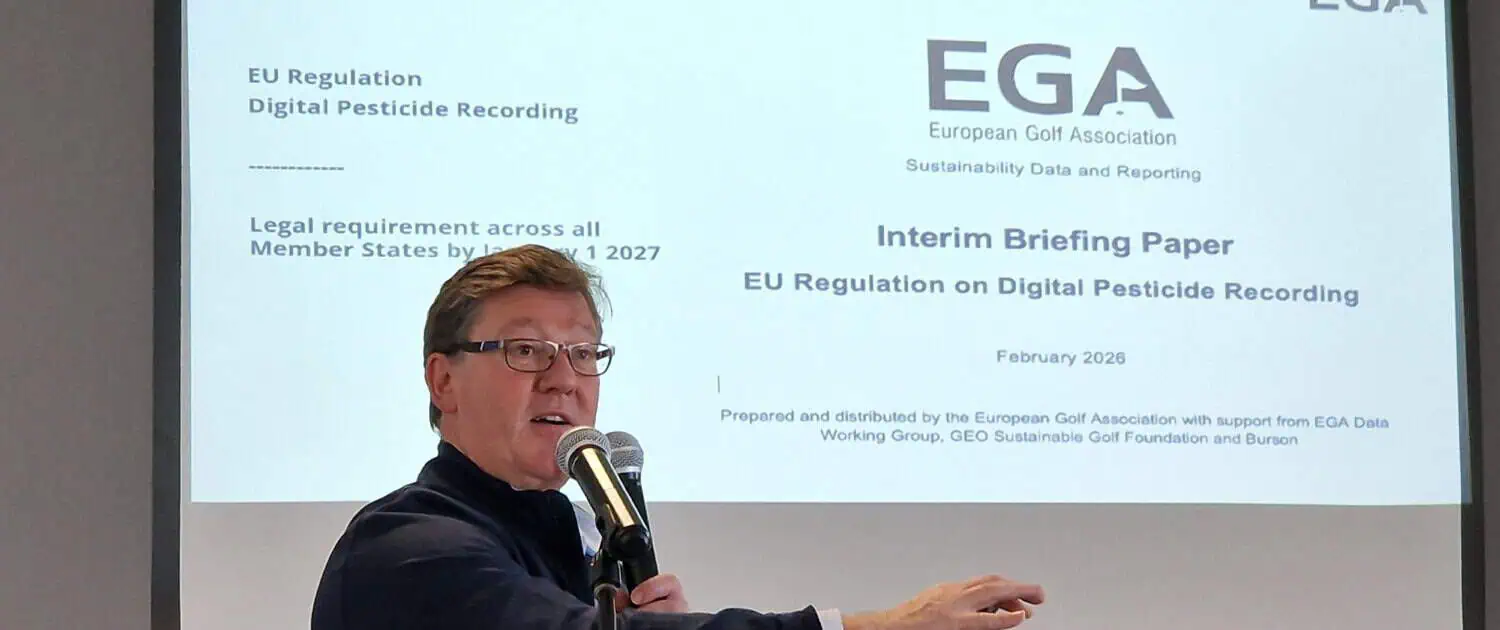
“You have a voice, so use it,” said John Kemp, Assistant Director for Sustainable Development at the R&A, calling on the chairmen of the European greenkeeper associations to get involved in this process. “There is no way around the provision of data,” said Martin Nilsson, who leads the discussions in the EGA and with the EU on behalf of the FEGGA, summing up his experiences with Brussels. “Unfortunately, pressure helps at this point,” is his assessment. In the end, only fixed obligations may deliver good reporting. “Then everyone knows that they can’t get by.”
Regulation or voluntariness – this fundamental question affects Europe’s legislation on so many levels. But anyone who followed the mood at the FEGGA conference closely will have noticed that there is a growing awareness, at least among the greenkeeper associations, that there is no alternative to the mandatory submission of data on water consumption and pesticide use, for example, in order to enable proper dealings with the EU, national and regional authorities in the long term.