

Better CO₂ footprint for golf trips
The carbon footprint of golf trips varies greatly per person depending on the destination, the type of arrival and departure and the choice of accommodation. If you travel to the nearest state or a neighboring state by car, the CO₂ balance accounts for a relatively small proportion of the overall balance. For long-distance destinations, on the other hand, the journey to and from the destination accounts for the largest part and the carbon footprint quickly becomes much larger.
According to tour operators, carbon footprint issues are not yet having a noticeable impact on travel behavior. The golfer has a desire to play courses he does not know yet. On the other hand, air travel doesn’t have the best reputation when it comes to CO₂ emissions, and the Gulf cruise isn’t really a gift for the environment either. On the other hand, even small measures can save emissions. A 5-star hotel with large rooms, spa and fitness room has a significantly higher footprint than a guesthouse or vacation apartment.
Seefeld or Mauritius?
An overview with practical examples calculated with four different starting points (Munich, Hamburg, Vienna, Zurich) and three destinations (Seefeld in Tyrol, Mallorca and Mauritius) using the TU Graz CO2 calculator. This is the only one of all calculations known to us that also contains a round of golf as a value. Unfortunately, Graz University of Technology did not respond to several inquiries as to the exact points that make up the value for this round of golf.
The results of the trips to different destinations are broken down into five categories (arrival and departure, local mobility, accommodation, meals and golf).
Arrival and departure
Two examples illustrate very well how different arrivals and departures affect CO₂ values:
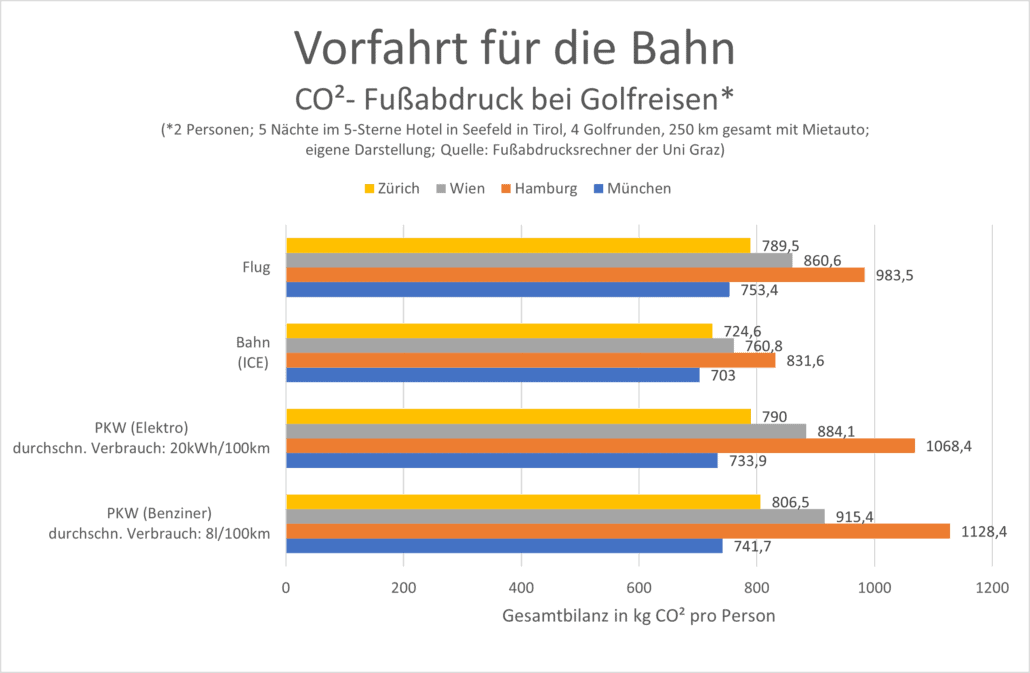
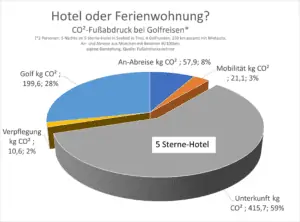
Emissions from a five-day vacation for two people: Travel by car (petrol) from Vienna to Seefeld. Five nights in a 5-star hotel and four rounds of golf per person. Within the city, 50 km are covered daily. Footprint per person: 915.4 kg CO₂ (accommodation 415.7 kg, meals 10.6 kg, golf 199.6 kg, outward and return journey 231.6 kg and local mobility 57.9 kg)
The same journey on the ICE from Vienna to Seefeld produces more than half the emissions of the first example (just under 45 percent).
In some of the selected examples, air travel has higher emission values than other means of transportation, but not always necessarily. After measuring the air line between the starting airport and the nearest destination airport plus transfer to the golf course for further distances, the total kilometers for arrival and departure can sometimes be significantly less than the distance by car (for example, a total of 400 km less from Hamburg to Seefeld and back).
More luxury in the hotel means more emissions
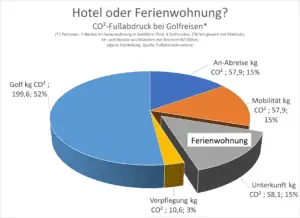
It becomes even more CO₂-friendly if you swap the 5-star hotel for a vacation apartment: five nights in the vacation apartment and four rounds of golf per person: 50 km are covered daily in a rental car in the city. Footprint per person: 403.2 kg CO₂ (accommodation 58.1 kg, catering 10.6 kg, golf 199.6 kg, travel to and from the event 77 kg and mobility on site 57.9 kg)
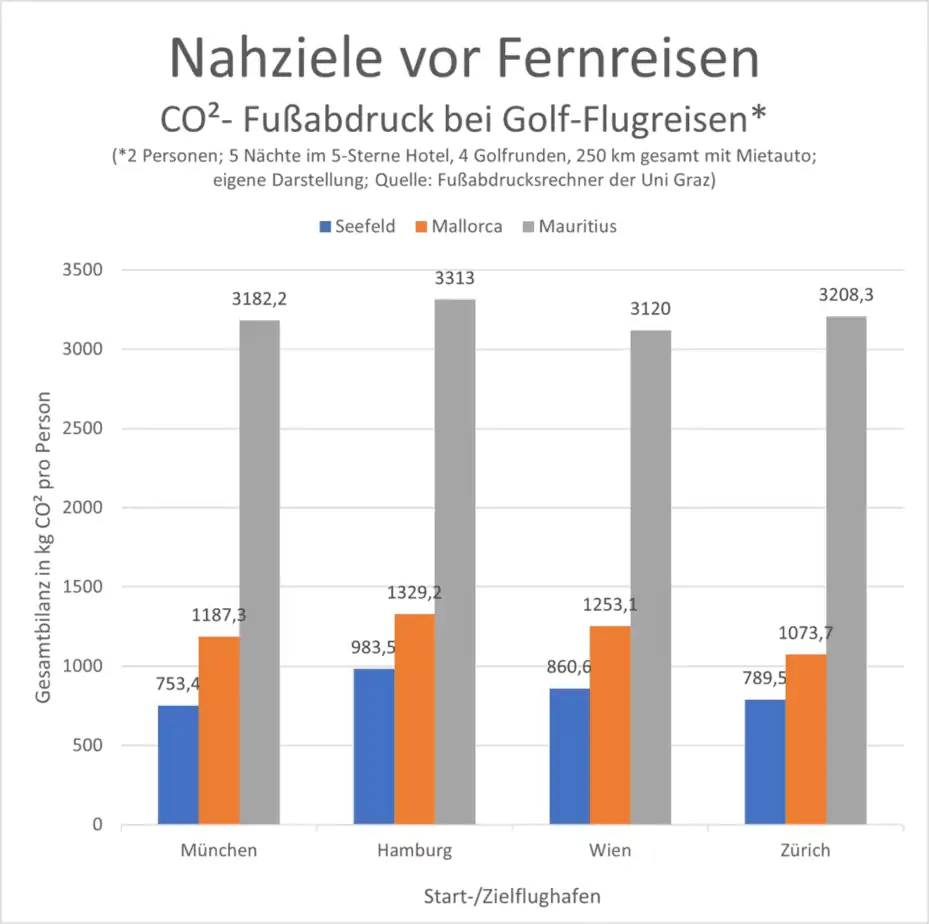
In the case of nearby travel destinations, travel to and from the destination by car accounts for between six percent (Munich; 44.5 kg) and 39 percent (Hamburg; 444.6 kg) of the overall balance, depending on the starting point. The greater the distance, the greater this proportion becomes. For trips to Majorca, this proportion is still less than half (between 36 and 49 percent; 390 – 645 kg), but for air travel to Mauritius, this category clearly has the highest proportion, between 70 and 72 percent (2,282 kg to 2,386 kg). For long-haul destinations such as Mauritius, the total weight per person increases rapidly (between 3,120 kg and 3,313 kg)
Accommodation and meals
The type of accommodation also plays an important role, as the following example illustrates.
Flight from Vienna to Palma de Mallorca. Five nights in a four-star hotel and four rounds of golf per person. On the island, a total of 250 km will be covered by rental car. Footprint per person: 1104.7 kg CO₂ (accommodation 232.6 kg, meals 10.6 kg, golf 199.6, outward and return journey 604.0 kg, local mobility 57.9 kg)
Flight from Hamburg to Mauritius. Five nights in a five-star hotel and four rounds of golf per person. On the island, a total of 250 km will be covered by rental car. Footprint per person: 3,313 kg CO₂ (accommodation 658.7 kg, food 10.6 kg, golf 199.6, round trip 2,386.3 kg, on-site mobility 57.9 kg).
Regardless of the destination, the percentages differ greatly for accommodation. While a 5-star hotel, in the example of Seefeld, has a relatively high value of 415.7 kg (between 39 percent and 59 percent of the total balance), the value for the carbon footprint of a vacation apartment is much lower (in Seefeld: 58.1 kg; between 8 and 17 percent depending on the starting point).
The values for food calculated in the Graz University of Technology footprint calculator, which were calculated with non-vegetarian meals in the above examples, account for a maximum of 3 percent of the total balance.
Mobility and golf
Local mobility, included in the above examples in the form of a rental car (petrol), is also relatively low with a value of 57.9 kg and accounts for between 2 and 15 percent of the total balance.
An example: flight from Zurich to Mallorca. Five nights in a five-star hotel and four rounds of golf per person: On the island, a total of 250 km are covered by rental car. Footprint per person: 1,073.7 kg CO₂ (accommodation 415.7 kg, catering 10.6 kg, golf 199.6, outward and return journey 390 kg, mobility on site 57.9 kg)
The fifth category, golf, should not be forgotten when it comes to the CO₂ balance. At 199.6 kg for four rounds of golf, this is relatively high and has shares of between 18 and 28 percent there, depending on the mode of transport chosen for arrival and departure.
INSERT_STEADY_NEWSLETTER_SIGNUP_HERE