• Home
  • Newsletter abonnieren
  • Das Team
  • Ziele
  • Deutsch Deutsch Deutsch de
  • English English Englisch en
Golf Sustainable
  • News
    • Club-News
  • Klimawandel
  • Wasser
  • Biodiversität
  • CO₂
  • Greenkeeping
  • Tourismus
  • Weitere Themen
    • Industrie & Equipment
    • Best Practice
    • Science
  • Click to open the search input field Click to open the search input field Suche
  • Menü Menü
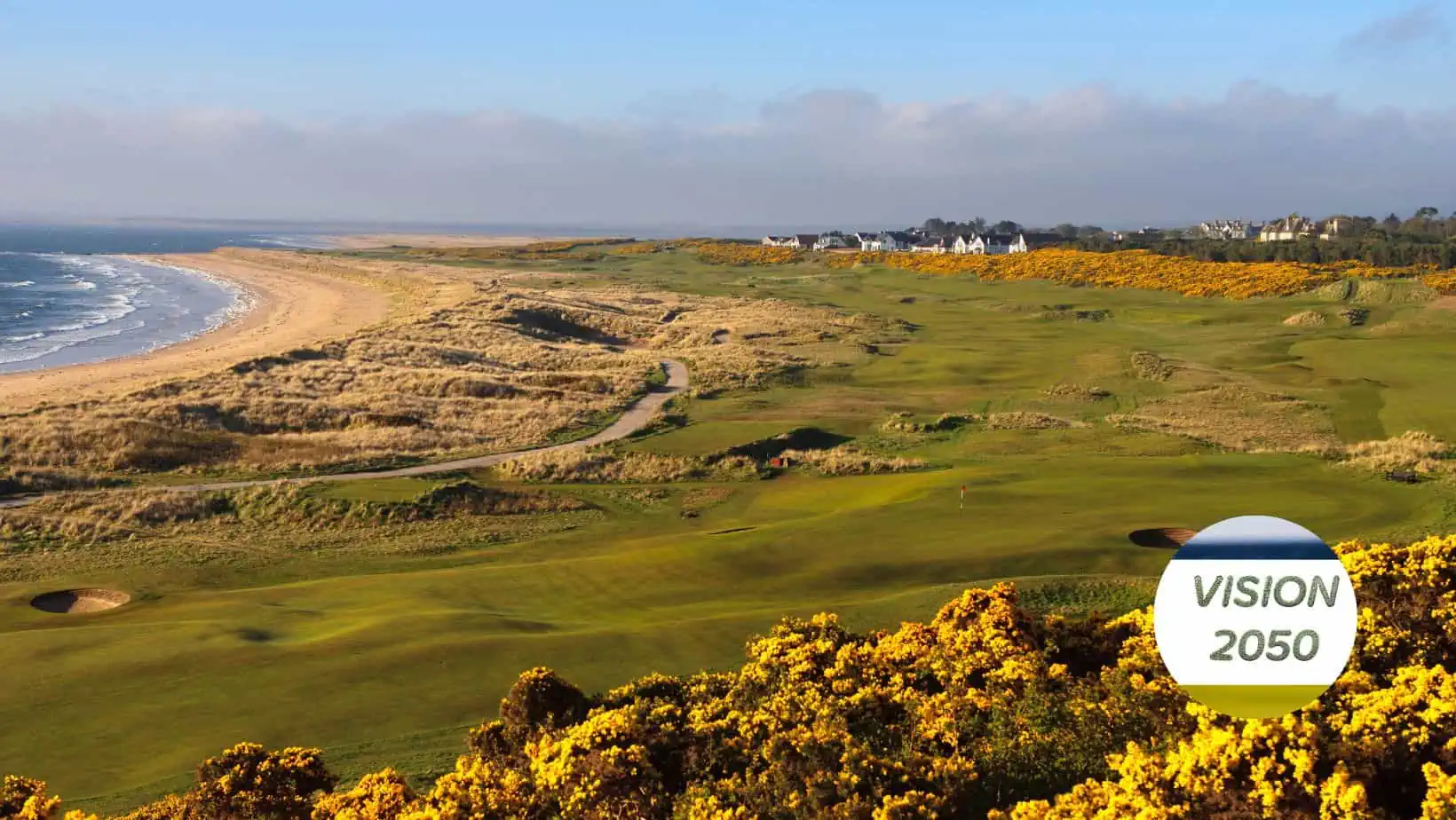
Blick auf den Golfplatz Royal Dornoch mit viel gelbem Ginster
Foto: Royal Dornoch/Petra Himmel

Royal Dornoch: „Wir mähen nur das Gras, das schon da war“

Für viele Golfer weltweit ist eine Fahrt nach Royal Dornoch fast wie eine Pilgerreise. Der Golfsport in der Stadt Dornoch lässt sich bis ins Jahr 1616 zurückverfolgen, und der Meisterschaftsplatz rangiert Jahr für Jahr in den Top 15 der besten Golfplätze der Welt.
In der Serie Vision 2050 spielt der Royal Dornoch Golf Club für uns eine herausragende Rolle. Einerseits zeigt er, wie sich der Golfsport über die Jahrhunderte hinweg positiv entwickeln und auch eine zentrale Rolle in einer Stadt spielen kann. Er steht aber auch für all jene Golfplätze, die unter dem Klimawandel leiden, denn Wissenschaftler des Dynamic Coast Projekts, das die Entwicklung der schottischen Küsten untersucht, halten den Struie Course in Royal Dornoch für stark erosionsgefährdet.
Grund genug für uns, mit Neil Hampton zu sprechen, dem General Manager des Royal Dornoch Golf Club und überzeugten Verfechter einer soliden Nachhaltigkeitsstrategie für den Club.

Den Studien von Dynamic Coast zufolge ist die Küste von Royal Dornoch stark erosionsgefährdet. Wann haben Sie davon erfahren, und welche Gefühle und Reaktionen hat das ausgelöst?

Neil Hampton: Wir haben das Glück, dass eines unserer Mitglieder, Alistair Rennie, an dem Dynamic Coast-Projekt mitarbeitet und in der Gegend wohnt. Er hat hier gelebt und gearbeitet, und er ist Golfspieler, mag also den Golfplatz und möchte ihm helfen. Vor fünf Jahren sprachen wir über seine Arbeit und darüber, wie Wissenschaftler vorhersagen, wie sich die Dinge in Zukunft verändern werden. Und er brachte uns dazu, über die Zukunft im Jahr 2050 oder 2100 nachzudenken. Er war also der Katalysator für uns.

Was war die erste Reaktion von Ihnen und den Verantwortlichen des Golfclubs? Waren Sie schockiert?

Neil Hampton: Nein. Ich denke, wir sind alle einigermaßen intelligente Menschen. Wir wissen, dass sich die Welt verändert, und den Klimawandel gibt es schon seit einer Weile. Ich glaube nur nicht, dass uns klar war, welch großen Unterschied das für uns bedeuten würde. Wissen Sie, wenn der Meeresspiegel um einen halben oder einen Meter ansteigt, wo bleiben dann die Golfplätze? Und was müssen wir dann tun? Wir sind uns alle bewusst, dass sich die Welt verändert. Wahrscheinlich haben wir es nur beiseite geschoben und nicht wirklich darüber nachgedacht, aber wir wussten, dass es in unserem Hinterkopf vorhanden war.

Offensichtlich ist der Struie-Kurs derjenige, bei dem man Lösungen finden muss.

Neil Hampton: Ja, denn er liegt viel tiefer. Wir hatten einige Erosionen in diesem Bereich, und so begann das Gespräch mit Alistair. Er hat uns dann seine Arbeit bei Dynamic Coast gezeigt; dann hatten wir Kontakt mit der St. Andrew’s University. Sie erforschen sanfte Methoden, um das Meer in Schach zu halten. All das zusammengenommen war sehr interessant.

Es gibt verschiedene Ansätze, um Erosionen zu stoppen; warum haben Sie sich für die Marschland-Methode entschieden?

Neil Hampton: Wir haben entlang von Teilen des Meisterschaftsplatzes einen Schutzwall aus Felsen, aber der wurde vor etwa 25 Jahren angelegt,  damit die Wellen dagegen prallen. Heute wissen wir, dass wir die Bewegung der Wellen brechen müssen, damit der Aufprall des Meeres auf die Küstenlinie viel geringer ist. Wir haben diese Art von Kastanienzaun, wie wir es nennen, errichtet. Auf diese Weise brechen wir die Energie der Wellen, so dass sich der Sand ablagert und die Salzwiesen wieder anwachsen können. Irgendwann wird der Zaun überflüssig sein. Die Salzwiese selbst wird dann die Arbeit für uns erledigen.
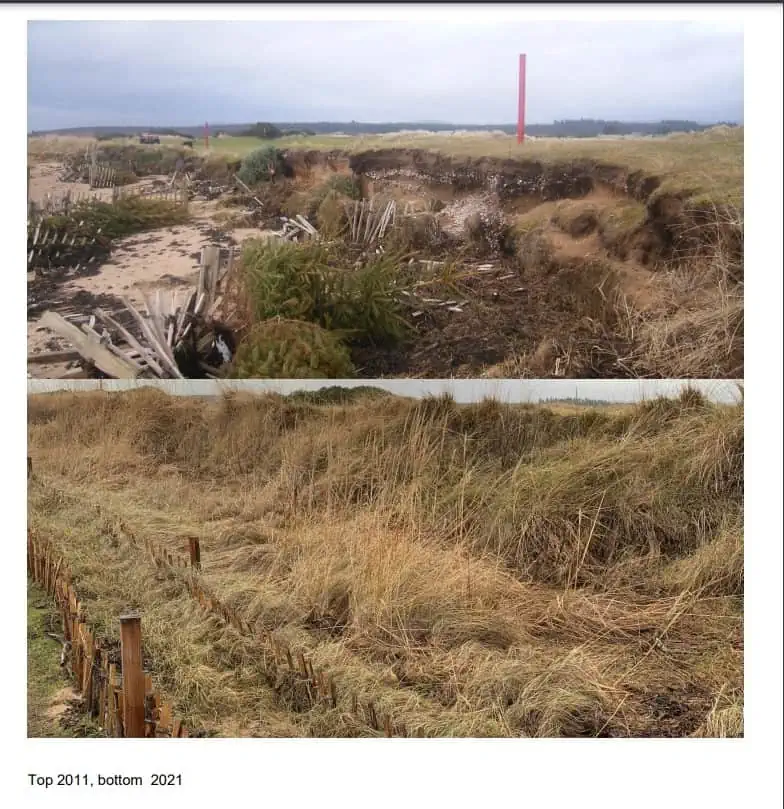
Zwei Bilder, die zeigen, wie man Marschland an der Küste wiedergewinnt

Wie wird Royal Dornoch als Golfclub im Jahr 2050 aussehen?

Neil Hampton: Ich denke, dass wir als Golfclub und als Unternehmen immer noch in einer sehr guten Position sein werden. Wir sind zuversichtlich, dass sich der Meisterschaftsplatz in den nächsten 25, 26, 27 Jahren nicht wesentlich verändern wird. Wir konzentrieren uns auf den Struie-Platz und darauf, was wir mit ihm machen können.

Wir erleben viele Diskussionen über den ökologischen Beitrag des Golfsports und die Nutzung von Land für Golfplätze in größeren Städten in vielen Teilen Europas. Wie sehen Sie die Zukunft des Golfsports und der Links-Plätze in Schottland im Allgemeinen?Neil Hampton: Ich glaube nicht, dass sich die Position des Golfsports in Schottland ändern wird. Golf wird in Schottland immer noch als der Ort betrachtet, an dem das Spiel seinen Anfang nahm. Und deshalb wollen die Leute hierherkommen. In Royal Dornoch wird schon seit über 400 Jahren Golf gespielt. Das ist ein großer Teil der Geschichte. Die Menschen wollen mit eigenen Augen sehen, warum das Spiel auf der ganzen Welt so erfolgreich war. Warum hat es so viel Spaß gemacht, und warum wollten die Leute es überallhin mitnehmen? Ich glaube, dass Golf in Schottland immer noch sehr stark sein wird.

Hätten Sie sich vorstellen können, dass Sie, als Sie die Stelle als Geschäftsführer eines Golfclubs antraten, auch ein Experte für Dinge wie Küstenerosion werden würden?

Neil Hampton: Nein, das habe ich mir nicht vorgestellt. Als ich meinen Job antrat, ging es mir vor allem um das Golferlebnis und darum, dafür zu sorgen, dass die Leute dieses bekommen. Aber jetzt ist unser Aufgabengebiet viel breiter gefächert, und es macht viel mehr Spaß. Jeder möchte, dass seine Arbeit abwechslungsreich ist und dass es jeden Tag etwas anderes zu tun gibt. Es geht hier viel um Nachhaltigkeit. Zum Beispiel Recycling oder die Arbeit mit der Golf Environment Organisation – all diese Dinge, an denen wir uns in den letzten zehn Jahren beteiligt haben, sind wunderbar. Es hilft mir, das Spiel zu fördern, indem ich zeige, dass Golf gut für die Umwelt ist.
Neil Hampton

Wenn wir in die Historie zurückblicken, hat Golf eigentlich nicht viele Ressourcen gebraucht. Hilft es manchmal einen Blick in die Vergangenheit zu werfen? 

Neil Hampton: Ja. Ich hatte kürzlich ein paar Diskussionen über die alten Zeiten in den siebziger und achtziger Jahren, als wir Golf im Farbfernsehen sahen. Meiner Meinung nach waren Farbfernseher gleichzeitig etwas Gutes und etwas Schlechtes für das Spiel, denn wir haben das Masters im April angesehen, das leuchtend grüne Gras und das tiefblaue Wasser und all diese schönen Blumen, und die Leute dachten, das Spiel müsse überall so sein. Jetzt haben wir es geschafft, den Kreis wieder zu schließen und zu der Tatsache zurückzukehren, dass ein Platz braun und gelb sein kann und die Fairways fest sind. So sollte das Spiel sein, und je weniger Einfluss wir haben, desto besser wird das Golferlebnis.

Ist es eine echte Stärke des Golfsports, dass er nicht mehr braucht als ein bisschen Gras und Wasser?
Neil Hampton: Ja, sehr sogar. Wenn wir zurückblicken und nach der Antwort auf die ursprüngliche Frage suchen, warum die Menschen nach Schottland kamen, um Golf zu spielen, sehen wir, dass wir immer nur das Gras gemäht haben, das schon da war. Wir haben kein neues Gras oder neue Samen importiert. Wir haben einfach gesagt: Hier ist ein Stück Gras; wir schneiden es ein wenig, maniküren es und arbeiten damit. In vielen Gesprächen, die ich über den Golfsport in den Vereinigten Staaten geführt habe, war zu hören, dass er so künstlich hergestellt wird und dass sie Gras in der Wüste anbauen, wo vorher kein Gras gewachsen ist. Da erkennt man den Unterschied zwischen der Intensität der Golfproduktion in den USA und der Leichtigkeit, die wir hier haben. Ich glaube, das ist der Weg, den das Spiel geht, und unser Team hier ist sich sehr bewusst, dass es darauf ankommt nur das zu schneiden, was notwendig ist. Das ist ein sehr einfacher Ansatz, und das ist gut so. Außerdem säen wir Wildblumensamen in den äußeren Spielbereichen aus. Wir haben jetzt unsere Bienenstöcke, wir haben unsere Insektenhotels. Wir geben uns große Mühe, das zu zeigen. Wenn man auf dem Golfplatz ist, ist man der Natur sehr nahe. Man befindet sich nicht in einer künstlichen Umgebung.

Die Anpassung an den Klimawandel kostet Geld….

Neil Hampton: Das war in Royal Dornoch noch nie ein Thema. Wir wollen in die Zukunft investieren, und wir wollen einen eigenen Nachhaltigkeitsbeauftragten haben, jemanden, der sich darum kümmert, dass wir alles richtig machen. Und auch hier können wir Geld sparen, wenn wir auf invasive Prozesse verzichten oder auf Prozesse, die im Verhältnis zu dem, was wir produzieren müssen, zu intensiv sind. In den nächsten vier Wochen haben wir eine Studentin der Stanford University hier. Sie analysiert unseren Kohlenstoff-Fußabdruck und wird uns sagen, was wir tun können, um ihn zu verringern.

Vision 2050: Die Zukunft des Golfsports ist positiv

Was ist Ihr langfristiges Ziel?

Neil Hampton: Wir wollen die Nummer eins der Golfclubs in der Welt sein, wenn es um Nachhaltigkeit und Umweltfreundlichkeit geht. Und wenn wir das hinbekommen, indem wir jemanden einstellen, der sich täglich darum kümmert, werden wir das auch schaffen. Dann erwarten wir, dass wir bei den Prozessen, die wir einführen, Geld sparen werden.

Wie reagiert der normale Clubgolfer auf all diese Projekte?
Ich höre keine Gespräche im Golfclub, an der Bar oder auf dem Golfplatz über die Umwelt. Diese Leute sind hier, um zu spielen und den Golfplatz zu genießen und den besten Sport oder das beste Erlebnis zu haben.

Einer der Eckpfeiler des Erfolgs ist die Interaktion zwischen dem Club und der gesamten Gesellschaft. Wie wichtig ist das für die Zukunft?
Neil Hampton: Wir sind in einer kleinen Stadt, in der nur 1500 Menschen leben. Man muss sich darüber im Klaren sein, dass jeder seinen Teil dazu beitragen muss, dass Dornoch als Standort, als Unternehmen und als wirtschaftliches Umfeld wächst. Der Club hat sich in der Vergangenheit teilweise von der Stadt separiert. Ein Teil meiner Arbeit bestand darin, dafür zu sorgen, dass wir wieder in die Stadt zurückkehre. Jetzt sind wir ein Teil der Stadt sind und nicht nur der Grund für die Stadt. Ich arbeite in vielen Ausschüssen und Gremien mit. Wir finanzieren eine Menge Dinge mit. Wir sorgen dafür, dass der Club die Stadt in einer Weise unterstützt, die sich die Stadt wünscht. Dornoch ist ein kleiner Ort im Norden Schottlands; es ist keine große Metropole. Wir wissen, dass wir zusammenarbeiten müssen.

Apropos Zukunft: Haben Sie Angst vor Wetterextremen wie in anderen Ländern?
Neil Hampton: Bis jetzt hatten wir nicht die extremen Wetterbedingungen wie andere Länder. Als kleine Insel und weil wir im Norden einer kleinen Insel liegen, bekommen wir ein bisschen Wind, ein bisschen Regen, aber wir haben nicht die Dinge, die ich zum Beispiel in den Vereinigten Staaten sehe, diese riesigen Gewitterstürme. Ich denke also, dass Schottland die beste Umgebung für das Golfspiel ist. Haben wir Angst vor der Zukunft? Nein. Ich denke, wir haben das Glück, dort zu sein, wo wir sind. Bei uns regnet es viel. Wir haben viel Sonnenschein. Wir haben das Glück, dass Golf Schottlands Spiel ist, weil es hier am besten gespielt werden kann.

Net-Zero-Ziele: Offsetting ist kein Allheilmittel

Eintrag teilen
  • Teilen auf Facebook
  • Teilen auf X
  • Teilen auf WhatsApp
  • Teilen auf Pinterest
  • Teilen auf LinkedIn
  • Per E-Mail teilen

INSTAGRAM

golfsustainable

Golf Sustainable is an independent news platform, founded by Petra Himmel.

From groundwater to reclaimed water: Since July 8, From groundwater to reclaimed water: Since July 8, the Evian Golf Resort has been completely self-sufficient when it comes to water management. 

Through a partnership with Danone’s Evian bottling plant, treated industrial water is pumped via a five-kilometer pipeline to the Golf Academy and the golf resort, where it is used for irrigation. 

“We made this decision 18 months ago,” explains Franck Riboud, Honorary President of the Danone Group, which also owns the Evian Golf Resort. “We wanted freedom, and now we have it.” When Riboud speaks of freedom, he is referring to the increasingly strict French regulations governing the use of groundwater for irrigating sports fields. 

By installing a completely closed-loop system—which ensures full self-sufficiency for the golf courses—the golf club is no longer dependent on government regulations.

Fotos: The Amundi Evian Championship /Philippe Millereau, Petra Himmel
#amundi #evian #eviangolfresort #amundievianchampionship #lpga #let #professionalgolf #golfsustainable #SustainableGolf #watermanagement #greenkeeping #golf #golfer #womeningolf #resilience #innovation #water

The overall project is called “REUT” (Réutilisation des Eaux Usées Traitées)
At the Amundi Evian Championship meadows create ha At the Amundi Evian Championship meadows create habitats for insects between the playing area. This is the backdrop of hole No. 18.
This is history: A winner's cheque worth 1,950.000 This is history: A winner's cheque worth 1,950.0000 US dollars for Hae-Ran Ryu. The KPMG Women's PGA Championship has made a statement: Equal pay and gender equality are relevant topics in golf. 

Yes, there are still differences between the payouts for male and female golfers, but especially at the Majors, the gaps are closing. The KPMG Women's PGA Championship is the most recent striking example.

🔹 For the 2026 season, the prize money for the KPMG Women's PGA Championship has surged to $13.1 million. For context, the purse was just $10.4 million in 2025.

🔹 Narrowing the Divide: The men's PGA Championship currently sits at $20.5 million. While a gap still exists, it is shrinking at a record pace. At $13.1 million, the pay gap has been reduced to approximately 1.56x.

🔹 Equality by Exception: Unlike the regular tour, where the structural gap remains wider, these Majors are closing the gap massively.  The Amundi Evian Championship has also increased the prize money to $ 9,1 million. 

#Golf #KPMGWomensPGA #PGAChampionship #SportsBusiness #EqualPay #Leadership #LPGA #GenderEquality #womeningolf #femalegolfer #golf #prizemoney #golfsustainable

Foto: Scott Taetsch/PGA of America

#Golf #KPMGWomensPGA #PGAChampionship #SportsBusiness #EqualPay #Leadership #LPGA #GenderEquality
Prepared for extreme heat? Here’s what’s really ha Prepared for extreme heat? Here’s what’s really happening out here - some personal impressions from the last days in Munich: 

🤣 During my fitting session, the portable TrackMan keeps breaking down. At one point, we’re cooling it down with a wet towel just to get through. Poor thing. 

😉 The early morning round starts at 6:30. The temperature is perfect, and the course is surprisingly busy. But once you finish, don’t expect coffee—like always, the club restaurant doesn’t open until ten.

😅 Wednesday’s tournament? The organisers wisely moved the start-up to 11 am instead of noon. That hour makes really all the difference in beating the heat.

🙁 The club secretary’s phone won’t stop ringing with buggy requests. The only snag: most of the clubs don't have enough buggies to go around.

😩 Water stations on the course are another story. On most courses, you only find a refill station after nine holes. If you want more, you’d better pack an extra bottle or two. 

Conclusion: Extreme heat isn't just a health issue but also a management question. Clubs in cooler countries, which aren't used to heat,  have to adapt to different playing times and consumer needs in the future.
 Yes: This is also a business opportunity. 

📷 Generated by AI

#golf #golfmanagement #transformation #adaptation #extremeheat #golfer #golfinglife #golfclub #extremeheat #golfplatz
What happens when world-class links golf meets a p What happens when world-class links golf meets a perfectly closed ecological cycle? 🌿⛳️🌊

At Prince’s Golf Club on the Kent coast, they aren't just maintaining a stunning 27-hole Open Qualifying course—they are developing new dune habitats. 

Course Manager Aaron Launchbury and his team excavate and reuse sand directly from the site. By removing invasive species, they create moist microhabitats in the winter and nutrient-poor havens in the summer. The result? An ecosystem where 100 of their 134 hectares are reserved entirely for nature, welcoming rare orchids and specialized wildlife. 🌸🦅

👉 Link in the first comment: Read the full story on Golf Sustainable!
📺 Watch the breakdown: Head over to our YouTube channel for more expert insights on the future of sustainable golf, and make sure to subscribe!
Fotos: Prince's Golf Club, Petra Himmel
#golfinengland #linksgolf #greatgolfcourses #golfsustainable #sustainablegolf #naturalengland #golfandnature #golf #golfclub #golftravel
Is your golf course ready for the climate of tomor Is your golf course ready for the climate of tomorrow? 🌡️⛳️ TV weather expert Karsten Schwanke shares a clear forecast – and concrete solutions.

In an exclusive interview with leading sustainability consultant and golf strategist Petra Himmel, Schwanke breaks down exactly what changing weather patterns mean for the sport. With 2027 projected to be the hottest year on record globally, the DACH region needs to prepare for a Mediterranean climate: significantly drier summers, more intense thunderstorms, and much higher evaporation rates.

For regions like the Berlin area , which are already experiencing enormous drought stress, it is high time to act. Schwanke strongly warns against letting drainage water simply flow into the sewage system – calling it the "greatest sin." Instead, clubs need intelligent water retention strategies, fully in the spirit of the Sponge City concept, to capture heavy winter rainfall in storage ponds for the dry months. Furthermore, we must protect existing, often older tree populations from unprecedented heat.

The good news? The solutions for climate adaptation are already here; we just need to implement them much faster. 🌍💧

Read the full interview on Golf Sustainable to find out how to future-proof your course. Link in bio! 🔗

Foto: Ralf Wilschewski

#GolfSustainable #ClimateAdaptation #WaterManagement #SpongeCity #Greenkeeping #SustainableGolf #KarstenSchwanke #FutureOfGolf #GolfCourseManagement #GolfStrategy
Get on your bike for the Solheim Cup 😃 With fewer Get on your bike for the Solheim Cup 😃

With fewer than 90 days to go until the 2026 Solheim Cup, European PING Junior Solheim Cup Captain and Solheim Cup Vice Captain Anne van Dam completed the fan cycle route today in The Netherlands.

The Dutch star is back on home soil this week for the Dutch Ladies Open on the Ladies European Tour (LET) taking place at Goyer Golf & Country Club .
Get on your bike for the Solheim Cup

Van  Dam cycled from ’s-Hertogenbosch (known as Den Bosch) station to Bernardus Golf alongside Eva-Lotta Strömlid, Head of Client Partnerships at the LET, to replicate the scenic 9km route that fans will be completing in September.

Van Dam said: “As we get closer to the 2026 Solheim Cup, it’s great to be back in the Netherlands this week and to visit Bernardus. Cycling is such a key part of Dutch culture, I love being on my bike and I hope fans will take the option to cycle to Bernardus from Den Bosch station. It’s going to be an unforgettable week, and I can’t wait to have you all there with us.”

This journey is also a follow-up ride to the Road to Bernardus, which saw Strömlid complete a 1,000km journey from her home in Sweden to Bernardus Golf to mark one year until the 2026 Solheim Cup and showcase smarter eco-friendly travel options, as part of the LET Sustainability Initiative (LETSI).

#sustainabletravel #golfsustainable #SustainableGolf #SolheimCup #Bernardus #fantravel #sustainableevents
🏌️‍♀️ Elite Sports and Climate Action – An Unsolva 🏌️‍♀️ Elite Sports and Climate Action – An Unsolvable Conflict? 🌍

"I see myself as a bridge builder," says German professional golfer Celina Sattelkau in her new interview with Golf Sustainable. As an EcoAthlete she proves that high-performance golf and environmental awareness don't have to be a contradiction. 🌱

From offsetting her travel emissions through wind power projects in India to driving an EV on the Ladies European Tour – Celina is leading the way. But she also addresses the hard truth: our sport is already feeling the massive impacts of climate change, particularly through extreme weather. We simply can't afford to ignore this topic!

👉 Read the full, in-depth interview with fascinating insights now on golfsustainable.com! (Link in Bio 🔗)

Fotos: LET / Tristan Jones 

#GolfSustainable #NachhaltigkeitimSport #GolfundNatur #SustainableGolf #WomeninGolf #Frauengolf #Wassermanagement
Which golf club knows its carbon footprint? In gen Which golf club knows its carbon footprint? In general, the topic of the golf industry's carbon footprint is difficult, as there are few published numbers and only a few event hosts, federations, or tour officials have developed strategies to reduce their emissions. 

GC Kitzeberg in Germany is a well-known but not very big club whose board members decided to act positively: They commissioned a report from a credible external consultancy, realised that "we have to become better," and started working on the first projects. Buying some new electric mowers is one of the steps. Communication with the membership was important, but successful. 

The journey isn't finished; many projects remain for the future. But what we like is the commitment to improve. Good luck for the next steps. 
#golf #greenkeeping #golfer #co2 #carbonemissions
☀️ Golf in extreme heat is becoming the new realit ☀️ Golf in extreme heat is becoming the new reality.
Yesterday, London recorded its hottest May day ever with temperatures reaching 34.8°C — a dramatic new heat record for the British capital.

For golfers, greenkeepers and wildlife on the course, rising heat means much more than just “summer weather”:
🏌️ Increased health risks for players
🌱 Heat stress and drought damage on turf
🐝 Pressure on biodiversity and ecosystems

Our latest article explores how climate change is already reshaping golf — and why adaptation is becoming essential for the future of the game.

Read more via Golf Sustainable

#Golf #ClimateChange #Sustainability #GolfCourseManagement #Heatwave #London #GolfSustainable #SportsAndClimate #Greenkeeping #ExtremeHeat #Biodiversity #SustainableGolf
One glance across the fairway, and it’s clear: Nat One glance across the fairway, and it’s clear: Nature thrives here! 🌿✨

GC Feldafing, situated in historic Lennè Park,  beautifully demonstrates that golf courses are far more than just sports venues—they are intricate mosaics of vital ecosystems. What looks like a pristine playing surface at first glance is actually a network of crucial habitats:

🪵 Deadwood providing shelter for insects & small mammals
🦅 Perches designed for birds of prey
🌸 Species-rich meadows bustling with pollinators
💧 Natural waterways serving as thriving aquatic habitats
🌳 And the ultimate highlight: A true natural monument – the majestic oak tree!

Today, sustainability and modern golf course management go hand in hand. Want to bring this expertise to your home club? The Golf Sustainable Academy offers webinars for free 🎓⛳️

🔗 Link to the Academy & website is waiting for you in our bio! (@golfsustainable)

What does your home course look like? Do you have designated eco-zones or natural monuments on your fairways? Let us know in the comments below! 👇

#golfsustainable #biodiversity #golfing #sustainability #greenkeeping #naturelovers #sustainablegolf #growthegame #ecoheritage #biotope #creatureconservation #gcfeldafing #reels
🌿✨ **Bois d’Arlon – Europe’s Living Lab for Next-G 🌿✨ **Bois d’Arlon – Europe’s Living Lab for Next-Gen Golf Resorts** ✨🌿

Nestled across 220 hectares of untouched nature in Belgian Luxembourg, the Bois d’Arlon Golf & Resort is more than just a golf destination – it is emerging as a future blueprint for sustainable, high-end golf resorts in Europe.

We visited the project, which was opened in 2024, to talk with the greenkeeping team and the investor Robert Schintgen about their vision of a high-end golf resort in Wallonie, where pesticides aren't allowed, and the rules for irrigation only allowed the use of collected rainwater and recycled water from the hotel. 

With two distinct courses – a challenging 18-hole Heathland layout and a scenic 9-hole Parkland course – the resort combines **world-class design, biodiversity-rich landscapes, and year-round playability on sandy soil**. The vision blends sport and nature seamlessly, creating an immersive experience for golfers of all levels. ⛳🌱 

But Bois d’Arlon goes far beyond golf. The 4-star château hotel with 64 rooms, spa, restaurant, and event spaces positions the estate as a **fully integrated luxury ecosystem** where hospitality, wellness, and outdoor sports meet. 🏨🌳

What makes it stand out is its positioning as a future laboratory for sustainable resort development – demonstrating how modern golf destinations can evolve with nature rather than against it, while still delivering premium guest experiences.

Bois d’Arlon isn’t just a resort. It’s a model for how European golf destinations can redefine luxury through sustainability, landscape design, and long-term environmental thinking.

📍 Belgium | Luxembourg province
⛳ Golf | 🌿 Nature | 🏨 Luxury | ♻️ Sustainability

#BoisDArlon #GolfSustainable #SustainableGolf #LuxuryResort #GolfArchitecture #EcoTourism #GolfCourseDesign #SustainableTourism #FutureOfGolf #BelgiumGolf #GreenResorts #HospitalityInnovation
What happens when a golf club completely stops usi What happens when a golf club completely stops using fungicides over the winter? 🚫🍄 The result might surprise you.
With pesticide regulations tightening across Europe (including strict bans in Switzerland, France, and Belgium), the question for greenkeepers is no longer if chemical restrictions are coming, but when.

Michael Scheffold, Head Greenkeeper at GC Wörthsee (Germany), decided to do a real-world test run. This past winter, he completely dispensed with fungicides on his greens to see how they would react.

The verdict? Better than expected! Despite a little more snow mold, the greens recovered beautifully and by mid-May, they were almost as good as usual. 🌿

This success didn't happen by accident. It is the result of years of prioritizing Integrated Pest Management (IPM) and mechanical measures to build robust, naturally resilient soil and grass. Supported fully by Club Managing Director Sven Hilgenberg, GC Wörthsee is actively future-proofing its course.

Proactive greenkeeping beats waiting for the ban! 📈⛳️

Call to Actions:
🔗 Read the full case study: Tap the link in our bio to read the detailed interview on Golf Sustainable.
🎓 Learn Sustainable Management: Want to implement pesticide-free strategies at your club? Explore our advanced courses at the Golf Sustainable Akademie (Link in Bio!).
📺 Subscribe for more insights: Check out our YouTube Channel for expert talks on the future of greenkeeping and eco-friendly golf operations!

Foto: Nicolas Martin Beaumont

#GolfSustainable #SustainableGolf #Greenkeeping #GCWörthsee #PesticideFree #IntegratedPest Management #GolfCourseManagement #EcoGolf #TurfManagement #SustainableTurf #GolfManager #GolfAkademie #GolfInspiration #GolfEnvironment #SnowMold #EcoFriendlySports
🚨 What does Donald Trump's new ballroom have to do 🚨 What does Donald Trump's new ballroom have to do with the environmental problems of East Potomac Golf Links? 

A growing environmental controversy is unfolding at East Potomac Golf Links: according to reports by the New York Times and the U.S. National Park Service, thousands of cubic meters of soil and construction debris from the demolition work at the White House East Wing were deposited on the public golf course — including material reportedly contaminated with lead, chromium, pesticides, and other hazardous substances. 

The site is planned to become part of a future championship golf course redevelopment. Environmental groups and local residents, however, are raising serious concerns about potential impacts on ecosystems, waterways, and public access to one of Washington’s most historic municipal golf facilities. 

What makes the case especially sensitive: the golf course sits directly along the Potomac River and has long served as an accessible public space for golfers, walkers, and families alike. Critics warn the project could come at a high environmental and social cost. 

💬 The story is another reminder of how closely golf, urban development, and environmental responsibility are connected — and why transparency and sustainable land management matter for the future of the game.

#GolfSustainable #Sustainability #Golf #Environment #GolfCourseManagement #EnvironmentalIssues #PublicGolf #Biodiversity #WashingtonDC
Mauritius, the island in the Indian Ocean, is firs Mauritius, the island in the Indian Ocean, is first and foremost a dream destination for many golfers. For Philippe Espitalier-Noël, who, as CEO of the ER Group, is also responsible for major golf destinations such as Beachcomber and Heritage Resorts, among others, this dream destination is extreme pressure. A recent report by the World Bank Group on climate and development on the island of Mauritius entitled CCDR has prompted him to call for significant changes in the direction of tourism on the island.

Read the whole interview on https://golfsustainable.com. Link in the first comment
Follow our You Tube channel https://www.youtube.com/@golfsustainable

#mauritius #golf #golftravel #tourism #sustainabletravel
Copernicus has published the European State of the Copernicus has published the European State of the Climate Report. The golf industry must learn from data and scientific research, as outdoors sports are challenged by the resulty of climate change.
New competition for Bavarian golf clubs 🌿🦋 The 'B New competition for Bavarian golf clubs 🌿🦋

The 'Blühpakt Bayern' has launched a new competition specifically for golf clubs, that have combined a biodiversity project with a successful communication idea.  This isn't just about aesthetics; it's a critical move to boost biodiversity and protect our essential insect populations on golf. 

Golf Sustainable founder, Petra Himmel:

"This competition is a great motivator. However, the real success lies in long-term strategy and understanding ecological systems. Communication is an important part of a successful biodiversity strategy. 

All information about the enrollment in the first comment. 

#SustainableGolf #GolfSustainable #BlühpaktBayern #Biodiversity #EcologicalGolf #GolfCourseManagement #PetraHimmel #GolfAkademie #Greenkeeping #EcoFriendlySports #GolfGermany
Burgenland in Austria is now the first region to b Burgenland in Austria is now the first region to be certified with the Austrian Environmental Label.
International Day of Orchards. There are so many o International Day of Orchards. There are so many orchards and fruit trees on golf courses. As an important habitat for insects, birds and even bats, they are so much more than just a wonderful aesthetic element for our sport. 
#golf #golfsustainable #biodiversity #orachards #streuobstwiese #
#Nature #Wildlife #Birdwatching #BeeEaters #Austri #Nature #Wildlife #Birdwatching #BeeEaters #Austria #Burgenland #Biodiversity #NaturePhotography #HiddenNature #Conservation #Golf
Yes, the Masters Tournament and Augusta National G Yes, the Masters Tournament and Augusta National Golf Club are all about exclusivity. But it is important to realise that the whole town of Augusta has to agree with this concept and tradition. 

There is a huge economic value that comes with the tournament week, but there are other soft factors that secure the acceptance of The Masters in the town. 

The renovation of the municipal course at The Patch, plus the opening of The Loop at The Patch, is good news for the local community. Affordable, good golf is important to grow the game. Here, the Masters Charity Funds, First Tee of Augusta, and Augusta Technical College have teamed up to finance this important project. 
#firsttee #golf #golfsustainable #golfforeverybody #themasters #augusta #growthegame
Instagram-Beitrag 18158981992431306 Instagram-Beitrag 18158981992431306
Golf without the use of #pesticides? This is the s Golf without the use of #pesticides? This is the scenario the Swiss golfing community will face from January 2027. Due to a new classification of land use, the use of herbicides will be completely banned, whilst other plant protection products will be subject to much stricter regulations. 
The issue of #health protection is becoming increasingly important on sports grounds. This development is also relevant for golf courses in Germany and Austria. Here too, plant protection products are often the last resort in combating fungal diseases on greens.
We have talked to experts in Switzerland. The good news: some agronomists also see positive consequences arising from the regulation. 
#golf #greenkeeping #turfgrass #nopesticides #golfmanagement #golfsustainable
#golfsustainable #golf #water #golfsustainable #golf #water
Follow me!

Follow us on Facebook

Weitere News

  • Green Energy Scottish Open Golf SustainableFoto: DP World Tour
    Scottish Open setzt neue Maßstäbe bei Energiewende12. Juli 2026 - 8:05
  • Golf The Amundi Evian ChampionshipFoto: The Amundi Evian Championship - Philippe Mellereaux
    Evian Golf Resort: „Freiheit“ beim Thema Wasser10. Juli 2026 - 20:04
  • Collage mit Gras
    „Die Züchtung von Gras ist viel komplexer geworden“5. Juli 2026 - 16:05
  • Fotos: Nikolas Martin-Beaumont
    Blühpakt Bayern: Experten-Tipps vom LBV30. Juni 2026 - 12:23
  • Global Sustainable Sports SPI Index GolfGSS
    Swiss Golf, R&A, DPWorld Tour: Führend bei KI-Nachhaltigkeitsanalyse28. Juni 2026 - 10:34

Kooperationen

© Copyright - Golf Sustainable | Website [ Bottega Design ]
  • Link zu Facebook
  • Link zu Instagram
  • Kontakt
  • Impressum
  • Datenschutzerklärung
  • Privatsphäre-Einstellungen ändern
  • Einwilligungen widerrufen
Link to: Das Schaf wird im Golfsport zum Publikumsliebling Link to: Das Schaf wird im Golfsport zum Publikumsliebling Das Schaf wird im Golfsport zum PublikumslieblingHeidschnucken im Hamburger GC Falkenstein (Foto: Stefan von Stengel) Link to: Greenkeeping: Zwiegespräch mit dem Gras Link to: Greenkeeping: Zwiegespräch mit dem Gras Mehrere Greenkeeper im PorträtGreenkeeping: Zwiegespräch mit dem Gras
Nach oben scrollen Nach oben scrollen Nach oben scrollen
DSGVO Cookie Consent mit Real Cookie Banner