
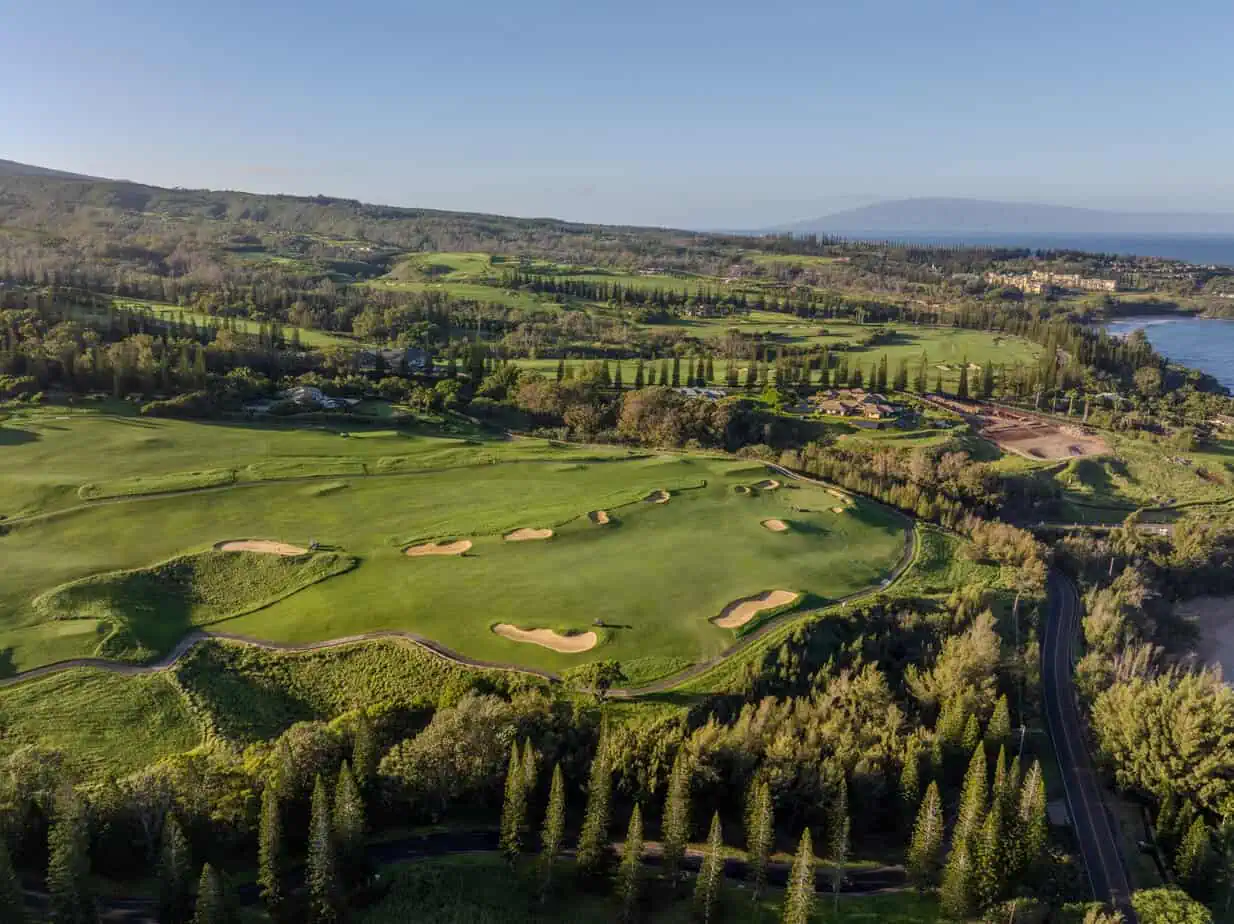
A perfect green on the coast of Maui. When you see the picture of the Plantation Course at Kapalua Resort, you immediately feel like playing. There is nothing to suggest that the world-famous resort’s golf operations have just emerged from what is probably the biggest crisis in its history. After a complete ban on water extraction in September 2025, both courses were closed, followed by the cancellation of the traditional opening tournament, The Sentry, in January 2026.
“The condition of the grass was somewhere between life and death,” says Kevin Kammien, Senior Marketing Manager at the resort, describing the state of the golf courses at their lowest point. In the meantime, the water supply has been partially restored. 60 percent of the previous quantity can be used again. The management and agronomy team, led by Andrew Rebman, decided to concentrate this amount of water on restoring the Plantation Course.
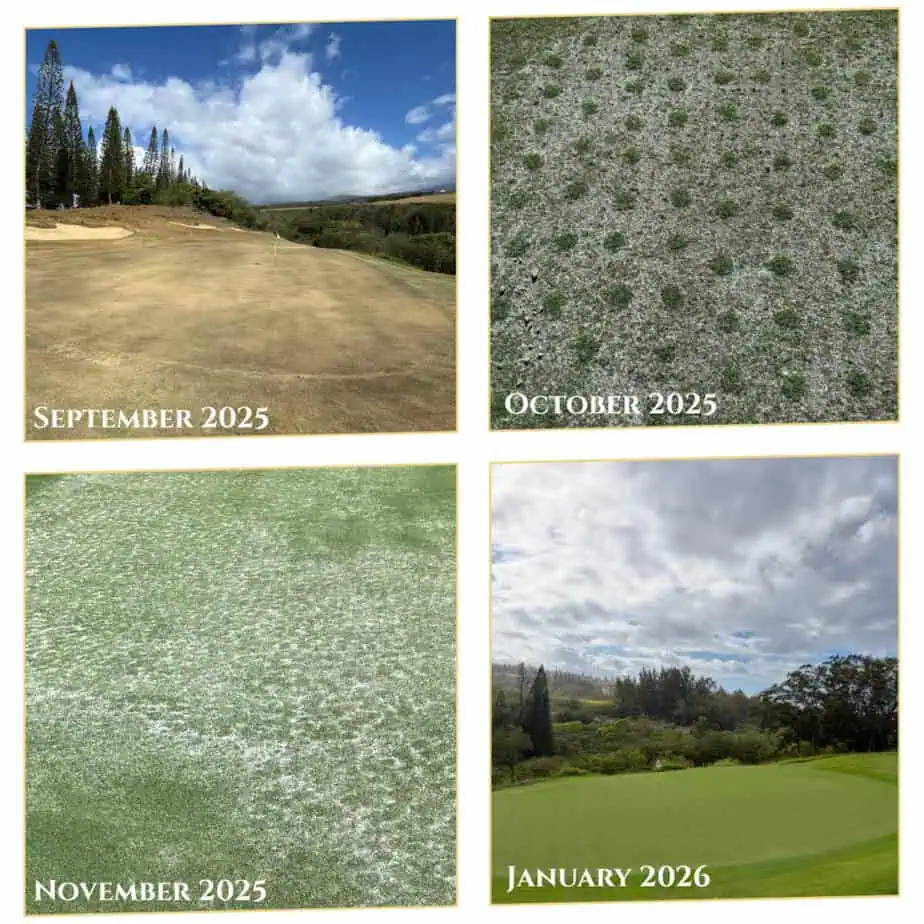
The past few weeks have been a completely new experience for the greenkeeping team. “There is no manual for this type of resuscitation,” explains Kammien. “It’s not taught at school.” Rebman’s team had to rely on their own experience, on their existing knowledge of the characteristics of the courses and the local climate. It was a trip into the unknown.
31,540 cuttings planted
And yet, at this point, it showed how a greenkeeping team can benefit from smart decisions made in the decision-making process. In the case of Kapalua Resort, which is run by world-renowned management company Troon, a change of grass types in 2019 became a success factor. “Our tees, fairways and roughs were switched to Celebration Bermuda grass in 2019, which has contributed significantly to our recovery. Our greens are planted with TifEagle bermudagrass. Both TifEagle and Celebration have developed a deep root system over the last 6 years and Celebration’s drought tolerance has really proven itself during the period of 100% water restrictions,” explains Kammien.
Two greens were still lost. “Our agronomy team took 15,770 2-inch cuttings from our nursery and pulled another 15,770 to re-vegetate greens #1 and #8 – for a total of 31,540 cuttings! It was an incredibly laborious but necessary process,” Kammien says, still taking his hat off to his staff.
INSERT_STEADY_NEWSLETTER_SIGNUP_HERE
As complex as the entire process leading up to the reopening of the Plantation Course was, the excellent condition of the course is surprising, as recently confirmed by a reporter from the trade magazine Golf Digest. According to the management team, the rapid recovery was only possible because the course’s water management, including the entire irrigation infrastructure, meets the latest standards. “We are very efficient water users, we have scientific-grade weather stations, soil moisture meters and crop sensors,” explains Kammien. “Each irrigation head has its own precipitation rate and the run times are based on the daily evaporation measured by the weather stations. The central control computer then calculates the individual run times of the sprinkler heads accordingly.”
The fact that not a single one of the 43 employees was laid off during the closure of the plant also helped to ensure that work could be resumed quickly and efficiently when the water restrictions were partially lifted. Each of them was then deployed in a multidisciplinary manner in order to make rapid progress.
Further water savings
Nevertheless, the management has learned from the crisis: the water requirements of the courses are to be reduced once again in future. The two golf course architects Bill Coore and Ben Crenshaw have already been on site to work with the local managers to develop a concept for reducing the amount of irrigated areas. Native grass, which is not to be irrigated, will play a greater role in some areas. At the same time, the resort is currently working on a permit for an additional water source in order to be less dependent on the regulations of “Maui Land & Pineapple” in the future.
Looking back, Kammien still finds it difficult to understand how such a water crisis could occur on an island with Maui’s rainfall, which, including the tournament cancellation, has probably caused an economic loss of 50 million dollars for the region. “The Pu’u Kukui Preserve is directly above the Kapalua Golf Course and is one of the rainiest places on earth. So I still can’t quite understand why there wasn’t enough water for our community this year,” he says doubtfully.
Advice for other golf resorts
Andrew Rebman’s advice for other golf resort operators is therefore clear: only with the right preparation can such crises be survived at all. Regular audits of the irrigation system are crucial, as are daily adjustments to water consumption based on weather data and plant health. And there is no alternative to the consistent use of modern technology to increase efficiency.
The work is not over for the agronomy team at Kapalua Resort. The Bay Course also needs to be brought back into shape. But a look at the fairways and greens of the Plantation Course shows that it can be done.