• Home
  • Newsletter abonnieren
  • Das Team
  • Ziele
  • Deutsch Deutsch Deutsch de
  • English English Englisch en
Golf Sustainable
  • News
    • Club-News
  • Klimawandel
  • Wasser
  • Biodiversität
  • Greenkeeping
  • Tourismus
  • Diversität
  • Weitere Themen
    • CO₂
    • Industrie & Equipment
    • Best Practice
    • Science
  • Click to open the search input field Click to open the search input field Suche
  • Menü Menü
Golfball mit Ameisen
Foto: Niels Dokkuma

Vision 2050: Lasst uns über Gras sprechen

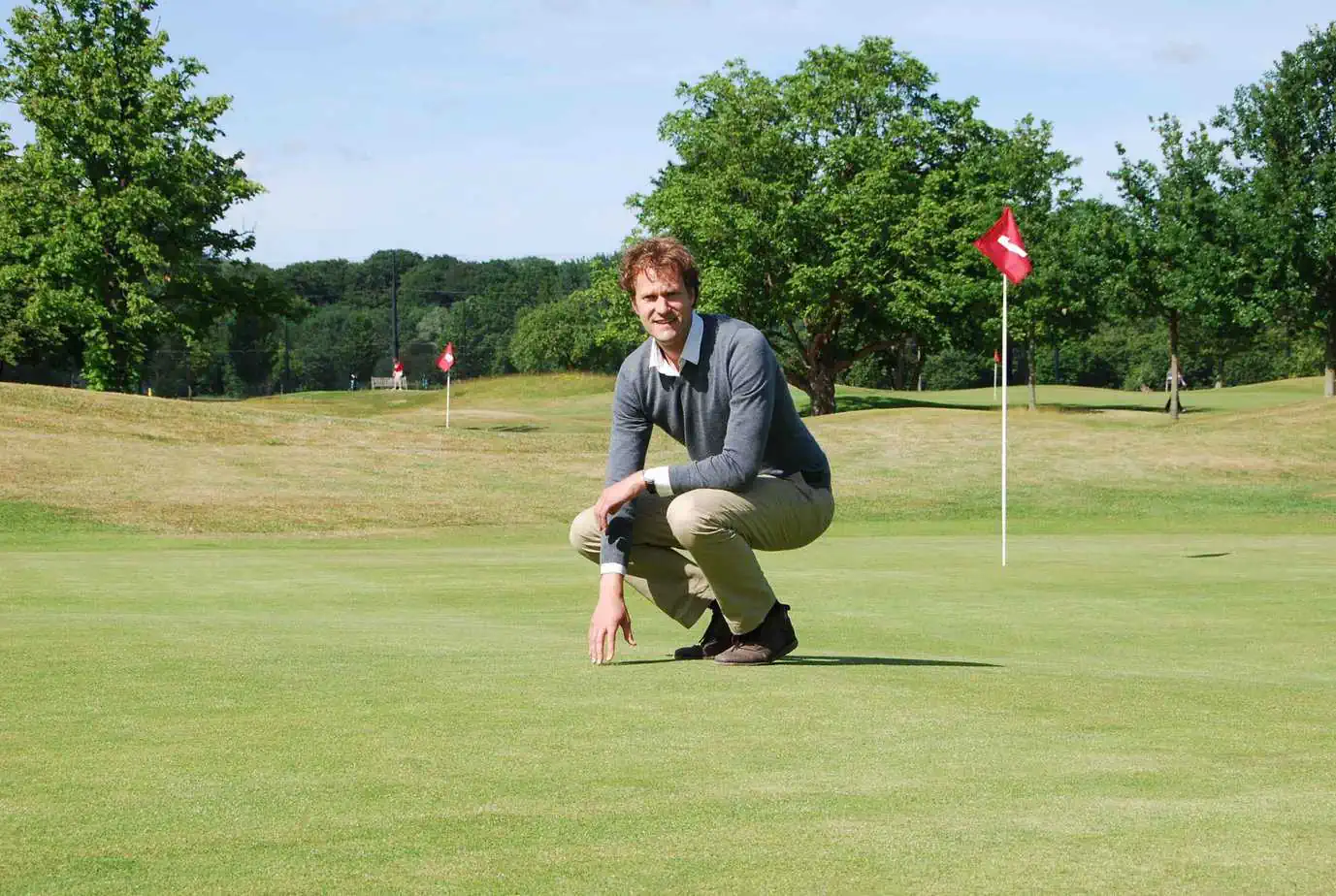
Gras ist sein Ding. Der Niederländer Niels Dokkuma, Agrarwissenschaftler mit Abschlüssen von der HAS green academy und der Penn State University, ist zum einen beim Königlich Niederländischen Golfverband als Agronom für Sustainable Management zuständig, zum anderen aber auch bei der European Golf Association. Daneben verfügt er über Berufserfahrung auf so renommierten Plätzen wie Baltusrol in den USA. Wir wollten in der Serie Vision 2050 von ihm wissen, wie die Zukunft des Golfsports aus der Sicht eines Grasspezialisten aussehen könnte. Die gute Nachricht zuerst: Auch 2050, so Dokkuma, wird es noch Golfplätze geben – sie werden womöglich nur anders aussehen.

Sie sind jetzt 40 Jahre alt. Glauben Sie, dass Sie auch 2050 noch Golf spielen?

Dokkuma: Oh ja, absolut. Aber für mich ist das Golfspiel in erster Linie ein Freizeitvergnügen. Ich bin da nicht wettbewerbsorientiert. Aber ich bin überzeugt, dass ich die nächsten Jahrzehnte spielen werde.

Was fasziniert Sie am meisten? Ist es die Natur, das Spiel oder die Menschen, mit denen Sie spielen?

Dokkuma: Auf jeden Fall die Naturkomponente. Das macht den Sport für mich einzigartig. Der Kampf mit der Landschaft, die verschiedenen Lagen, die man bekommen kann, die Schlagwinkel, die Einschätzung der Entfernung, das Design des Platzes. Aus professioneller Sicht schätze ich einen qualitativ hochwertigen Golfplatz im Hochsommer. Ich selbst mag extrem manikürte Golfplätze nicht so gerne, weil sie mir zu künstlich sind.

Was glauben Sie, wie ein Golfplatz in 30 Jahren aussehen wird?

Dokkuma: Weniger perfekt gestaltet und manikürt. Was die Ressourcen angeht, und dabei ist es mir egal, ob es sich um Arbeitskräfte, Sand oder andere Ressourcen handelt, werden wir eine geringere Verfügbarkeit in Verbindung mit einer strengeren Gesetzgebung erleben, z. B. bei der Entwicklung der biologischen Vielfalt, der Entwicklung der Natur und dem Einsatz von Pestiziden. Das wird den Übergang zu einem Golfplatz mit geringerem Aufwand erleichtern, bei dem das Qualitätsniveau weiter entwickelt wird.

Werden die Golfplätze generell von der Fläche kleiner werden, weil es diese anhaltende Debatte über die Landnutzung für Golfplätze gibt?

Dokkuma: Das kann in zwei Richtungen gehen – unsere Golfplätze könnten kleiner und intensiver genützt werden. Oder wir könnten darüber nachdenken, so sogar zu vergrößern und sie damit mehr der Öffentlichkeit zugänglich zu machen? Ich denke da zum Beispiel an Golfplätze, die wirklich sehr weitläufig angelegt sind und viel Platz für eine multifunktionale Nutzung bieten, sei es zum Reiten oder für Spazierwege usw. Das wäre dann so etwas wie ein öffentlicher Park für 250 Hektar, mit einem Golfplatz und allen möglichen anderen Funktionen dazwischen. Das klingt aus meiner Sicht auch gut.

Ein Blick in die Zukunft – mit dem Wissen aus 50 Jahren Golf

Die EU strebt an, im Jahr 2050 Netto-Null-Emissionen zu erreichen, und mehrere Sportorganisationen und Golfverbände haben das gleiche Ziel. Ist das aus Ihrer Sicht erreichbar?

Dokkuma: Bisher haben wir alle in der Golfbranche den Eindruck, dass die Plätze aufgrund der Bäume und des Grases auf den Golfplätzen CO₂-positiv sein können. Bei großen Turnieren spielt natürlich die Mobilität der Golffans eine große Rolle für den CO₂-Wert. Aber auch in einem durchschnittlichen Golfclub ist allein der Weg mit dem Auto zum Golfclub und zurück ein Problem für die Emissionen. Dieses Mobilitätsproblem könnte jedoch durch den Einsatz von mehr Elektroautos gelöst werden. Der Golfsport könnte dabei eine Vorreiterrolle spielen, denn der durchschnittliche Golfspieler ist ein früher Nutzer von Elektroautos, die in der EU ja in der Nutzung von einigen Regierungen steuerlich begünstigt werden.

Als Agrarwissenschaftler ist Gras Ihre Kernkompetenz. Werden wir im Jahr 2050 völlig andere Gräser auf den Golfplätzen sehen und auf viel mehr Gräsern spielen, die derzeit nur in südlichen und sehr warmen Regionen zum Einsatz kommen?

Dokkuma: Das wird vom Klimawandel abhängen. Die Verwendung von Gräsern wird sich definitiv verschieben, wobei Bermuda und Zoysia auch mehr im Norden eingesetzt werden.  Golfplätze werden von Bentgras auf Bermuda umsteigen, weil Bentgras in bestimmten Klimazonen nicht haltbar ist. Wir haben das bereits in den Vereinigten Staaten oder in Südspanien gesehen, wo die Plätze mit diesen Gräsern nicht mehr nachhaltig betrieben werden konnte. Zunächst einmal könnte es schwierig werden, die Qualitätsstandards zu erreichen, dann wird der Ressourceneinsatz wichtig. Aber wir werden auf jeden Fall noch viele Innovationen bei den Rasensorten und Entwicklungen sehen.

Spielen wir im Jahr 2050 vielleicht viel mehr auf Kunstrasen?

Dokkuma: Die Frage ist doch: Passt Kunstrasen zur Funktion des Golfspiels in der Naturlandschaft? Wenn er passt, wird er mehr zum Einsatz kommen. Andererseits sprechen wir darüber schon seit 30 Jahren und es kommen alle möglichen Umweltthemen auf uns zu.  Ich bin der Meinung, dass es generell immer eine Nische für den Golfsport geben wird. Aber ich glaube nicht, dass wir komplette 18-Löcher-Plätze aus Kunstrasen sehen werden.

Mit dem Klimawandel tauchen immer mehr Insekten auf und suchen sich neue Lebensräume. Gleichzeitig gibt es eine Tendenz zu einer pestizidfreien Gesetzgebung. Wie können die Greenkeeper in Zukunft mit all den Insekten umgehen?

Dokkuma: Je mehr Artenvielfalt wir auf den Golfplätzen haben, desto mehr natürliche Feinde für Insekten gibt es. In einer Monokultur kann sich ein Insekt schneller entwickeln. Das ist also die eine Seite der Medaille. Die andere ist, dass der Wegfall von immer mehr chemischen Insektiziden auch die Entwicklung biologischer Insektizide bedingt. Die größte Herausforderung sind vielleicht nicht einmal die Insekten, sondern die Unkräuter und ihre Bekämpfung.

Vision 2050: Die Zukunft des Golfsports ist positiv

Was bedeuten diese Herausforderungen für den Greenkeeper und seine Ausbildung?

Dokkuma: Wir brauchen mehr datengestütztes Greenkeeping, aber auch mehr Wissen.Die STERF-Forschung in den skandinavischen Ländern hat bereits gezeigt, wie wichtig all‘ dieses Fachwissen sein kann. Was die Clubs betrifft, so werden wir eine größere Differenzierung der Qualitätsniveaus bei den Clubs sehen – mehr als jetzt. Die Top-Clubs werden über die Mittel verfügen, um den integrierten Pflanzenschutz anzuwenden, mit Daten zu arbeiten und ihr Wissen zu erweitern, damit sie ihre Ziele zu erreichen. Clubs der unteren Kategorie werden weniger Ressourcen haben, um sich darum zu kümmern.

Wenn Sie in die Geschichte zurückblicken – was können wir von den alten, klassischen Kursen für die Zukunft lernen?

Dokkuma: Mit einer Umwelt im Wachstum, also Gras, arbeitet man sowohl ober- wie auch unterirdisch. Das ist natürlich ideal auf einem Links-Course mit drainierendem Sand und ohne Bäume. Das sind perfekte Bedingungen für Gras. Ich kann mir viele Golfplätze vorstellen, die keine idealen Wachstumsbedingungen in Bezug auf Bäume und Schatten bieten. Das ist dann ein begrenzender Faktor. Dennoch lässt sich sowohl in der oberirdischen als auch in der unterirdischen Wachstumsumgebung eine Menge erreichen, um über die Jahre hinweg Verbesserungen zu erzielen.

Stellen Sie sich vor, Sie sind der Superintendent Ihres Traum-Golfclubs, und Sie können drei Entscheidungen für eine bessere Zukunft des Golfplatzes treffen. Welche Entscheidungen treffen Sie?

Dokkuma: Erstens, die Dinge, die ich gerade erwähnt habe – verstärktes Arbeiten an der oberirdischen Umgebung und vor allem an der unterirdischen Umgebung. Wir müssen uns um die Ursachen kümmern, nicht um die Symptome. Der zweite Punkt ist die Kommunikation – das Management von Erwartungen beim Golfer. Der dritte Punkt wäre: Daten sammeln und analysieren, denn was man nicht messen kann, kann man auch nicht managen.


Royal Dornoch: „Wir mähen nur das Gras, das schon da war“

Teile diesen Eintrag
  • Teilen auf Facebook
  • Teilen auf X
  • Teilen auf WhatsApp
  • Teilen auf Pinterest
  • Teilen auf LinkedIn
  • Per E-Mail teilen

Neuerscheinung

INSTAGRAM

golfsustainable

Golf Sustainable is an independent news platform, founded by Petra Himmel.

How much can electrified mowing reduce a golf club How much can electrified mowing reduce a golf club's carbon emissions? Greenkeeping remains a key lever for reaching ambitious climate goals.  How effective is the switch to electric fairway mowers? Research is limited, but we found one 2025 study, and we examined a 27-hole course with strong data. 

The Scientific Baseline (2025 Study, Italy)
A case study conducted at the 27-hole Montecchia golf course compared conventional diesel mowers with autonomous, battery-powered models on 10.69 hectares of fairways:
▪️ Relative CO₂ emission reduction: 66.2%
▪️ Absolute savings: 9.24 tons of CO₂/year
▪️ Emission comparison: 1,305 kg/hectare (diesel) vs. 441 kg/hectare (electric)

Operational Data (Golfpark Weiherhof, Germany)
Operational records from a 27-hole facility utilising 25 electric mowers for tees, fairways, and semi-roughs over one season show:
▪️ Diesel consumption decreased from 18,180 litres to 8,683 litres.
▪️ CO₂ emissions were reduced from approximately 48 tons to 23.01 tons.
▪️ Charging infrastructure: The facility utilises a 100 kWh on-site solar system, aligning the charging cycles with active power generation to optimise the emission factor.

Find the full article on our website. 

#GolfSustainable #Golfcourse #Golfplatz  #Greenkeeping #GolfIndustry #SustainableGolf #CarbonFootprint #GolfCourseManagement #SportsManagement #EnvironmentalData #golf #golfer 

Fotos: Golfpark Weiherhof
Today the LET will likely look to the WTA with a t Today the LET will likely look to the WTA with a touch of envy. Women’s tennis swiftly reoriented itself yesterday after announcing a new title sponsor for the season-ending WTA Finals: the yoghurt brand Fage. Before that, the WTA terminated its three-year contract to host the WTA Finals in Riyadh (Saudi Arabia) a year early.

The LET, meanwhile, continues to face the sobering reality that GOLF Saudi's significant reduction in involvement means massive financial losses, at least for the time being. Instead of five events with $15 million in prize money, by 2027 there will be just one tournament with $4 million in prize money and a ranking-bonus sponsorship.

The challenge for the LET becomes still more visible when looking at the blank numbers: 
 💠 The prize money for the WTA Finals accounted for around six per cent of the total prize money in 2025.
 💠 On the LET, the share of PIF tournaments in the total prize money in 2026 was about 32 per cent.
 💠 On the LPGA, where the co-sanctioned Aramco Championship took place, PIF prize money counted for about three % in 2026.

The LET’s figures send a clear message: this is what dependence looks like. On top of that, fossil fuel sponsorship in sport has been criticised for years anyhow. 

The WTA also found a solution to this problem by securing a deal with the yoghurt brand Farge. One thing is clear about yoghurt: it is completely politically neutral.

#golf #tennis #let #wta #femalesports #sponsorship #femalegolf #golfsustainable #greensports #professionalgolf
Instagram-Beitrag 17992628706052347 Instagram-Beitrag 17992628706052347
Did you watch the Aramco Korea Championship last w Did you watch the Aramco Korea Championship last week? It made me think about how important golf courses are in urban areas. 

Step back and consider the value of a golf course to society. The sponge city concept aims to retain rainwater where it falls, letting it infiltrate the soil, replenish groundwater, and reduce pressure on drainage systems during heavy rainfall. Golf courses can contribute to this approach through:

 💠 Rainwater retention and infiltration in permeable green spaces and soils.
 💠 Natural cooling through vegetation, evaporation and transpiration.
 💠 Water storage and biodiversity in ponds, wetlands, biotopes. 
 💠 Climate resilience through species-rich meadows, woodland and hedgerows that complement the intensively maintained playing areas.

But: Do cities already recognise this value? Is more communication needed to make regulators aware of the benefits of golf courses in urban areas? Looking back at the pictures of the Aramco Korea Championship at New Korea Country Club last week the value of a golf course in an urban environment became very visible. 

We just have to talk about it. 

👉 Read the full article on Golf Sustainable. 
Fotos: LET/Oliver Brady, Petra Himmel/AI generated

#GolfSustainable #SustainableGolf #SpongeCity #WaterManagement #ClimateAdaptation #Biodiversity #UrbanPlanning #GreenInfrastructure #golf #golfer #greensports #greenkeeper #golfmanagement
Instagram-Beitrag 18436447168151171 Instagram-Beitrag 18436447168151171
Visibility is so important.We love the Green Thurs Visibility is so important.We love the Green Thursday project of Eco Athletes. A perfect best-practice case for golf associations or clubs. An easy way to start a conversation about sustainability.

Four professional golfers promote a greener game. Camille Chevalier, Celina Sattelkau, Sára Kousková and Patricie Macková have joined the Green Month initiative of  EcoAthletes. The inaugural Green Sports Month is bringing athletes and the wider sports community together to raise awareness and drive climate action.

🟢 Green Thursdays

Throughout the October tournament weeks, the four players will wear green on Thursdays to make climate action visible on the golf course – and encourage fellow LET players to join them. First occasion: Yesterday during the LET tournament in Korea. 

♻️ Plogtober

They will also take part in EcoAthletes’ Plogtober initiative, combining physical activity with litter collection. The idea is simple: get outside, move, pick up waste and use social media to inspire others to do the same.

For golf, this message matters. First of all, sustainability is not only about golf-course management, water, biodiversity or energy. It is also about the people who represent the sport and promote sustainable behaviour. 
Foto: LET/Oliver Brady

#GreenSportsMonth #EcoAthletes #SustainableGolf #greensports #ClimateAction #LadiesEuropeanTour  #Golf #SportForClimateAction #golfsustainable #greensports #womeningolf
Sylt is a high-end hotspot for golf tourists. The Sylt is a high-end hotspot for golf tourists. The island is working on its mission statement, due to be unveiled at the end of the year. One thing is already certain: with the ‘Lebenswert – sustainable Sylt’ seal of approval, the ‘environmentally conscious travel’ segment will play a significant role in it.

But what is the reality? How many hoteliers and golf courses truly stand behind this seal, and how do they put it into practice in their catering, hotel management and greenkeeping? We visited some golf clubs and hotels -  the résumé: 

 💠  Landhaus Stricker, led by Michelin-starred chef and owner Holger Bodendorf, offers the perfect combination of luxury holidays and sustainability. Meticulous attention is paid here to regional supply chains, resource conservation, waste prevention and renewable energy. This ranges from the tea bags at the buffet to membership in the Feinheimisch association. GreenSign certification is the icing on the cake. Perfect choice. 

 💠  The island has four golf courses, three of which have been awarded the highest ‘Gold’ level of the German Golf Association’s ‘Golf and Nature’ certificate. The Marine Golf Club, GC Sylt and the Budersand Resort are therefore the top destinations for golf tourists who like to travel in an environmentally conscious manner. It was a welcome discovery that sustainability is also a major priority at the Budersand Resort with its 5-star hotel. Plastic, at any rate – a real problem at golf resorts, particularly in the catering sector – definitely has no place here.

So what's next? All that remains is to adapt the marketing. Because one thing is clear: right now, Germany’s top island isn’t really associated with sustainable golf tourism in the customer's mind. Sylt is known as a golf destination, but not yet as a sustainable golf destination. Hopefully, that will change in the near future. 

Fotos: Sylt Marketing e.v., Landhaus Stricker, Budersand Hotel - Golf & Spa -Sylt, Marine Golf Club, Petra Himmel 

#sylt #sustainabletravel #tourism #golfsustainable #golftravel #golfholiday #sustainablehotels #golf #golfer
In Japan, abandoned golf courses become solar park In Japan, abandoned golf courses become solar parks - like here in Fukushima, where the EDP Group has converted a 60-hectare golf course into a vast solar park comprising 63,000 solar panels. The plant is expected to generate over 48 GWh of energy annually. 

Japan faces a shortage of space – not only for housing but also for the expansion of renewable energy. In this densely populated and mountainous country, solar project developers are desperately searching for suitable sites. 

In Japan, strict requirements apply to large-scale solar farms: They must have sufficient sunlight, be located a certain distance from residential areas, and have good access to the power grid. Solar farm developers are now finding that former golf courses meet these exact criteria.

From a developer's perspective, a golf course is essentially a ready-to-go power plant that simply hasn’t been connected to the grid yet. The land has already been developed, trees have often been cut down, and the terrain is generally not too hilly or extremely uneven. Added to this are the underground irrigation systems that are still in place. The development work required for solar park operators is minimal.

The case of Japan shows that a golf course can be transformed – sometimes more rapidly than golfers can imagine. 
📷EDP APAC

#golf #golfmanagement #sustainable #solarenergy #golfsustainable #golfcourse
🔥 Burning trolley batteries inside buildings are a 🔥 Burning trolley batteries inside buildings are a real problem at golf courses. That’s why we liked this new product idea.
😄 A solar-powered battery charging station - with no underground wiring and available in custom sizes - solves the problem. The stainless steel frame can be placed anywhere outdoors. The golf club decides how many batteries shall be charged at the same time or how many e-trolleys shall be parked here. Golfers can use them during their drinks or lunch at the clubhouse. 
🤑 Plus: All surfaces can be used for advertising partners, so the charging station can pay for itself. The batteries hide behind the advertising surfaces. 
Great idea: We’re excited to see it on the first courses. 

Link for the full story in the first comment, or have a look at golfsustainable.com

#golf #golfmanagement #golfsustainable #smartideas #golfindustry #solarenergy 

Foto: Alexander Fend
🏌 Golf for the community - an approach that is oft 🏌 Golf for the community - an approach that is often missing in today’s booming American golf market. Starting in December, The Gate Golf Club will provide a counterbalance in the Naples region, which ranks among the top destinations when it comes to private, high-end country clubs. 
 😀 Golf for the community - this is the goal that President Kristina Schmieding is consistently pursuing, with a whole host of supporters from Collier County by her side. Among them is First Tee, which is finally finding a permanent home at The Gate Golf Club.
Social sustainability in golf means creating added value for many. The countdown to The Gate has begun. Good luck with this wonderful initiative.
Fotos: The Gate Golf Club
#TheGateGolfClub #GolfSustainable #NaplesFlorida #NaplesGolf #PublicGolf #GrowTheGame #FirstTee #FloridaGolf #CommunityFirst #GolfLife #InclusiveGolf
🏌️‍♂️💦 Dew might look beautiful and harmless, but 🏌️‍♂️💦 Dew might look beautiful and harmless, but it's actually one of the biggest seasonal challenges for greenkeepers!

Autumn is dew season. When nighttime temperatures drop and humidity rises, a fine film of water forms on the turf. For us golfers, it just means a slower rolling ball—but for the health of the course, it can be a real threat.

👉 Why?
When the turf remains damp for hours, it creates the perfect microclimate for aggressive fungal diseases like the dreaded Dollar Spot. The water on the leaves also draws out sugars and amino acids from the plant—an absolute feast for pathogens.

🌱 The Sustainable Solution:
The magic phrase is: Interrupt leaf wetness! Mechanically removing the dew—through early morning mowing (even with disengaged blades) or dragging hoses and nets—breaks the disease cycle.

Studies confirm it: Regular dew removal drastically reduces Dollar Spot outbreaks and minimizes the need for strictly regulated pesticides. A massive win for both the environment and your playing surface! 🌍💚

💡 Want to dive deeper?
Read the full article featuring exclusive insights from Christian Spring (STRI Group) on golfsustainable.com!
🔗 https://golfsustainable.com/en/dew-and-dollar-spot-strategy/

#GolfSustainable  #Greenkeeping #TurfManagement #SustainableGolf #DollarSpot #GolfCourseMaintenance #GolfAcademy #EcoFriendlyGolf #GolfIndustry #golf
💧 Let’s talk about water management! As water cons 💧 Let’s talk about water management! As water conservation becomes central to golf course design, storage ponds are playing a vital role in securing irrigation for dry periods.

But not all reservoirs are created equal. Depending on space, budget, and ecological goals, there are different ways to store water on a golf course. Here are the main variants:

⛳ 1. The on-course strategic pond
Beautiful, functional, and part of the game! These ponds are integrated into the playing areas. They serve as a strategic hazard and are visually appealing. When designed with shallow-water zones and shoreline planting, they become massive boosters for local biodiversity. 🌿🦆

🚜 2. The engineered "off-course" pond
Built out of sight, these are designed purely for function. They are typically much deeper with a smaller surface area to minimise evaporation. Because they are hidden from players, there's no need to worry about aesthetics.

☀️ 3. Covered ponds
 To stop water from evaporating in the heat, some reservoirs use floating covers like open cisterns. There are also examples for ponds with solar panels—preventing evaporation while simultaneously generating clean electricity for the club! ⚡💧

Whether for strategic gameplay, maximum storage, or clean energy, each variant has its own unique benefits and costs. Keep in mind, that each reservoir is part of the whole water management strategy of the golf club. 

Which solution fits your course best? Read the full breakdown of costs, sizes, and design strategies in our latest article! We talked to golf course designer Thomas Himmel about his recommendations for the construction process. 

Link in first comment

#GolfSustainable #WaterManagement #Greenkeeping #GolfCourseDesign #Sustainability #EcoGolf #Biodiversity #GolfCourseArchitecture #WaterConservation #FutureOfGolf
The Solheim Cup is all about empowering women in s The Solheim Cup is all about empowering women in sports,  a crucial part of social #sustainability 
🌍⛳It has grown into a global media product broadcast in over 170 countries, proving that when women are given a massive platform, they deliver unmatched passion, intensity, and teamwork. 

But this incredible event didn't just appear out of nowhere. We owe a massive debt to a female business pioneer behind the scenes,  Louise Solheim. Alongside her husband Karsten, Louise was the strategic business force behind the PING brand. Together, they guaranteed the sponsorship for the first ten Solheim Cups, laying a rock-solid foundation for the tournament's future. Louise's sharp management and business administration background showed that women in executive roles are essential to the game's growth. 

At Golf Sustainable, we celebrate the women who build the platforms for others to shine. ✨ Enjoy the Solheim Cup!

You want to read more about Female Success Stories in golf: Link to the (German) book in the first comment and in the profile. 

Fotos: Ping, Shutterstock

👇#GolfSustainable #WomenInGolf #SolheimCup #GrowTheGame #SustainableSport #InclusiveGolf #LouiseSolheim#Ping #golf #frauengolf
What does an inclusive golf club really look like? What does an inclusive golf club really look like?

It starts with more than accessible facilities. At Haxterpark in Paderborn, inclusion is part of the club’s DNA – on the course, in the workplace and in everyday club life.

Bunkers are designed to remain a sporting challenge while being accessible to wheelchair users. The course and facilities are designed around accessibility. But perhaps even more importantly, people with disabilities are not simply welcomed as golfers – they are colleagues.

Haxterpark operates as an inclusion business, with people with and without disabilities working side by side in golf administration, greenkeeping, gastronomy and service.

Rafa Lawah is a powerful example. She joined Haxterpark as an employee and discovered golf through her work. Today, she plays regularly and competes internationally.

That is what inclusion can look like when a golf club takes responsibility beyond the tee box: creating a place where people can work, play and participate – without their disability defining their role.

Inclusion is not a special programme. It is about designing the club so that more people can be part of it.

Link for full story in first comment. 

#GolfSustainable #InclusiveGolf #GolfForAll #Inclusion #AccessibleGolf #GolfAndSociety #SustainableGolf #GolfClub #paragolf 

Fotos: Rafa Lawah, Hardt
Learn more about the future of water & golf with o Learn more about the future of water & golf with our four-part webinar series. Water has been a hot topic across the European golfing world. Our new four-part series, ‘Golf & Water’ (in German with subtitles), provides board members, golf managers, association officials and indeed all amateur golfers with a straightforward overview of the topic of #irrigation. Together with the experts from Toro Germany and GC St. Leon-Rot, we aim to ensure that awareness of this issue increases amongst non-greenkeepers within the industry.

Anyone wishing to secure the future of a golf course must give serious consideration to irrigation. Only those with the necessary knowledge can make the right decisions. We look forward to welcoming everyone who wishes to treat themselves to a little further training with the help of these four free webinars.

👉 Golf & Water: Introduction https://www.youtube.com/watch?v=HPpf4Bnaytg
👉 Golf & Water: Technical basics of irrigation
https://www.youtube.com/watch?v=JQ8uVj5rcps
👉 Golf & Water: Most important irrigation tips
https://www.youtube.com/watch?v=Z3_7oZ5tYmg
👉 Golf & Water: https://www.youtube.com/watch?v=q43u0eK5ezE 

👉 Mehr insights: Golf Sustainable Akademie: https://golfsustainable.com/golf-sustainable-akademie/

#golf #education #water #irrigation #golfmanagement #TheFutureOfGolf #golfmanagement #golfclub #golf #golfer #golfdeutschland #greenkeeper #wasser #bewässerung
The end and the beginning: Heavy rain at the Husqv The end and the beginning: Heavy rain at the Husqvarna British Masters marks the end of England's extreme drought and the start of a transformation in the Hashtag#golf industry's use of water. But golf clubs have realised this summer - sustainable, efficient water management is necessary for a quality course. We talked to Jim Croxton from British & International Golf Greenkeepers Association (BIGGA) about the learnings of this summer. 

The Belfry Hotel & Resort is a positive example of a forward-thinking approach to irrigation. Most of the water for the Brabazon Course is reclaimed water from the hotel. Prioritising watered areas also saves water, carbon emissions, and money.

Conclusion: There are ways to transform golf in a positive way when it comes to the use of water as one of our most important resources. Hopefully every member of a committee or board has learned that this year. 

Full article: https://golfsustainable.com/en/england-drought-british-masters/
#golf #watermanagement#golfsustainable #dpworldtour #husqvarnabritishmasters #thebelfry #greenkeeping #golfer #water #irrigationsystem
How climate-friendly is a golf course – really? 🌍⛳ How climate-friendly is a golf course – really? 🌍⛳

Golf courses can store carbon in their soils. But they also generate CO₂ emissions through mowing, irrigation, energy use and maintenance.

So what is the actual balance?

A new international research initiative is tackling this question. The ITRI “Pathways to a Climate-Positive Future for Golf” project, supported by STERF, The R&A and the USGA, aims to develop a globally applicable methodology for measuring both CO₂ sequestration and emissions on golf courses.

Researcher Robert Kempster of NIBIO explains why this matters: without reliable data, golf clubs cannot know where their emissions come from – or where reductions will have the greatest impact.

Climate, grass species, irrigation, energy sources and even previous land use can all influence the carbon balance of a golf course.

The goal is not simply to make golf courses more resilient to climate change. It is to understand and reduce the emissions that contribute to it.

The key question for golf is no longer just: How do we adapt?
It is also: How much CO₂ do we emit – and how can we reduce it?

Read the full interview with Robert Kempster on Golf Sustainable

Foto: Robert Kempster

#GolfSustainable #GolfAndClimate #CO2 #CarbonEmissions #CarbonFootprint #ClimatePositive #ClimateAction #SustainableGolf #GolfCourses ##Freen#GolfCourseManagement #GolfIndustry #CarbonSequestration #GolfAndNature #Sustainability #ClimateChange #STERF #TheRA #USGA #NIBIO #ITRI
It’s time to talk about #carbon emissions. The sum It’s time to talk about #carbon emissions.
The summer of 2026  was dominated by two words: #adaptation and #resilience. But focusing only on adaptation and resilience misses the root of the problem.

Without reducing #CO₂ and other greenhouse gas emissions — including those generated by the golf industry itself — the costs of adaptation and resilience will continue to rise.

1⃣ At international management, greenkeeping, and golf travel conferences, carbon emissions have received little attention over the last two years.

2⃣ At the golf facility level very few lighthouse projects have begun active ESG reporting and are working toward a net-zero target.

3⃣ In professional golf, the picture is still limited. LIV Golf measures and reports its carbon emissions, as does the WM Phoenix Open. The DP World Tour has calculated emissions for eight events and its headquarters, including Rolex Series events, and has committed to achieving net-zero carbon emissions by 2040.

4⃣ In golf equipment, carbon footprints still play only a very limited role in corporate communication and public reporting.

5⃣ And in science, research into the carbon emissions and carbon balance of golf course management remains relatively scarce and fragmented. Earlier studies have examined greenhouse gas emissions from turf management and the energy and carbon footprint of golf course maintenance. But the international evidence base is still limited.

📍 Conclusion:
Carbon emissions are currently receiving far less attention within the golf industry than they need to if golf wants to establish itself as a credible contributor to climate action and environmental protection.

⛳ Let’s talk about carbon emissions:
Starting next week, Golf Sustainable will report on the people, projects, institutions, and companies pushing this issue forward.

We’ll start with an interview with Robert Kempster of NIBIO Norwegian Institute of Bioeconomy Research, Principal Investigator of “Pathways to a climate-positive future for golf.”

It’s time to talk about carbon. If you are driving the topic, send me a DM. 

#golf #golfmanagement #climatechange #lesscarbon #netzero #greenkeeping #golfsustainable #golfer
🌳 Did you know that perfectly healthy-looking tree 🌳 Did you know that perfectly healthy-looking trees can suddenly drop large branches? It’s called "Summer Branch Drop" , and it's a growing safety issue on golf courses. ⚠️

Record temperatures and long droughts are putting massive stress on trees. But why do healthy branches fall?
☀️ Due to severe heat and a lack of water, the cell pressure inside the tree drops.
📉 This causes the internal tension that stabilises the branches to suddenly disappear.
🔥 Additionally, the breaking strength of wood significantly decreases as temperatures rise.

The tricky part is that these branches can snap completely unexpectedly, even when they are totally healthy and their crowns are full of green leaves. This poses a major safety risk for golfers who might be standing underneath them seeking shade.

**How golf clubs are responding & how you can stay safe:**

* Golf clubs are working closely with arborists and tree experts to conduct regular, detailed tree inspections to ensure player safety.
* Always pay attention to warning signals like sudden cracking or unusual noises coming from the canopy.
* Avoid lingering under trees during extreme heat and prolonged dry spells.
* Pay attention to course communications—some clubs are actively warning members via their websites or may even temporarily close the course during dangerous wind conditions.

Stay safe out on the fairways and respect course warnings! 🏌️‍♂️⛳ Have you ever witnessed a sudden branch drop on your home course? Let us know in the comments! 👇
Images: Frankfurter GC

#GolfSustainable #SummerBranchDrop #Grünastbruch #Greenkeeping #GolfCourseMaintenance #TreeCare #GolfSafety #ClimateChange #SustainableGolf
Heat can be deadly. Precautions against extreme he Heat can be deadly. Precautions against extreme heat on golf courses are essential, as summers are getting hotter because of climate change. This mist shower, situated in a central position at Golf & Country Club de Bossey in France, is a wonderful idea - and extremely refreshing. 
#golf #heat #golfmanagement #golfsustainable #golfinfrance
It is during crises that it becomes clear where th It is during crises that it becomes clear where the problems lie. The current heatwave and drought are putting golf courses in Central Europe to the test in terms of irrigation management and infrastructure. One thing is clear: the ‘champions’ are those golf courses that have long been investing in modern infrastructure for water collection and irrigation, whilst also taking a strategic approach to site selection, education and new grasses.

Nevertheless, this picture shows that there is still room for improvement to ensure that precisely such a scenario – automatic standard irrigation during rain and hail – does not occur. We spoke to five experts and asked them for their tips on improving irrigation.
Full article on our website https://golfsustainable.com, and the link is in the first comment. 
#greenkeeping #golfsustainable #golf #golfmanagement #sustainablefuture
The AIG Women's Open at Royal Lytham & St. Annes G The AIG Women's Open at Royal Lytham & St. Annes Golf Club demonstrates what top tournament conditions are. Depending on the dry and hot weather the course is presented with hard, fast and running fairways.
A home for reptiles – and so much more. 🦎🌿 Health A home for reptiles – and so much more. 🦎🌿

Healthy ecosystems are built on habitat diversity. At Golf Club St. Leon-Rot, this carefully designed reptile habitat demonstrates how golf courses can provide valuable refuges for wildlife.

Combining natural stone, deadwood and open sandy ground, the site offers ideal conditions for reptiles such as lizards. The stones absorb and retain heat, while the deadwood and crevices provide shelter, nesting opportunities and safe places to overwinter.

These seemingly simple structures also benefit a wide range of insects and other small animals, making them an important part of a connected, biodiverse landscape.

Creating habitats like this is a powerful reminder that sustainable golf course management goes far beyond maintaining playing surfaces—it means making space for nature to thrive.

🌱 Every habitat counts. Every species matters.

#GolfSustainable #GolfAndNature #Biodiversity #ReptileHabitat #NaturePositive #Sustainability #WildlifeConservation #HabitatCreation #GolfCourseManagement #Ecology #StLeonRot
With temperatures reaching 33 degrees, the golf in With temperatures reaching 33 degrees, the golf industry in Central Europe is breaking a sweat. Extreme heat is directly linked to two other issues: customer service and occupational safety. We wanted to know from experts on the subject of heat how this works. Tom Rourke, General Manager at The Els Club in Dubai, deals with extreme heat on a daily basis. He can list a whole range of services that are part of everyday life at The Els Club in Dubai.

1. Early start times as early as 6 a.m. to take advantage of the most pleasant temperatures.
2. Extend the clubhouse’s hours so that breakfast and coffee are available before the first tee time.
3. Additional drinking water and hydration stations throughout the facility.
4. Golf carts equipped with coolers and ice to keep drinks cold throughout the round.
5. USB ports on the golf carts that can be used to power portable fans.
6. Chilled towels provide a small but effective way to cool off during the round.
7. Free ice cream or fresh snacks to cool off quickly.
8. More shaded areas and places to relax, especially at the halfway houses and on the terraces.
9. Player assistants or beverage carts that actively deliver chilled drinks and refreshments onto the course.
#golfindubai #troongolf #golfsustainable #extremeheat #customerservice #golf #golfmanagement #elsclubdubai #dubaigolf 

Fotos: The Els Club Dubai
Follow me!

Follow us on Facebook

Weitere News

  • Grafik CO2 Emissionen auf einem E MäherFoto: Golfpark Weiherhof
    CO2-Emissionen bei E-Mähern: Praxistest mit mehr als 50 % Reduktion22. Oktober 2026 - 15:09
  • Ein Sparschwein vor einer Golfanlage
    „Förderansätze werden im Golf zu selten mitgedacht““19. Oktober 2026 - 13:02
  • Fotos: GolfRange Berlin Großbeeren, Petra Himmel
    Artenvielfalt braucht keine großen Flächen14. Oktober 2026 - 11:16
  • Artenreiche Wiesen: Die besten Tipps13. Oktober 2026 - 14:38
  • Golfplatz als Schwammstadt KI-generatedFoto: Golf Sustainable - KI generated
    Konzept Schwammstadt: Golfplätze als wichtiges Element13. Oktober 2026 - 14:18

Kooperationen

© Copyright - Golf Sustainable | Website [ Bottega Design ]
  • Link zu Facebook
  • Link zu Instagram
  • Kontakt
  • Impressum
  • Datenschutzerklärung
  • Privatsphäre-Einstellungen ändern
  • Einwilligungen widerrufen
Link to: Anmeldephase für Blühpakt Bayern 2024 startet Link to: Anmeldephase für Blühpakt Bayern 2024 startet Anmeldephase für Blühpakt Bayern 2024 startetFoto: GC Herzogenaurach Link to: Die Skiindustrie als Lehrstück für den Golfsport Link to: Die Skiindustrie als Lehrstück für den Golfsport Die Skiindustrie als Lehrstück für den Golfsport
Nach oben scrollen Nach oben scrollen Nach oben scrollen
DSGVO Cookie Consent mit Real Cookie Banner