• Home
  • Newsletter abonnieren
  • Das Team
  • Ziele
  • Deutsch Deutsch Deutsch de
  • English English Englisch en
Golf Sustainable
  • News
    • Club-News
  • Klimawandel
  • Wasser
  • Biodiversität
  • Greenkeeping
  • Tourismus
  • Diversität
  • Weitere Themen
    • CO₂
    • Industrie & Equipment
    • Best Practice
    • Science
  • Click to open the search input field Click to open the search input field Suche
  • Menü Menü
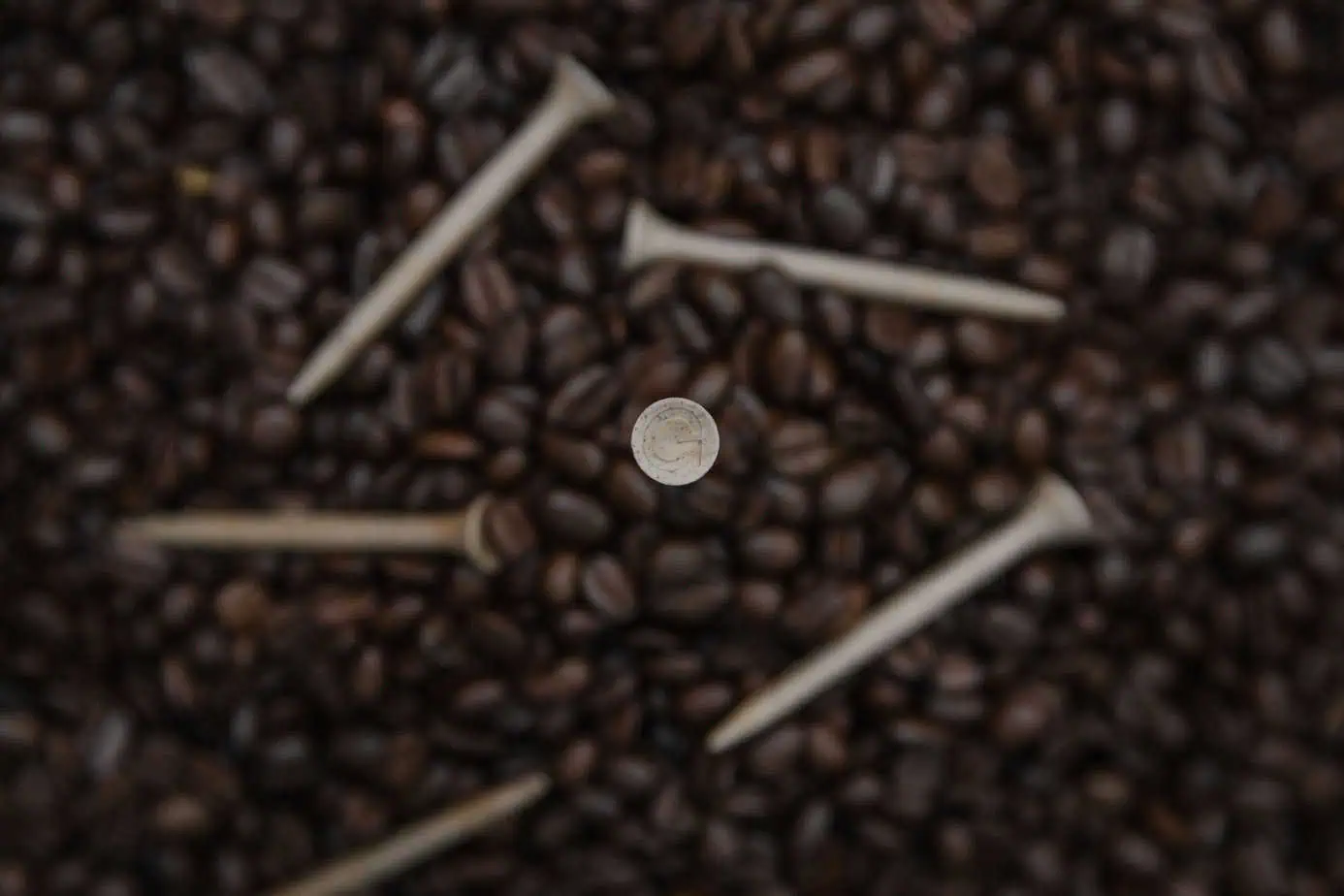
Kaffebohnen, in denen Golftees stecken
Foto: Greenup Golf

Kreislaufwirtschaft: Kaffee-Tees sind profitauglich

Der schnelle Espresso vor dem Turnier. Der Cappucchino nach der Runde. Eiskaffee auf der Terrasse. Affogato als Dessert. Der Kaffee fließt in Strömen. Auch in den Clubhäusern von Golfanlagen.  2,5 Kilogramm Kaffe- und Espressobohnen werden in einem durchschnittlichen Club mit einer 18 Löcher Anlage durchaus pro Tag verbraucht, das sind mehr als 300 Tassen.

Rund 2,25 Milliarden Tassen Kaffee werden laut Statistiken pro Tag weltweit verzehrt. Mit einher kommt der Müll – der entsteht reichlich. Nach Angaben des Nachhaltigkeits-Experten Gunter Pauli, Gründer von The Blue Economy, erzeugt die weltweite Kaffeeproduktion jährlich rund 20 Millionen Tonnen Kaffeesatz. Der reicht von der Verpackung des Endprodukts bis zu den nicht verwendeten Teilen der frischen Kaffeebohne.

Zuviel findet Kristian Kohn, Mitgründer von Greenup Golf, einem dänischen Unternehmen, das sich der Produktion von Tees für Golfer verschrieben hat, die aus schwedischem Biomaterial und recyceltem Kaffesatz bestehen. Die Greenup Golf Tees, die in Kooperation mit KaffeBueno einer Upcycling Firma für Kaffeeabfall, hergestellt werden, sind inzwischen auf der ECCO Tour in Dänemark bei Profigolfern im Einsatz. „Damit zeigen wir, dass die Stabilität und Spielbarkeit der Tees gewährleistet ist”, stellt Kohn fest.

Kaffee ist ein Standardgetränk - auch in Golfclubs. Doch was passiert mit all' dem Kaffemehl?

Nicht immer gewährleisten Tees, die mit dem Anspruch daherkommen, nachhaltig zu sein, nämlich genau das: Eine normale Runde Golf für den Spieler. Mal sind sie wabbelig, mal zersetzen sie sich im Regen. Beides aber, da ist sich Kohn nach Beobachtung des Golfmarktes sicher, ist essentiell für den Erfolg des Produktes. Die Greenup-Tees jedenfalls halten dem Test stand, die Spielbarkeit ist exzellent. Das bedeutet auch, dass sie sich nicht sofort auf dem Golfplatz zersetzen. Im Schnittgutabfall aber können sie – anders als Plastiktees – problemlos mitentsorgt werden, weil sie sich auf Dauer zersetzen.

Billig aus China ist oft die Variante

Wobei das Thema nachhaltige Tees ohnehin kein einfaches ist. Das hat zuletzt Anfang des Jahres 2024 die Insolvenz der britischen Firma Ocean Tee bewiesen, die als einer der Vorreiter beim Thema nachhaltige Tees aus Bambus die Diskussion um die Verwendung der üblichen Plastiktees auf Golfplätzen anstieß. Nachdem Ocean Tee bei diversen Profiturnieren und anderen Veranstaltungen als Sponsor aufgetreten war und dem Thema durchaus Sichtbarkeit verliehen hat, wurde die Wirtschaftlichkeit des Bambustees zum Problem. Der Golfmarkt feierte die nachhaltigen Tees zwar gerne öffentlichkeitswirksam, wenn es um den Einkauf in Massen für Veranstaltungen, Clubs oder große Turniere ging, hielten sich die Käufer aber lieber zurück. Ocean Tees sind nicht mehr erhältlich.

Stattdessen werden in den meisten Proshops, die sich dem Thema Nachhaltigkeit verschrieben haben, inzwischen andere Beutel mit Bambustees verkauft, die meist in China produziert werden.

Hanfsäckchen mit Tees

Womit wir wieder beim Thema Nachhaltigkeit wären: Bambus ist zwar ein schnell nachwachsender Rohstoff. Bei der Herstellung der Tees fällt aber wieder Abfall an, die Tees werden in der Regel in China lackiert und anschließend per Schiff auf die Reise geschickt. Einmal abgesehen vom Bambus an sich, fällt die Nachhaltigkeitsanalyse bei der Verwendung in Europa oder den USA also nicht besonders positiv auf.

Dort setzt Greenup Golf an. „Unsere Tees werden in Europa hergestellt, sie werden nicht lackiert und sie haben einen kurzen Transportweg“, erklärt Kohn. Und: Wir fördern die Kreislaufwirtschaft, indem wir einen Abfallstoff für die Herstellung verwenden.

Bleibt der Verkauf: Kein einfaches Thema in der Golfszene, hat der Däne inzwischen festgestellt. Kohn ist ein Fachmann sowohl was das Thema Kaffee als auch das Thema Sales und Marketing anbelangt. Vor seinem Einstieg als Investor bei Greenup war der Freizeitgolfer beruflich Countrymanager bei Segafredo in Dänemark. Jetzt also geht es um den Vertrieb von Tees statt von Kaffeekapseln.

Feilschen um Centbeträge

Der weltweite Markt für Tees wird von der Golfindustrie auf zirka fünf Milliarden Stück pro Jahr geschätzt. Gut laufende Golfanlagen in Großbritannien, bei denen die Tees für ihre Kunden, Gäste und Events verwendet werden, bestellen durchaus 200.000 Tees pro Jahr. In China liegt der Preis bei zirka fünf bis sechs Cent pro Stück. Mit Aufdruck kommt womöglich noch ein Cent dazu. Preise, die in Europa schwer zu halten sind.

„Ich glaube daran, dass wir im Golf beim Thema Nachhaltigkeit einen Schritt in die nächste Richtung machen müssen, und das Thema Kreislaufwirtschaft miteinbeziehen müssen“, erklärt Kohn die Devise von Greenup Golf. Die entscheidende Frage, die dann folgt: Wieviel ist die Golfszene generell bereit, für teurere nachhaltigere Produkte zu zahlen? Verzichten Kunden auf optische Elemente, wie zum Beispiel die Lackierung, zu verzichten, weil sie weniger nachhaltig ist?

Beim Team von Greenup Golf ist man optimistisch. „Wir versuchen langsam aber kontinuierlich zu kommunizieren, welche Aspekte der Begriff Nachhaltigkeit umfasst“, erklärt Kohn die Strategie

Kaffeemehl ist ein Upcycling-Hit

Dass gerade Kaffeeabfall für die Produktion der Tees verwendet wird, ist dabei keineswegs ungewöhnlich. Kaffee erweist sich, was seine Verwendung für weitere Produkte anbelangt, als ausgesprochen vielfältig. Kohn arbeitet gerade auch an der Entwicklung von Blumentöpfen für Gärtnereien und an der Verwendung für Stifte. In der Kosmetikindustrie werden die gefilterten Öle aus Kaffeeabfall ebenfalls gerne verwendet. Kaffeesatz als Dünger für Blumen ist vielen Hobbygärtnern ein Begriff.

Klar ist aber auch: Ein Großteil des Kaffeesatzes in der Gastronomie landet im Restmüll und damit auf der Mülldeponie. Schon das Trennen des Kaffeemülls und die Entsorgung im Biomüll wäre – auch in der Golf-Gastronomie – ein erster Schritt in die richtige Richtung. Laut Zahlen von The Blue Economy von Gunther Pauli benötigt man pro Tasse Kaffee nur 0,2 Prozent einer Kaffeebohne. 99,8 Prozent fallen als Müll an. 99,8 % aus denen man mehr machen kann – Golftees zum Beispiel.


Slipstream G Sustainability vermittelt Retro-Feeling

Eintrag teilen
  • Teilen auf Facebook
  • Teilen auf X
  • Teilen auf WhatsApp
  • Teilen auf Pinterest
  • Teilen auf LinkedIn
  • Per E-Mail teilen

Neuerscheinung

INSTAGRAM

golfsustainable

Golf Sustainable is an independent news platform, founded by Petra Himmel.

Wer sich nicht ausreichend um die Beregnungsanlage Wer sich nicht ausreichend um die Beregnungsanlage kümmert, riskiert einen wirtschaftlichen Totalschaden. Die Experten Petra Himmel, Golf Sustainable, Tobias Bareiss, Toro Deutschland, und Daniel Lüttger, GC St. Leon-Rot erklären, wieso die Infrastrukter der Bewässerungsanlage für deutsche Golfanlagen überlebenswichtig ist. 

#golf #greenkeeper #bewässerung #golfplatz #golfsustainable
Foto: Stefan von Stengel #golf #mentalhealth #insp Foto: Stefan von Stengel
#golf #mentalhealth #inspiration #mindfulgolf #calmgolf #golfsustainable #golfandnature #golfcourse #happygolfer
Stephen Thompson, senior greenkeeper at the Nation Stephen Thompson, senior greenkeeper at the National Centre in Woodhall Spa, has identified 513 species of moths to date on the world-famous 36-hole course. Here, he explains how he did it. 
Moths are important pollinators and are under pressure in England: Red List species, in particular, are seeing their populations steadily decline. 
And: Stephen Thompson is nominated for the National Biodiversity Network Biodiversity Lifetime Achievement Award. He is one of four finalists. 

If you’d like to learn more about biodiversity and sustainability in golf, give us a like and subscribe to our channel. You can read the full story about Stephen Thompson on our website. Link in the first comment.
Bags are packed, tee times are booked – right now, Bags are packed, tee times are booked – right now, thousands of golfers are heading south for their winter golf trips. ✈️⛳

Golf tourism is booming, making sustainability a central question for destinations, resorts, and travelling golfers alike. Yet while everyone talks about "green travel," real sustainability happens through measurable agronomy, resource management, and daily operations out on the turf.

Because travel matters so much to golfers, we find the EU's new sustainability tourism strategy pretty interesting. What do you think? 

💡 Want to dive deeper into sustainability in golf?
→ : Investigative reports, research breakdowns, and global industry insights. We are journalists who love to write the full story. 
→ Follow us on our new YouTube Channel;  All links in bio. 

And most of all: Thanks for your interest in sustainability!

#golf #golftravel #sustainabletravel #golfhotels #golfdestinations #golfsustainable #golfer
Golf is more affected by climate change than other Golf is more affected by climate change than other outdoor sports. Golf Sustainable founder Petra Himmel explains the consequences. 
#golf #golfcourse #greenkeeping #SustainableGolf #Golfsustainable #golfer #sustainability 
AI generated voice
How will European fairways survive the next decade How will European fairways survive the next decade?  This summer's severe dry periods across Europe have exposed many courses to new challenges, more heat and drought than ever before. Petra Himmel analyses the future of turf technology with two of the seed industry's specialists:

▪️ Anne Mette Dahl Jensen (Product Development Manager Turf, DLF): She highlights that while extreme summers haven't changed core grass relevance, they have triggered an urgent focus on water-use efficiency, salt tolerance, and regional breeding goals.
▪️ Olaf Bos (Technical Specialist Turf, Barenbrug): He emphasises the crucial difference between drought tolerance and heat tolerance. While fescues excel in water efficiency due to deep rooting, warm-season species like Bermudagrass are now actively gaining ground in Central Europe.

The main takeaway? Turf breeding takes up to 16 years. Quick miracles don't exist, and real resilience is decided at the cultivar level, not just the species level. Testing varieties on local trial plots before committing course budgets is essential.

🔗 Read the full analysis: golfsustainable.com/en/europe-grass-of-the-future/

#GolfSustainable  #TurfManagement  #Greenkeeping #Barenbrug #DLFTurf #GolfCourseManagement #TurfScience #ClimateResilience #Golfcourse #golfplatz
Mit welchem Wasser werden Golfplätze eigentlich be Mit welchem Wasser werden Golfplätze eigentlich beregnet?
There is only one golfer on SportsPro’s 2026 list There is only one golfer on SportsPro’s 2026 list of the 50 Most Marketable Athletes in the World, and that's a female golfer: Nelly Korda. The American is ranked No. 33. This rise is remarkable. In 2024, Korda was ranked 115th. Two years later, she has broken into the global top 50. What explains this development?

 1️⃣ Korda's success is built on extraordinary commitment. As Major-Champion, Olympic gold medallist and world No. 1, she has established herself among the dominant figures in women's golf. Her daily routine,  from mobility training and fitness to several hours of practice and work with her coach, reflects a level of professionalism that makes her sporting achievements credible and consistent.

 2️⃣ Korda has a distinctive approach to public visibility. Unlike many athletes, she rarely shares intimate details of her private life. Instead, she has built a brand around performance, consistency and authenticity. Her representation by Wasserman since 2022 has helped position her beyond the traditional golf market.

3️⃣ TaylorMade, Nike, Delta Air Lines, Ernst & Young and Goldman Sachs: her partners represent premium brands across sport, travel and finance. Korda offers access to an international audience with considerable purchasing power.

 4️⃣ Her appearance at the 2026 Met Gala in an Oscar de la Renta gown illustrates another important step: Korda is increasingly positioning herself beyond the golf community. With 1.3 million Instagram followers and prominent connections in the sports world, she has the potential to reach audiences who might not regularly follow women's golf.
 
5️⃣ Her commercial appeal has proved resilient even when her results fluctuated. Forbes estimated her 2025 annual earnings at around $13 million, with sponsorships accounting for the majority. 

SportsPro's ranking shows that Nelly Korda has climbed the ranks among sports personalities.  This migt also help make golf more appealing to women.

#GolfBusiness #WomenInSport #Golf #femalegolfer #professionalgolf #diversity #golfsustainable 
📷 The Amundi Evian Championship/Philippe Millereau
#FeelSomethingReal #BeHereNow #Golflover #GolfSust #FeelSomethingReal #BeHereNow #Golflover #GolfSustainable
A Ryder Cup and AIG Women's Open venue with a worl A Ryder Cup and AIG Women's Open venue with a world-famous heather restoration programme? Welcome to Walton Heath Golf Club.

Over the past 200 years, the Surrey region has lost a staggering 85% of its natural heathland. Walton Heath is fighting back. Superintendent Michael Mann and his team are cultivating nine hectares of precious Lowland Heath - clearing brushwood, growing their own seeds, and proving that championship-level golf and rigorous nature conservation are a perfect match.

It takes four to five years of patience for these cleared soils to grow back into resilient, healthy heather. Why this massive effort is not only a lifeline for local biodiversity but also an essential, punishing strategic element for golf course architecture is detailed in our article on Golf Sustainable (Link in Bio).

Check out our YouTube Channel for more videos about famous clubs, biodiversity or sustainability topics. 
#golfsustainable #heather #bestcourses #sustainablecourses #greenkeeping #golfcourse #golf
How much can electrified mowing reduce a golf club How much can electrified mowing reduce a golf club's carbon emissions? Greenkeeping remains a key lever for reaching ambitious climate goals.  How effective is the switch to electric fairway mowers? Research is limited, but we found one 2025 study, and we examined a 27-hole course with strong data. 

The Scientific Baseline (2025 Study, Italy)
A case study conducted at the 27-hole Montecchia golf course compared conventional diesel mowers with autonomous, battery-powered models on 10.69 hectares of fairways:
▪️ Relative CO₂ emission reduction: 66.2%
▪️ Absolute savings: 9.24 tons of CO₂/year
▪️ Emission comparison: 1,305 kg/hectare (diesel) vs. 441 kg/hectare (electric)

Operational Data (Golfpark Weiherhof, Germany)
Operational records from a 27-hole facility utilising 25 electric mowers for tees, fairways, and semi-roughs over one season show:
▪️ Diesel consumption decreased from 18,180 litres to 8,683 litres.
▪️ CO₂ emissions were reduced from approximately 48 tons to 23.01 tons.
▪️ Charging infrastructure: The facility utilises a 100 kWh on-site solar system, aligning the charging cycles with active power generation to optimise the emission factor.

Find the full article on our website. 

#GolfSustainable #Golfcourse #Golfplatz  #Greenkeeping #GolfIndustry #SustainableGolf #CarbonFootprint #GolfCourseManagement #SportsManagement #EnvironmentalData #golf #golfer 

Fotos: Golfpark Weiherhof
Today the LET will likely look to the WTA with a t Today the LET will likely look to the WTA with a touch of envy. Women’s tennis swiftly reoriented itself yesterday after announcing a new title sponsor for the season-ending WTA Finals: the yoghurt brand Fage. Before that, the WTA terminated its three-year contract to host the WTA Finals in Riyadh (Saudi Arabia) a year early.

The LET, meanwhile, continues to face the sobering reality that GOLF Saudi's significant reduction in involvement means massive financial losses, at least for the time being. Instead of five events with $15 million in prize money, by 2027 there will be just one tournament with $4 million in prize money and a ranking-bonus sponsorship.

The challenge for the LET becomes still more visible when looking at the blank numbers: 
 💠 The prize money for the WTA Finals accounted for around six per cent of the total prize money in 2025.
 💠 On the LET, the share of PIF tournaments in the total prize money in 2026 was about 32 per cent.
 💠 On the LPGA, where the co-sanctioned Aramco Championship took place, PIF prize money counted for about three % in 2026.

The LET’s figures send a clear message: this is what dependence looks like. On top of that, fossil fuel sponsorship in sport has been criticised for years anyhow. 

The WTA also found a solution to this problem by securing a deal with the yoghurt brand Farge. One thing is clear about yoghurt: it is completely politically neutral.

#golf #tennis #let #wta #femalesports #sponsorship #femalegolf #golfsustainable #greensports #professionalgolf
Instagram-Beitrag 17992628706052347 Instagram-Beitrag 17992628706052347
Did you watch the Aramco Korea Championship last w Did you watch the Aramco Korea Championship last week? It made me think about how important golf courses are in urban areas. 

Step back and consider the value of a golf course to society. The sponge city concept aims to retain rainwater where it falls, letting it infiltrate the soil, replenish groundwater, and reduce pressure on drainage systems during heavy rainfall. Golf courses can contribute to this approach through:

 💠 Rainwater retention and infiltration in permeable green spaces and soils.
 💠 Natural cooling through vegetation, evaporation and transpiration.
 💠 Water storage and biodiversity in ponds, wetlands, biotopes. 
 💠 Climate resilience through species-rich meadows, woodland and hedgerows that complement the intensively maintained playing areas.

But: Do cities already recognise this value? Is more communication needed to make regulators aware of the benefits of golf courses in urban areas? Looking back at the pictures of the Aramco Korea Championship at New Korea Country Club last week the value of a golf course in an urban environment became very visible. 

We just have to talk about it. 

👉 Read the full article on Golf Sustainable. 
Fotos: LET/Oliver Brady, Petra Himmel/AI generated

#GolfSustainable #SustainableGolf #SpongeCity #WaterManagement #ClimateAdaptation #Biodiversity #UrbanPlanning #GreenInfrastructure #golf #golfer #greensports #greenkeeper #golfmanagement
Instagram-Beitrag 18436447168151171 Instagram-Beitrag 18436447168151171
Visibility is so important.We love the Green Thurs Visibility is so important.We love the Green Thursday project of Eco Athletes. A perfect best-practice case for golf associations or clubs. An easy way to start a conversation about sustainability.

Four professional golfers promote a greener game. Camille Chevalier, Celina Sattelkau, Sára Kousková and Patricie Macková have joined the Green Month initiative of  EcoAthletes. The inaugural Green Sports Month is bringing athletes and the wider sports community together to raise awareness and drive climate action.

🟢 Green Thursdays

Throughout the October tournament weeks, the four players will wear green on Thursdays to make climate action visible on the golf course – and encourage fellow LET players to join them. First occasion: Yesterday during the LET tournament in Korea. 

♻️ Plogtober

They will also take part in EcoAthletes’ Plogtober initiative, combining physical activity with litter collection. The idea is simple: get outside, move, pick up waste and use social media to inspire others to do the same.

For golf, this message matters. First of all, sustainability is not only about golf-course management, water, biodiversity or energy. It is also about the people who represent the sport and promote sustainable behaviour. 
Foto: LET/Oliver Brady

#GreenSportsMonth #EcoAthletes #SustainableGolf #greensports #ClimateAction #LadiesEuropeanTour  #Golf #SportForClimateAction #golfsustainable #greensports #womeningolf
Sylt is a high-end hotspot for golf tourists. The Sylt is a high-end hotspot for golf tourists. The island is working on its mission statement, due to be unveiled at the end of the year. One thing is already certain: with the ‘Lebenswert – sustainable Sylt’ seal of approval, the ‘environmentally conscious travel’ segment will play a significant role in it.

But what is the reality? How many hoteliers and golf courses truly stand behind this seal, and how do they put it into practice in their catering, hotel management and greenkeeping? We visited some golf clubs and hotels -  the résumé: 

 💠  Landhaus Stricker, led by Michelin-starred chef and owner Holger Bodendorf, offers the perfect combination of luxury holidays and sustainability. Meticulous attention is paid here to regional supply chains, resource conservation, waste prevention and renewable energy. This ranges from the tea bags at the buffet to membership in the Feinheimisch association. GreenSign certification is the icing on the cake. Perfect choice. 

 💠  The island has four golf courses, three of which have been awarded the highest ‘Gold’ level of the German Golf Association’s ‘Golf and Nature’ certificate. The Marine Golf Club, GC Sylt and the Budersand Resort are therefore the top destinations for golf tourists who like to travel in an environmentally conscious manner. It was a welcome discovery that sustainability is also a major priority at the Budersand Resort with its 5-star hotel. Plastic, at any rate – a real problem at golf resorts, particularly in the catering sector – definitely has no place here.

So what's next? All that remains is to adapt the marketing. Because one thing is clear: right now, Germany’s top island isn’t really associated with sustainable golf tourism in the customer's mind. Sylt is known as a golf destination, but not yet as a sustainable golf destination. Hopefully, that will change in the near future. 

Fotos: Sylt Marketing e.v., Landhaus Stricker, Budersand Hotel - Golf & Spa -Sylt, Marine Golf Club, Petra Himmel 

#sylt #sustainabletravel #tourism #golfsustainable #golftravel #golfholiday #sustainablehotels #golf #golfer
In Japan, abandoned golf courses become solar park In Japan, abandoned golf courses become solar parks - like here in Fukushima, where the EDP Group has converted a 60-hectare golf course into a vast solar park comprising 63,000 solar panels. The plant is expected to generate over 48 GWh of energy annually. 

Japan faces a shortage of space – not only for housing but also for the expansion of renewable energy. In this densely populated and mountainous country, solar project developers are desperately searching for suitable sites. 

In Japan, strict requirements apply to large-scale solar farms: They must have sufficient sunlight, be located a certain distance from residential areas, and have good access to the power grid. Solar farm developers are now finding that former golf courses meet these exact criteria.

From a developer's perspective, a golf course is essentially a ready-to-go power plant that simply hasn’t been connected to the grid yet. The land has already been developed, trees have often been cut down, and the terrain is generally not too hilly or extremely uneven. Added to this are the underground irrigation systems that are still in place. The development work required for solar park operators is minimal.

The case of Japan shows that a golf course can be transformed – sometimes more rapidly than golfers can imagine. 
📷EDP APAC

#golf #golfmanagement #sustainable #solarenergy #golfsustainable #golfcourse
🔥 Burning trolley batteries inside buildings are a 🔥 Burning trolley batteries inside buildings are a real problem at golf courses. That’s why we liked this new product idea.
😄 A solar-powered battery charging station - with no underground wiring and available in custom sizes - solves the problem. The stainless steel frame can be placed anywhere outdoors. The golf club decides how many batteries shall be charged at the same time or how many e-trolleys shall be parked here. Golfers can use them during their drinks or lunch at the clubhouse. 
🤑 Plus: All surfaces can be used for advertising partners, so the charging station can pay for itself. The batteries hide behind the advertising surfaces. 
Great idea: We’re excited to see it on the first courses. 

Link for the full story in the first comment, or have a look at golfsustainable.com

#golf #golfmanagement #golfsustainable #smartideas #golfindustry #solarenergy 

Foto: Alexander Fend
🏌 Golf for the community - an approach that is oft 🏌 Golf for the community - an approach that is often missing in today’s booming American golf market. Starting in December, The Gate Golf Club will provide a counterbalance in the Naples region, which ranks among the top destinations when it comes to private, high-end country clubs. 
 😀 Golf for the community - this is the goal that President Kristina Schmieding is consistently pursuing, with a whole host of supporters from Collier County by her side. Among them is First Tee, which is finally finding a permanent home at The Gate Golf Club.
Social sustainability in golf means creating added value for many. The countdown to The Gate has begun. Good luck with this wonderful initiative.
Fotos: The Gate Golf Club
#TheGateGolfClub #GolfSustainable #NaplesFlorida #NaplesGolf #PublicGolf #GrowTheGame #FirstTee #FloridaGolf #CommunityFirst #GolfLife #InclusiveGolf
🏌️‍♂️💦 Dew might look beautiful and harmless, but 🏌️‍♂️💦 Dew might look beautiful and harmless, but it's actually one of the biggest seasonal challenges for greenkeepers!

Autumn is dew season. When nighttime temperatures drop and humidity rises, a fine film of water forms on the turf. For us golfers, it just means a slower rolling ball—but for the health of the course, it can be a real threat.

👉 Why?
When the turf remains damp for hours, it creates the perfect microclimate for aggressive fungal diseases like the dreaded Dollar Spot. The water on the leaves also draws out sugars and amino acids from the plant—an absolute feast for pathogens.

🌱 The Sustainable Solution:
The magic phrase is: Interrupt leaf wetness! Mechanically removing the dew—through early morning mowing (even with disengaged blades) or dragging hoses and nets—breaks the disease cycle.

Studies confirm it: Regular dew removal drastically reduces Dollar Spot outbreaks and minimizes the need for strictly regulated pesticides. A massive win for both the environment and your playing surface! 🌍💚

💡 Want to dive deeper?
Read the full article featuring exclusive insights from Christian Spring (STRI Group) on golfsustainable.com!
🔗 https://golfsustainable.com/en/dew-and-dollar-spot-strategy/

#GolfSustainable  #Greenkeeping #TurfManagement #SustainableGolf #DollarSpot #GolfCourseMaintenance #GolfAcademy #EcoFriendlyGolf #GolfIndustry #golf
💧 Let’s talk about water management! As water cons 💧 Let’s talk about water management! As water conservation becomes central to golf course design, storage ponds are playing a vital role in securing irrigation for dry periods.

But not all reservoirs are created equal. Depending on space, budget, and ecological goals, there are different ways to store water on a golf course. Here are the main variants:

⛳ 1. The on-course strategic pond
Beautiful, functional, and part of the game! These ponds are integrated into the playing areas. They serve as a strategic hazard and are visually appealing. When designed with shallow-water zones and shoreline planting, they become massive boosters for local biodiversity. 🌿🦆

🚜 2. The engineered "off-course" pond
Built out of sight, these are designed purely for function. They are typically much deeper with a smaller surface area to minimise evaporation. Because they are hidden from players, there's no need to worry about aesthetics.

☀️ 3. Covered ponds
 To stop water from evaporating in the heat, some reservoirs use floating covers like open cisterns. There are also examples for ponds with solar panels—preventing evaporation while simultaneously generating clean electricity for the club! ⚡💧

Whether for strategic gameplay, maximum storage, or clean energy, each variant has its own unique benefits and costs. Keep in mind, that each reservoir is part of the whole water management strategy of the golf club. 

Which solution fits your course best? Read the full breakdown of costs, sizes, and design strategies in our latest article! We talked to golf course designer Thomas Himmel about his recommendations for the construction process. 

Link in first comment

#GolfSustainable #WaterManagement #Greenkeeping #GolfCourseDesign #Sustainability #EcoGolf #Biodiversity #GolfCourseArchitecture #WaterConservation #FutureOfGolf
The Solheim Cup is all about empowering women in s The Solheim Cup is all about empowering women in sports,  a crucial part of social #sustainability 
🌍⛳It has grown into a global media product broadcast in over 170 countries, proving that when women are given a massive platform, they deliver unmatched passion, intensity, and teamwork. 

But this incredible event didn't just appear out of nowhere. We owe a massive debt to a female business pioneer behind the scenes,  Louise Solheim. Alongside her husband Karsten, Louise was the strategic business force behind the PING brand. Together, they guaranteed the sponsorship for the first ten Solheim Cups, laying a rock-solid foundation for the tournament's future. Louise's sharp management and business administration background showed that women in executive roles are essential to the game's growth. 

At Golf Sustainable, we celebrate the women who build the platforms for others to shine. ✨ Enjoy the Solheim Cup!

You want to read more about Female Success Stories in golf: Link to the (German) book in the first comment and in the profile. 

Fotos: Ping, Shutterstock

👇#GolfSustainable #WomenInGolf #SolheimCup #GrowTheGame #SustainableSport #InclusiveGolf #LouiseSolheim#Ping #golf #frauengolf
What does an inclusive golf club really look like? What does an inclusive golf club really look like?

It starts with more than accessible facilities. At Haxterpark in Paderborn, inclusion is part of the club’s DNA – on the course, in the workplace and in everyday club life.

Bunkers are designed to remain a sporting challenge while being accessible to wheelchair users. The course and facilities are designed around accessibility. But perhaps even more importantly, people with disabilities are not simply welcomed as golfers – they are colleagues.

Haxterpark operates as an inclusion business, with people with and without disabilities working side by side in golf administration, greenkeeping, gastronomy and service.

Rafa Lawah is a powerful example. She joined Haxterpark as an employee and discovered golf through her work. Today, she plays regularly and competes internationally.

That is what inclusion can look like when a golf club takes responsibility beyond the tee box: creating a place where people can work, play and participate – without their disability defining their role.

Inclusion is not a special programme. It is about designing the club so that more people can be part of it.

Link for full story in first comment. 

#GolfSustainable #InclusiveGolf #GolfForAll #Inclusion #AccessibleGolf #GolfAndSociety #SustainableGolf #GolfClub #paragolf 

Fotos: Rafa Lawah, Hardt
Follow me!

Follow us on Facebook

Weitere News

  • Pebble Beach Golfplatz mit Warnschild El Nino
    US-Golfplätze bereiten sich auf El Niño vor18. November 2026 - 15:26
  • Inselgrün im GC Husumer BuchtFoto: Petra Himmel
    GC Husumer Bucht: Innovativ und stark in der Umsetzung16. November 2026 - 11:44
  • Collage Stephen ThompsonFotos: England Golf, Petra Himmel, Stephen Thompson
    Stephen Thompson: Ein Greenkeeper und 513 Mottenarten15. November 2026 - 14:17
  • Collage mit Bildern vom GC HolledauFotos: GC Holledau/ Petra Himmel
    GC Holledau: Mehr Biodiversität auf 27 Löchern13. November 2026 - 10:19
  • EU legt neue Nachhaltigkeitsstrategie für Tourismus vor10. November 2026 - 17:11

Kooperationen

© Copyright - Golf Sustainable | Website [ Bottega Design ]
  • Link zu Facebook
  • Link zu Instagram
  • Kontakt
  • Impressum
  • Datenschutzerklärung
  • Privatsphäre-Einstellungen ändern
  • Einwilligungen widerrufen
Link to: Golf in Frankreich: 67.445 Artendaten registriert Link to: Golf in Frankreich: 67.445 Artendaten registriert Golf in Frankreich: 67.445 Artendaten registriertFotos: FFGolf/Terre Blanche Link to: Rekordhitze und Business-Boom: Sommergolf in Arizona Link to: Rekordhitze und Business-Boom: Sommergolf in Arizona Golfplatz in Arizona mit einer SonneFotos: We-Ko-Pa Golf Club/Petra Himmel Rekordhitze und Business-Boom: Sommergolf in Arizona
Nach oben scrollen Nach oben scrollen Nach oben scrollen
DSGVO Cookie Consent mit Real Cookie Banner